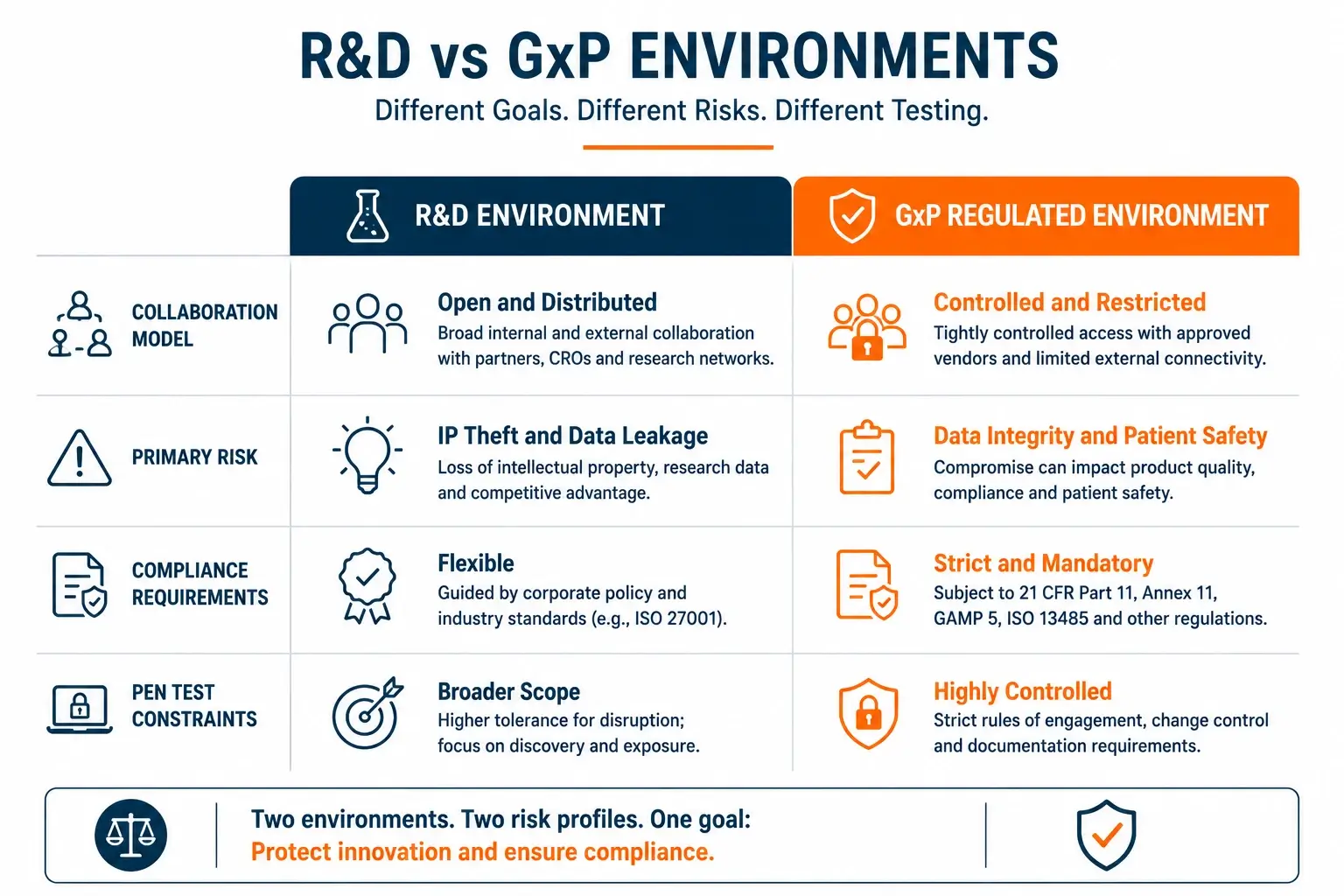
Most pharmaceutical companies have one security team managing two fundamentally different environments. The research and development (R&D) network is fast-moving, collaborative and built around researcher productivity. The GxP (good practice) regulated environment is controlled, validated and built around data integrity and auditability. These environments have different risk profiles, different compliance requirements and different constraints on how security testing can be conducted. Treating them with a single unified pen test scope produces results that serve neither environment well.
What Makes the Environments Different
The R&D environment is characterized by external collaboration. Researchers share data with academic partners, contract research organizations (CROs) and external collaborators. Cloud platforms are used for data storage and computational work. Mobile access is common. The primary risk is intellectual property (IP) theft, and the threat model centers on unauthorized access to high-value research data by external actors, whether criminal or state-sponsored.
The GxP regulated environment is characterized by validation and control. Systems are qualified, changes go through formal change control, and the integrity of electronic records is a regulatory requirement, not just a security objective. The primary risk is data integrity compromise, and the threat model includes both external attackers and insiders with legitimate system access. Testing in this environment has consequences that testing in R&D does not: an uncontrolled change to a validated system may require revalidation before it can be used for regulated activities. Regulators treat data integrity as a primary failure mode: data integrity deficiencies were cited in 79% of US Food and Drug Administration (FDA) drug good manufacturing practice (GMP) warning letters in fiscal year 2016 and 57% in fiscal year 2018.
Scoping for R&D
...is built around the data that matters: electronic lab notebooks, laboratory information management systems (LIMS), computational chemistry platforms, genomics data repositories and the collaboration tools that connect internal researchers to external partners. The methodology is standard for each system type, but the focus is on the paths that reach the most valuable data and the external access points that those paths expose.
Third-party and CRO access is the highest-priority area in most R&D scopes. The access that external research partners require is often broad, poorly documented and rarely reviewed after initial setup. Testing what a compromised CRO credential can reach inside the pharma environment consistently produces findings that surprise security teams who assumed the access was narrower than it is. The risk is not theoretical. In 2019, Charles River Laboratories, one of the largest contract research organizations, disclosed in a US Securities and Exchange Commission filing that a highly sophisticated, well-resourced intruder had copied data belonging to about 1% of its clients.
Scoping for GxP Regulated Systems
A GxP pen test scope requires a layer of planning that R&D scoping does not. Before any system is included in active testing, its validated state needs to be documented, and a qualified test environment needs to be established. Testing in production is not an option for validated systems. The risk of an uncontrolled change to the system, the data or the audit trail is too high, and the remediation of such a change, through revalidation, is far more expensive than the cost of setting up a proper test environment.
The scope document for GxP testing needs to specify, for each system, the validation status, the test environment approach, the change control documentation required before and after testing, and the criteria for what constitutes an acceptable finding versus one that requires immediate escalation to the validation team. This is more detailed than a standard pen test scope document, and it should be reviewed and approved by both the security team and the validation lead before the engagement starts. The validation expectations trace to 21 CFR Part 11 and EU Annex 11, which govern electronic records and computerized systems in regulated environments.
Running Both Scopes Efficiently
Running two separate pen test engagements, one for R&D and one for GxP, doubles the cost and the coordination overhead without necessarily producing better results. A single engagement with two clearly defined scope tracks, different methodologies for each track and coordinated reporting is the more efficient approach. The key is shared infrastructure. Systems that sit between R&D and GxP environments, such as identity management platforms, network infrastructure and shared file services, need to be tested in the context of both environments, not just one.
The reporting structure for a dual-scope engagement should keep R&D and GxP findings separate. The remediation process for a finding in a validated system is fundamentally different from the remediation process for a finding in R&D. Mixing them in a single findings list creates confusion about ownership and urgency that slows down remediation for both.
One engagement, two scope tracks, findings your validation team and your security team can each act on. Request a dual-track scoping session and test both environments the way each one requires.