
When manufacturers connected their factory floors to enterprise networks, they unlocked real-time visibility, remote diagnostics and smarter supply chains. They also opened doors that were never meant to exist.
Industry 4.0 transformed operational technology (OT) from isolated, air-gapped infrastructure into networked systems that attackers can reach from anywhere. Most manufacturers made that shift without fully understanding what they were exposing. Attackers noticed. Manufacturing accounted for 27.7% of cybersecurity incidents in 2025, the fifth consecutive year it ranked as the most attacked industry worldwide.
The OT Environment Was Never Built for Connectivity
Operational technology predates the internet. Programmable logic controllers (PLCs), supervisory control and data acquisition (SCADA) systems and distributed control system (DCS) platforms were engineered for reliability and uptime, not security. Protocols like Modbus and Profinet were designed for closed networks where trust was assumed. No authentication. No encryption. No concept of a threat from outside the plant floor.
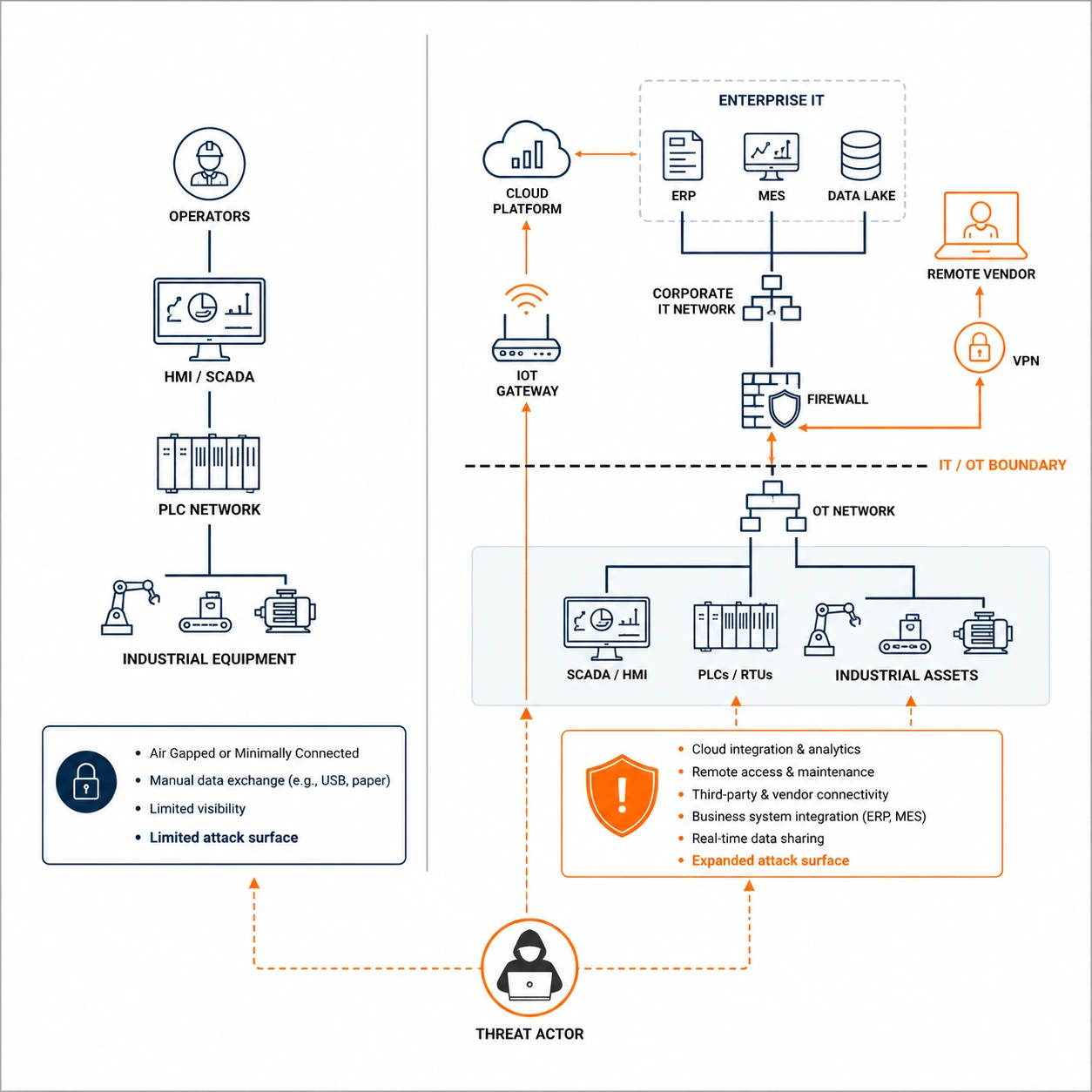
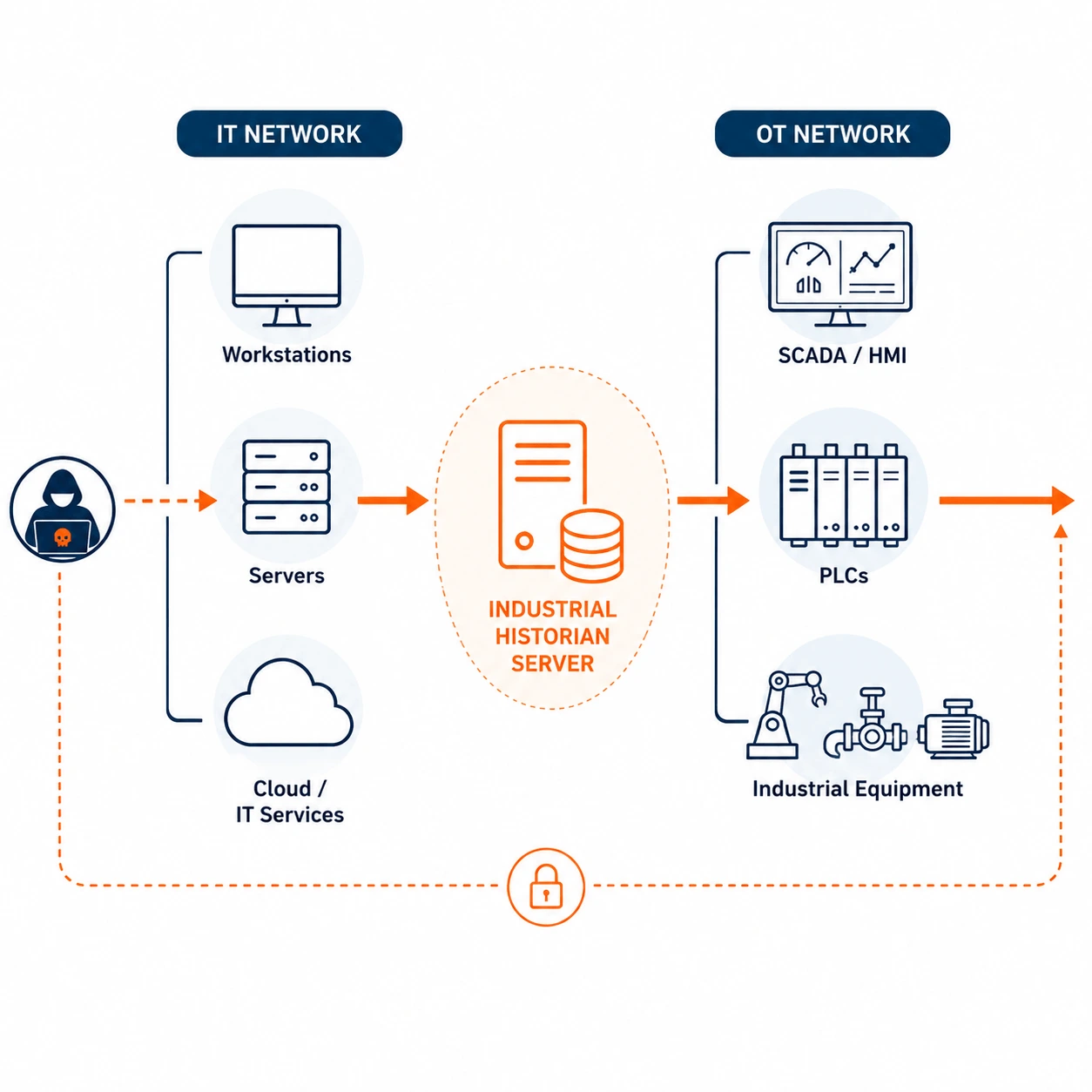
Industry 4.0 changed the environment, but not the technology running inside it. Sensors now push data to cloud platforms. Engineering workstations connect to corporate virtual private networks (VPNs). Historian servers sit at the boundary between IT and OT, accessible from both sides. The attack surface expanded dramatically while the underlying systems remained as exposed as ever.
Where the New Attack Surface Lives
The most dangerous entry points in a modern manufacturing environment are not exotic. They are the vendor remote access connections that were set up during installation and never reviewed. The engineering workstation running Windows 7 because the machine vendor never qualified an upgrade. The historian server that replicates process data to the cloud with credentials that have not rotated in three years.
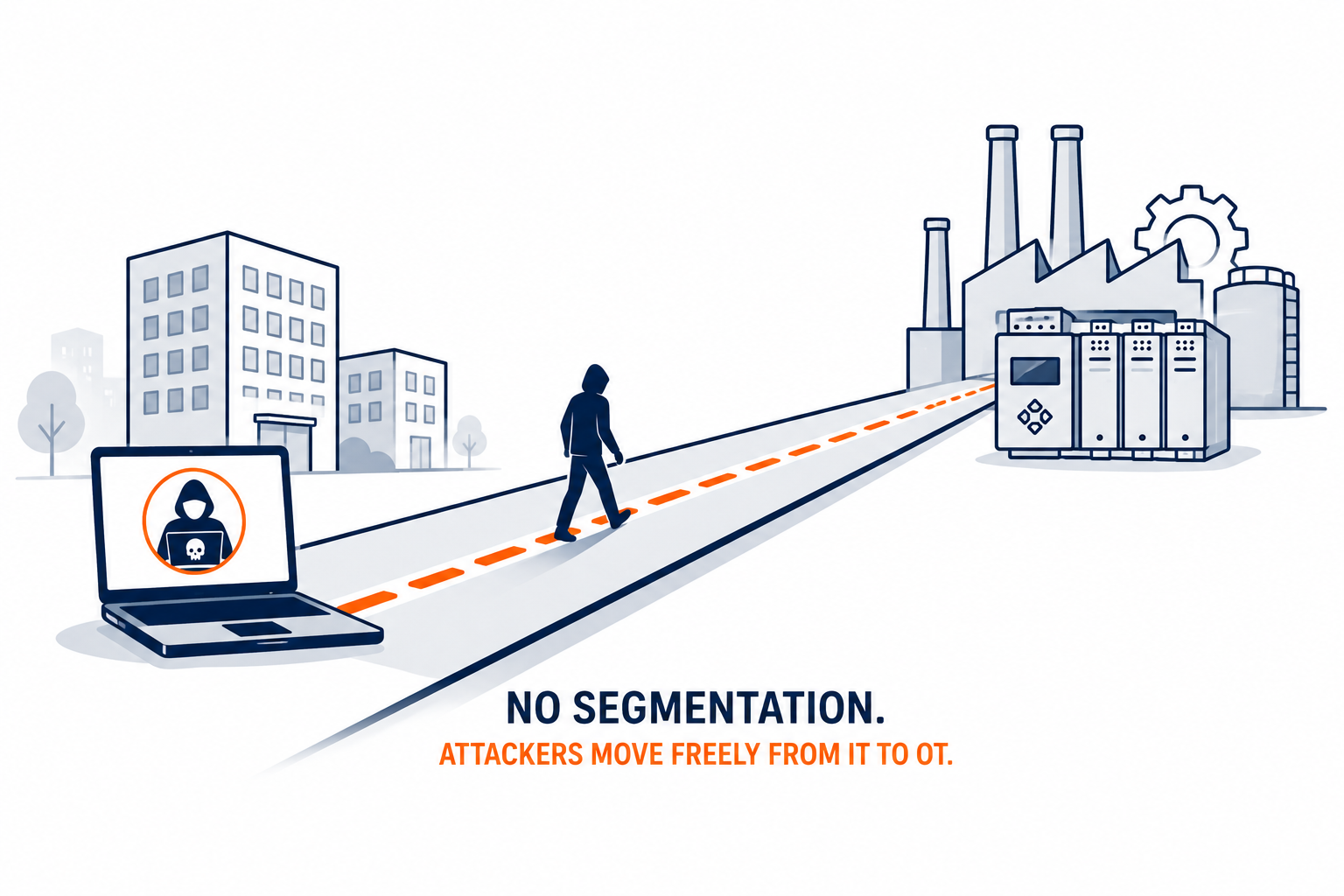
Industrial Internet of Things (IIoT) devices compound the problem. Sensors, meters and edge gateways often run embedded firmware with no patch mechanism and default credentials that ship from the factory. Once an attacker reaches one device, the flat networks common in OT environments make lateral movement straightforward. OT networks rarely carry the segmentation controls that exist on the IT side. The 2019 LockerGoga ransomware attack on Norsk Hydro showed where that leads. The malware spread across the aluminum producer’s global network, forced plants onto manual operations, and cost the company around NOK 800 million, roughly USD 70 million.
Why IT Security Tools Do Not Solve This
The instinct to apply standard IT security practices to OT environments is understandable but dangerous. Vulnerability scanners that are routine in IT can crash PLCs. Aggressive network scanning can disrupt real-time control processes. The availability requirement in OT is absolute in a way it rarely is in IT. A two-minute outage on a factory line can cost more than a week of security team salaries. Siemens puts the cost of unplanned downtime at a large automotive plant at USD 2.3 million per hour.
This constraint shapes everything about how testers must approach OT security work. Passive reconnaissance before any active testing. Careful coordination with operations teams. Rules of engagement written around production schedules, not security convenience. The tools and methodology must match the environment, not the other way around. Two frameworks govern security in this domain: IEC 62443 from the International Electrotechnical Commission and Special Publication 800-82 from the National Institute of Standards and Technology (NIST).
What Penetration Testing Finds That Audits Cannot
Compliance audits check documentation. A well-written network diagram and a set of policies can satisfy an auditor without reflecting what is actually running on the plant floor. Penetration testing checks reality. It finds the vendor access credentials that were never removed after a contract ended. The virtual local area network (VLAN) that appears segmented on paper but allows unrestricted traffic in practice. The human-machine interface (HMI) accessible from the corporate network because someone needed a quick fix during a production crisis and never reversed it.
The findings from an OT pen test are almost always surprising, even to experienced security teams. Not because the vulnerabilities are sophisticated, but because the environment has grown faster than visibility into it. Industry 4.0 added connectivity in increments, and each increment added exposure that was never formally assessed.
Where to Start
The first step is understanding what you actually have. Most manufacturers do not have a complete, current picture of every device on their OT network, every active remote access path or every place where IT and OT traffic can cross. Before you can protect the environment, you need to see it.
A structured OT attack surface assessment gives you that picture. It identifies what is exposed, where the highest-risk entry points are and what a real attacker would target first. That assessment is the foundation for every security decision that follows.
Ready to see your environment the way an attacker does? Schedule an OT attack surface assessment and get a prioritized map of your exposure before someone else builds one for you.