OT Ransomware Prevention: Practical Best Practices for Industrial Cybersecurity
Contributors

Ransomware incidents targeting OT/ICS environments escalated in 2025, with attackers using sophisticated evasion in malware like FrostyGoop and IOCONTROL via Modbus/MQTT protocols. Manufacturing faced heavy hits, as perimeter vulnerabilities enabled pivots from IT to OT, causing extended outages.
If you are responsible for operational technology security, you are not protecting data. You are protecting production, safety, revenue, and brand credibility.
This blog breaks down what prevents OT ransomware and where most organizations fail.
Why OT Ransomware Is Different from IT Ransomware
Most prevention failures begin with a wrong assumption.
OT is not IT.
| In IT: | In OT: |
|---|---|
| Systems can be patched weekly. Reboots are acceptable. Downtime is inconvenient. | Downtime costs millions per hour. Safety systems cannot be casually restarted. Legacy devices cannot support modern agents. Patching cycles may require scheduled shutdowns. |
Applying IT playbooks to OT environments creates blind spots attackers' exploit.
If your ransomware defense strategy does not account for uptime constraints, deterministic traffic, and safety interdependencies, it is incomplete.
How Modern OT Ransomware Attacks Actually Happen
Typical attack path:
- Phishing or credential compromise in IT.
- Lateral movement to Active Directory.
- Discovery of VPN or jump host into OT.
- Pivot into the plant network.
- Disable backups.
- Encrypt IT systems first.
- Disrupt operations to increase leverage.
If there are no strict boundaries between IT and OT, ransomware does not require a zero day. It needs poor architecture.
Core OT Ransomware Prevention Best Practices
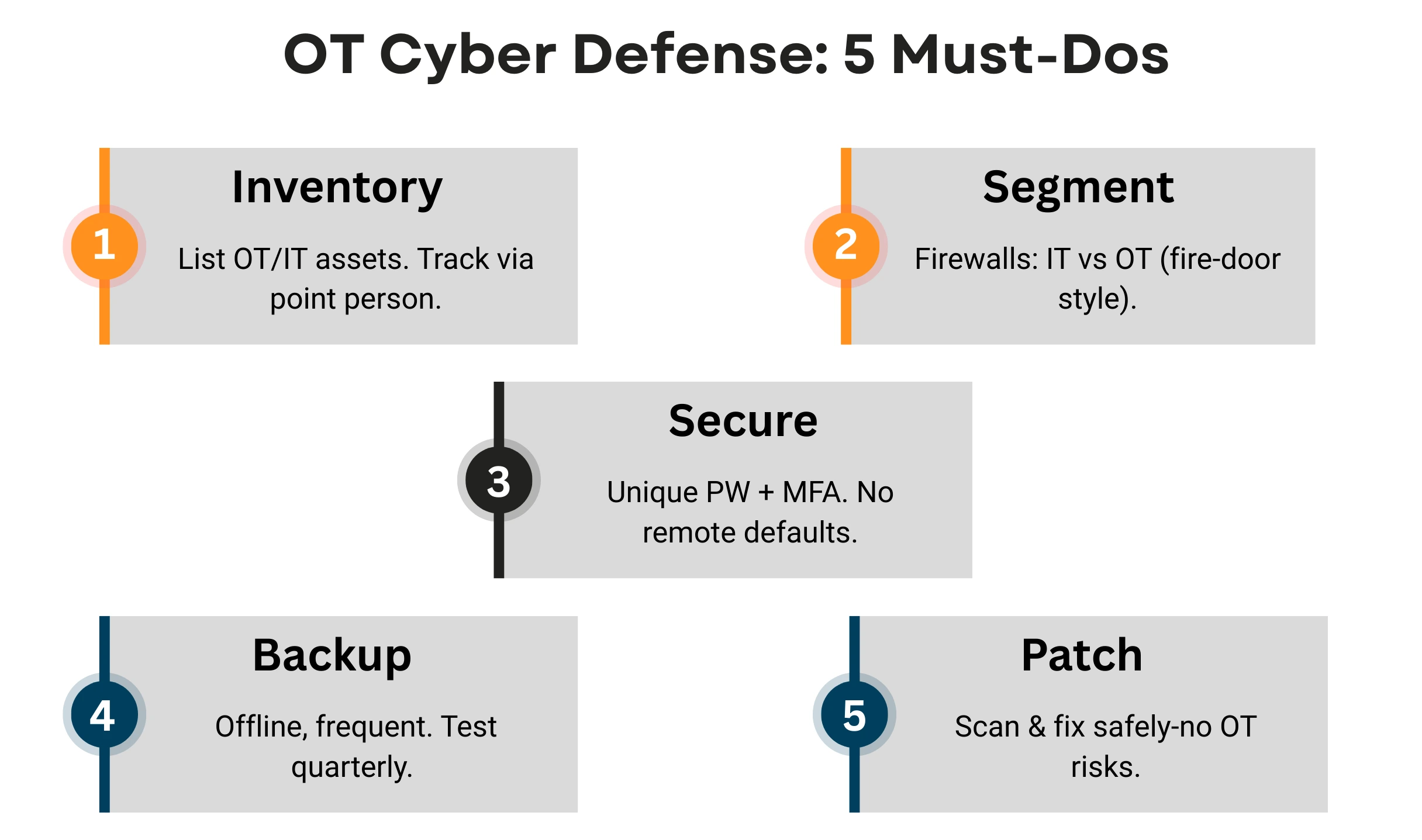
- Inventory Assets: List all OT devices, software, and IT connections; designate a cybersecurity point person to track changes.
- Segment Networks: Use firewalls to separate IT from OT zones, preventing lateral spread like containing a fire in one room.
- Secure Access: Enforce strong, unique passwords (no defaults) and multi-factor authentication (MFA), and limit remote logins.
- Backup Religiously: Maintain frequent, offline/air-gapped backups of critical data; test restores quarterly to ensure usability.
- Patch Vulnerabilities: Scan for known flaws in commodity systems; apply updates where safe without risking OT stability.
Foundational Best Practices Are Only the Starting Point
Reading best practices is easy. Operationalizing them in a live OT environment is complex.
Real prevention requires:
- Detailed architecture models.
- Implementation checklists.
- Configuration examples.
- Defined ownership across teams.
- Tested recovery procedures.
- That is where most organizations stall.
For organizations seeking to move beyond baseline controls and toward measurable resilience, the following advanced OT ransomware defense practices provide a deeper framework for evaluation and strengthening. Access Advanced OT Defense Strategies




Other Popular Articles
In the digital age, businesses must adopt an ad
GRC is the capability, or integrated collection
Get the latest insights straight from our desk to your inbox.
Other Featured Articles
Explore More
How to Design Custom Chatbots That Cannot “Make Stuff Up”
Confident AI answers without traceable sources create institutional risk. Learn how Grounded RAG architecture retrieves real documents first and attaches verifiable citations to every response.
Data and AI Solutions Group
Marketing Group view
How Citation-Backed Conversational AI Improves Public Access and Internal Decision-Making
AI without source citations creates real liability. Learn how citation-backed AI brings traceable sources, version awareness, and audit-ready outputs to every institutional decision.
Data and AI Solutions Group
Marketing Group view
OT Ransomware Prevention: Practical Best Practices for Industrial Cybersecurity
Explore enterprise grade OT ransomware prevention strategies, including segmentation, identity control, threat informed detection, and resilient recovery design to protect industrial operations fro
Cybersecurity Solutions Group
Marketing Group view
10 Myths About OT/ICS Security That Put Your Business at Risk
Think your OT network is secure? Learn the 10 most dangerous myths about OT and ICS cybersecurity that leave industrial operations exposed to attacks.
Cybersecurity Solutions Group
Marketing Group view
OT Ransomware Risks and Response for Industrial Systems
Learn why OT environments face higher ransomware risk, how attackers gain access, and how effective detection and response reduce operational impact.
Cybersecurity Solutions Group
Marketing Group view
AI Risk Assessment: Risk Types, Best Practices & More
Explore AI risk types, essential assessment frameworks, and proven best practices to mitigate threats in AI deployment. Learn actionable strategies for secure AI systems today.
Cybersecurity Solutions Group
Marketing Group view
AI Risk Assessment: Everything You Need to Know
Learn essential processes, methodologies, risk types, regulatory requirements, and practical implementation strategies for safe AI deployment.
Cybersecurity Solutions Group
Marketing Group view
Whitepaper: Ransomware Threat Management
Ransomware continues to be a real threat to business operations across all industries, no organization is safe from this threat.
Laszlo S. Gonc
CISSP, First Senior Fellow, DivIHN Cybersecurity Center of Excellence view
Cybersecurity Incident Response Preparedness
An incident response framework provides a structure to support incident response operations. A framework typically provides guidance on what needs to be done, but not on how it is done.
Laszlo S. Gonc
CISSP, First Senior Fellow, DivIHN Cybersecurity Center of Excellence view
IoT Medical Device Cybersecurity
Healthcare data and medical devices would be aggressively targeted by ransomware attacks since early 2017 has proven to be true