How Ransomware Crosses the IT-OT Boundary (And How to Stop It)

Contributors

Shantanoo Govilkar
Shantanoo Govilkar
SVP Strategic Solutions Risk & Cybersecurity Solutions
Image
IT-OT-Boundary-Ransomware-Risk

Ransomware operators understand manufacturing economics better than most security teams give them credit for. They know that a plant that cannot produce loses money by the hour. They know that operational technology (OT) systems are harder to restore than IT systems, that backups are often incomplete and that the pressure to pay comes faster when production is stopped. The IT-OT boundary is not an incidental target. It is a deliberate one. The numbers bear it out: Dragos tracked ransomware impacting 3,300 industrial organizations in 2025, and manufacturing accounted for more than two-thirds of the victims. 

How Ransomware Crosses From IT Into OT

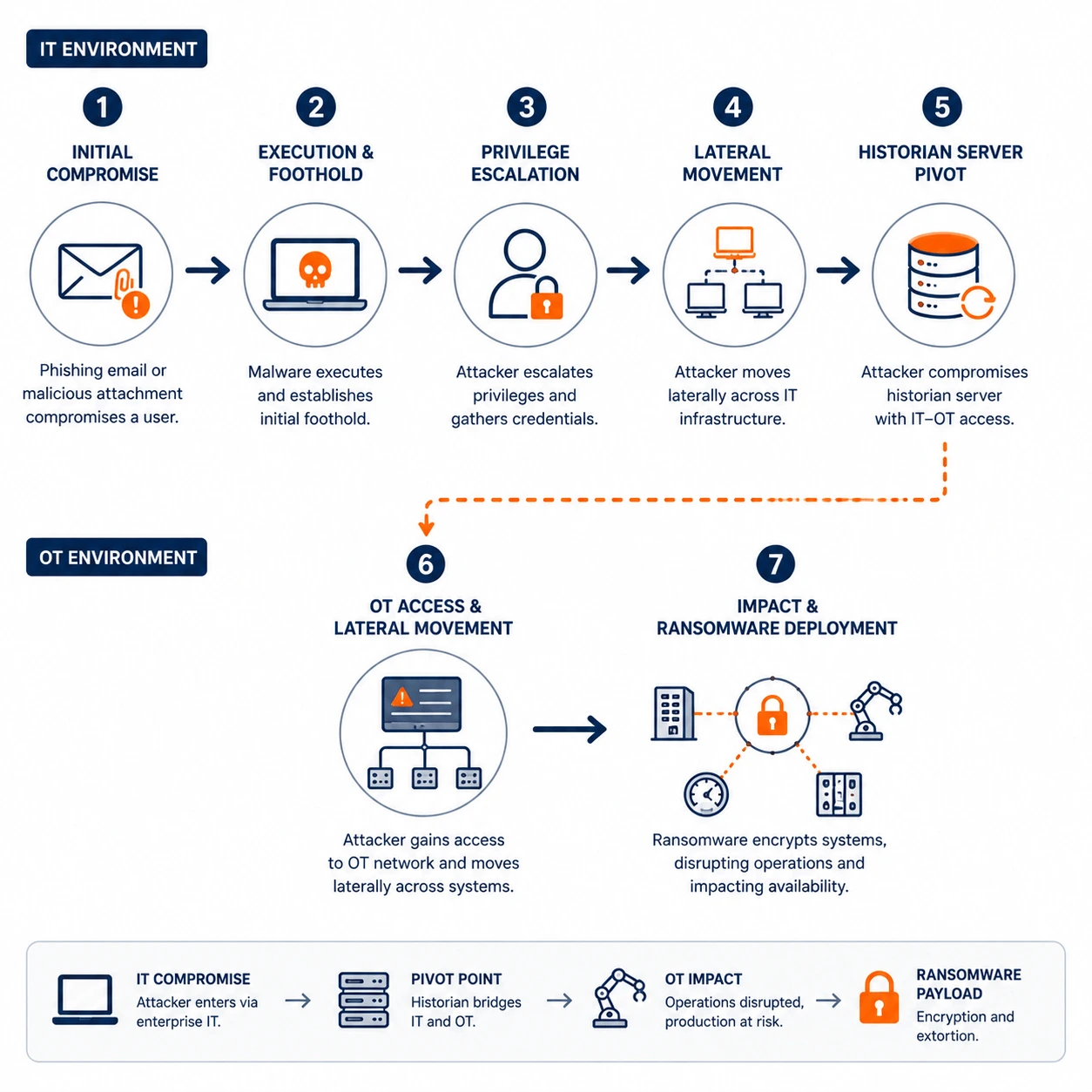
The path from a phishing email to a production shutdown follows a predictable pattern. An attacker gains an initial foothold in the IT environment, typically through a compromised credential or a phishing campaign targeting an employee with access to both IT and OT systems. From there, they move laterally, looking for systems that bridge the two environments. 

Historian servers are among the most common pivot points. They are designed to collect process data from OT systems and make it available to IT applications. That functionality requires connectivity in both directions, which means a compromised historian server provides access to the OT network. Engineering workstations create the same exposure. They sit on the corporate network for remote access and email, and they connect to programmable logic controllers (PLCs) and human-machine interfaces (HMIs) for configuration and diagnostics. 
Ransomware-Attack-Path-from-IT-to-OT-1

Why the Boundary Fails

The IT-OT boundary fails most often not because of sophisticated attacks but because of accumulated operational decisions that each seemed reasonable at the time. A shared credential set up so the night shift supervisor could access both systems. A firewall rule opened for a vendor during a maintenance window and never closed. A demilitarized zone (DMZ) that routes traffic between IT and OT but does not actually inspect or restrict what passes through it. 

These are not edge cases. In almost every OT environment that has undergone a security assessment, some version of these conditions exists. The boundary that appears robust in the architecture diagram is rarely as enforced as the documentation suggests. Ransomware operators, once they have access to the IT environment, are patient enough to find the gaps. They have the time: Dragos puts the industry-wide average dwell time for ransomware in OT environments at 42 days. 

What Ransomware in OT Actually Costs

The cost of a ransomware incident that crosses into OT is not just the ransom demand. It is the production loss during the shutdown, which for a mid-size manufacturer can run to hundreds of thousands of dollars per day. It is the recovery cost for OT systems, which cannot simply be reimaged from a backup the way a laptop can. It is the time required to revalidate and restart process control systems safely. It is the reputational damage with customers who depend on your production output. 

Colonial Pipeline is the most widely cited example, but the pattern repeats across manufacturing, food processing, pharmaceuticals and utilities. The May 2021 REvil ransomware attack on JBS halted cattle-slaughtering operations at 13 of its meat processing plants, and the company confirmed it paid the equivalent of $11 million in ransom. The attack does not need to target OT directly. It only needs to make enough of the environment inaccessible that operations leadership decides the cost of staying down exceeds the cost of paying. 

What Penetration Testing Finds Before Ransomware Does

The value of an IT-OT penetration test is not that it simulates a ransomware attack. It is that it finds the same paths a ransomware operator would use to reach the OT environment, before they get there. That means testing lateral movement from the IT network toward OT systems. Validating whether segmentation controls actually enforce the boundaries they are supposed to. Checking whether historian servers and engineering workstations are accessible from the IT network in ways that could be exploited. IEC 62443 from the International Electrotechnical Commission defines those boundaries as zones and conduits, and Special Publication 800-82 from the National Institute of Standards and Technology (NIST) describes how to assess them. 

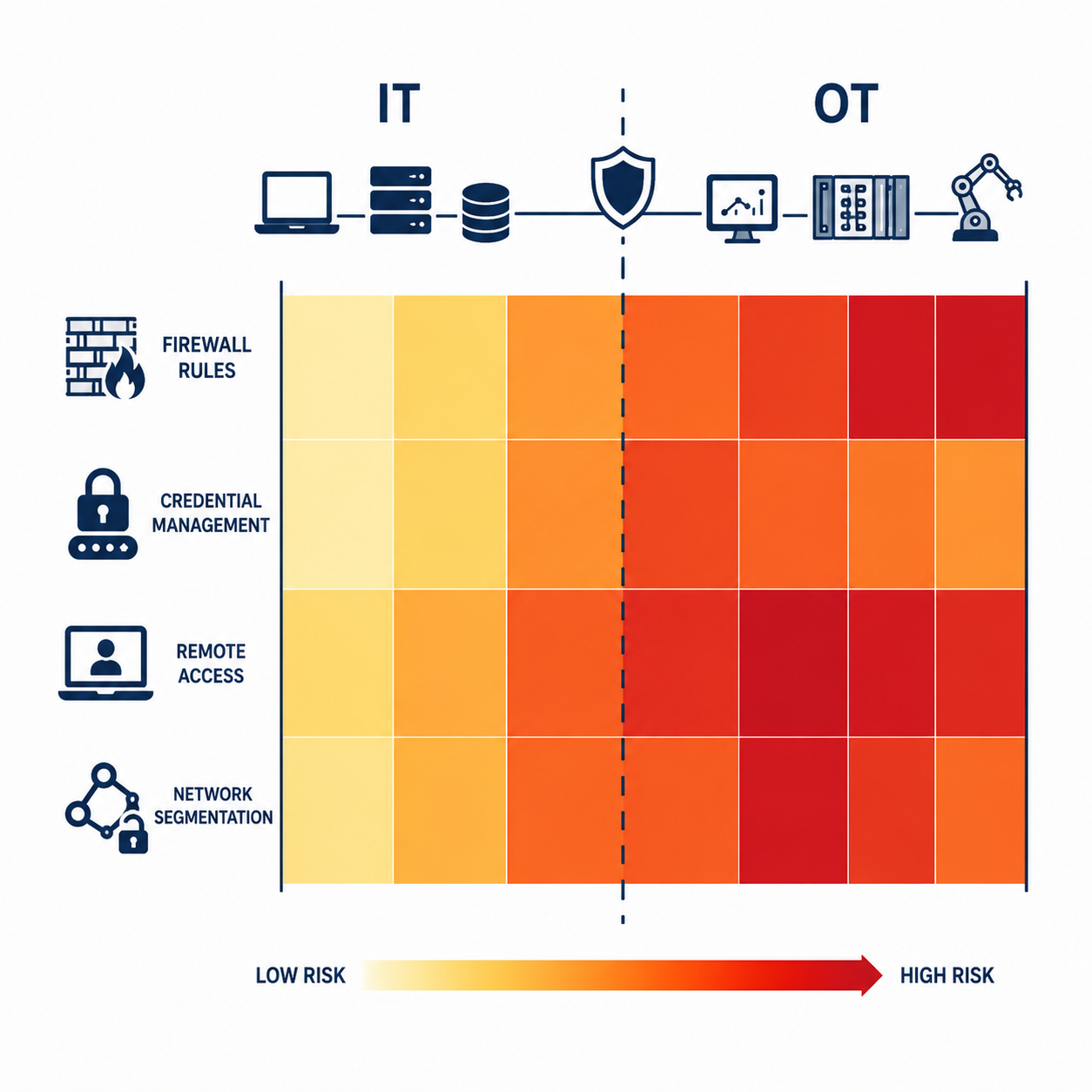
The findings from these tests consistently cluster around the same categories: overly permissive firewall rules at the IT-OT boundary, shared credentials with access to both environments, and remote access paths that were set up for operational convenience and never hardened. Finding them in a controlled pen test is significantly less expensive than finding them during an incident response. 
IT-OT-Risk-Assessment-1

Knowing Your Exposure

The first step toward protecting the IT-OT boundary is understanding how exposed it currently is. That requires looking at the actual state of your network, not the intended architecture. Where can traffic cross between IT and OT? What credentials exist with access to both environments? Which systems at the boundary have not been assessed in the past 12 months? 

A structured risk assessment focused on the IT-OT boundary gives you that picture. It identifies your most critical exposure points and maps them to the specific ways ransomware operators would exploit them. That is the foundation for a remediation plan that reduces real risk rather than checking compliance boxes. 

Ransomware operators are already looking for your boundary gaps. Find them first. Request an IT-OT boundary risk assessment and get your most critical exposure points identified, ranked and mapped to a remediation plan.


Get the latest insights straight from our desk to your inbox.

Other Featured Articles

Explore More
RD-and-Regulated-Systems-Penetration-Testing-Scopes

Pharmaceutical Pen Testing: Why R&D and GxP Need Different Scopes.

R&D and GxP regulated environments have different risk profiles, compliance requirements, and testing constraints.

Shantanoo Govilkar
SVP Strategic Solutions Risk & Cybersecurity Solutions view
Nation-State-Cyber-Threats-in-Pharma

Why Pharmaceutical Pen Testing Must Address Nation-State Threats

Nation-state actors treat pharma like critical infrastructure targeting formulation data, synthesis routes, and clinical IP with patience and precision.

Shantanoo Govilkar
SVP Strategic Solutions Risk & Cybersecurity Solutions view
IT-OT-Boundary-Ransomware-Risk

How Ransomware Crosses the IT-OT Boundary (And How to Stop It)

Ransomware operators target the IT-OT boundary deliberately and they know manufacturing economics well.

Shantanoo Govilkar
SVP Strategic Solutions Risk & Cybersecurity Solutions view
Where-Industry-4-0-Exposed-OT

Where Industry 4.0 Left Your OT Attack Surface Wide Open

Industry 4.0 connected OT environments were never built for. Learn why traditional IT security tools fall short and what OT penetration testing reveals that audits miss.

Shantanoo Govilkar
SVP Strategic Solutions Risk & Cybersecurity Solutions view
What-AS4-Actually-Solves-Banner-Image

What AS4 Actually Solves: Real Outcomes Companies See After Migration

Discover what AS4 actually solves for modern businesses. Learn the real outcomes companies achieve after migration, from stronger security to better B2B integration performance.


EDI Solutions Group
Marketing Group view
AS4-migration-pitfalls-Banner-image

7 Migration Pitfalls That Derail AS4 Upgrades (and How to Avoid Them)

Avoid costly AS4 upgrade mistakes. Discover 7 migration pitfalls that delay projects, create risk, and disrupt B2B messaging, plus practical ways to avoid them.

EDI Solutions Group
Marketing Group view
pen-testing-in-cloud-enviroment-banner-image

How to Perform Penetration Testing in Cloud Environments (AWS, Azure, and GCP) - 2026 Edition

A practical guide to cloud penetration testing across AWS, Azure, and GCP. Learn methods, tools, and best practices to identify vulnerabilities and improve security.

Cybersecurity Solutions Group
Marketing Group view
when-to-switch-legacy-edi-to-as4

5 Signs It's Time to Move Legacy EDI Environment to AS4 Protocol

Partner onboarding delays, compliance gaps, and rising maintenance costs are signals your EDI infrastructure is reaching its limits. Learn the five signs it is time to evaluate a move to AS4.

EDI Solutions Group
Marketing Group view
How-to-Design-Custom-Chatbots-Banner-Image

How to Design Custom Chatbots That Cannot “Make Stuff Up”

Confident AI answers without traceable sources create institutional risk. Learn how Grounded RAG architecture retrieves real documents first and attaches verifiable citations to every response.

Data and AI Solutions Group
Marketing Group view
Conversational-AI-blog-banner

How Citation-Backed Conversational AI Improves Public Access and Internal Decision-Making

AI without source citations creates real liability. Learn how citation-backed AI brings traceable sources, version awareness, and audit-ready outputs to every institutional decision.

Data and AI Solutions Group
Marketing Group view
Network-penetration-testion-blog-banner

How to Perform a Successful Network Penetration Test: Comprehensive Guide for 2025

Learn how to perform a successful network penetration test to identify vulnerabilities, simulate real cyberattacks, and strengthen your organization’s network security.

Cybersecurity Solutions Group
Marketing Group view
Penetration-testing-banner-image

What Is Penetration Testing? A 2026 Expert Guide

A 2026 expert guide to penetration testing for security leaders and IT teams seeking proactive defense, compliance, and stakeholder trust.

Cybersecurity Solutions Group
Marketing Group view
ot-ransomware-prevention-banner-image

OT Ransomware Prevention: Practical Best Practices for Industrial Cybersecurity

Explore enterprise grade OT ransomware prevention strategies, including segmentation, identity control, threat informed detection, and resilient recovery design to protect industrial operations fro

Cybersecurity Solutions Group
Marketing Group view
OT-Ransomware-Risks-and-Response-Banner

10 Myths About OT/ICS Security That Put Your Business at Risk

Think your OT network is secure? Learn the 10 most dangerous myths about OT and ICS cybersecurity that leave industrial operations exposed to attacks.

Cybersecurity Solutions Group
Marketing Group view
OT-ransomeware-risk-and-responses-banner-image

OT Ransomware Risks and Response for Industrial Systems

Learn why OT environments face higher ransomware risk, how attackers gain access, and how effective detection and response reduce operational impact.

Cybersecurity Solutions Group
Marketing Group view
AI-Risk-Assessment-Best-Practices-Banner

AI Risk Assessment: Risk Types, Best Practices & More

Explore AI risk types, essential assessment frameworks, and proven best practices to mitigate threats in AI deployment. Learn actionable strategies for secure AI systems today.

Cybersecurity Solutions Group
Marketing Group view
AI Risk Assessment Banner Image

AI Risk Assessment: Everything You Need to Know

Learn essential processes, methodologies, risk types, regulatory requirements, and practical implementation strategies for safe AI deployment.

Cybersecurity Solutions Group
Marketing Group view
Whitepaper: Ransomware Threat Management

Whitepaper: Ransomware Threat Management

Ransomware continues to be a real threat to business operations across all industries, no organization is safe from this threat.

Laszlo S. Gonc
CISSP, First Senior Fellow, DivIHN Cybersecurity Center of Excellence view
Cybersecurity Incident Response Preparedness

Cybersecurity Incident Response Preparedness

An incident response framework provides a structure to support incident response operations. A framework typically provides guidance on what needs to be done, but not on how it is done.

Laszlo S. Gonc
CISSP, First Senior Fellow, DivIHN Cybersecurity Center of Excellence view
Internet of Things

IoT Medical Device Cybersecurity

Healthcare data and medical devices would be aggressively targeted by ransomware attacks since early 2017 has proven to be true

Laszlo S. Gonc
CISSP, First Senior Fellow, DivIHN Cybersecurity Center of Excellence view
Back
to Top