Why Pharmaceutical Pen Testing Must Address Nation-State Threats

Contributors

Shantanoo Govilkar
Shantanoo Govilkar
SVP Strategic Solutions Risk & Cybersecurity Solutions
Image
Nation-State-Cyber-Threats-in-Pharma

Nation-state actors have targeted pharmaceutical companies with a consistency and sophistication that puts pharma in the same threat category as defense contractors and critical infrastructure operators. The COVID-19 vaccine intellectual property (IP) theft campaigns documented by the National Security Agency (NSA), the Cybersecurity and Infrastructure Security Agency (CISA) and international intelligence partners were not anomalies. They were the visible surface of ongoing targeting that predates the pandemic and continues today. Standard enterprise security programs were not designed to defend against this threat. Penetration testing that does not account for it produces a false picture of your actual risk.

What Nation-State Actors Want From Pharma

The primary targets are formulation data, synthesis routes, clinical trial results and regulatory strategies. These represent competitive intelligence of enormous economic value to state-sponsored pharmaceutical industries and strategic value to governments managing public health crises. Secondary targets include manufacturing process IP, which enables production of branded drugs without the research and development (R&D) investment, and corporate strategy information relevant to acquisition targets and partnership negotiations. The scale is documented: the FBI, citing the Commission on the Theft of American Intellectual Property, puts the annual cost of counterfeiting, piracy and trade secret theft to the US economy at between $225 billion and $600 billion

The threat actors most consistently documented targeting pharma include Chinese state-affiliated groups focused on technology acquisition, Russian groups that intensified pharma targeting during the pandemic period and North Korean groups that combine IP theft with ransomware deployment for revenue generation. Each group uses different tactics, but all of them rely on initial access methods that standard security controls are poorly calibrated to detect. The pandemic-era record is specific: in November 2020, Microsoft reported attacks by one Russian and two North Korean state actors against seven companies directly involved in researching COVID-19 vaccines and treatments. 

How They Get In and Stay Hidden

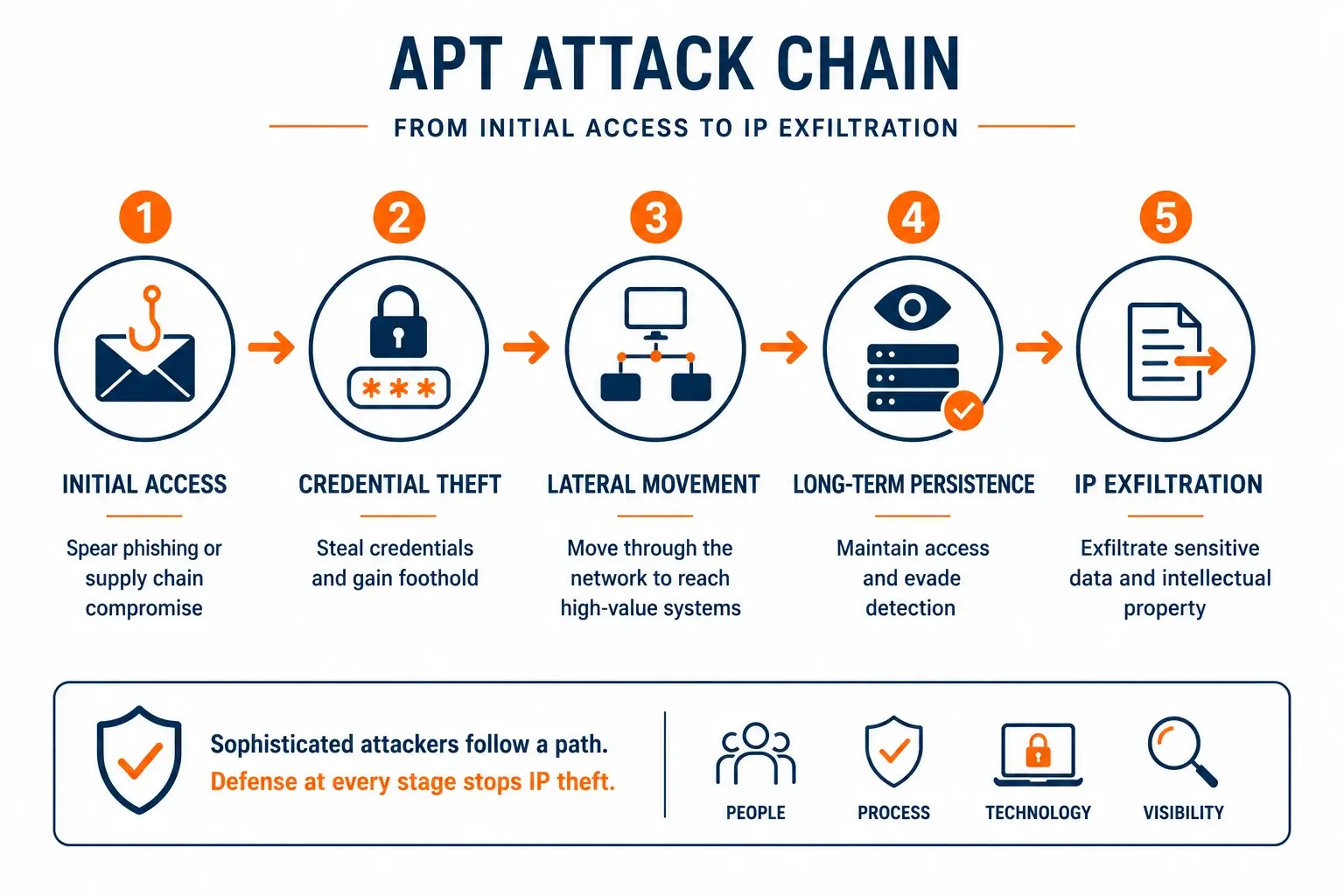
Spear phishing campaigns targeting pharma researchers and executives are the most common initial access method. These are not generic phishing emails. They are crafted to reference specific research areas, use the names of real collaborators and mimic the communication patterns of legitimate scientific correspondence. Standard email security filters that catch bulk phishing campaigns often miss them. 

Supply chain compromise is the second major entry vector. Contract research organizations, contract manufacturing partners and laboratory equipment vendors all have legitimate access to pharma environments. Compromising a smaller, less security-mature organization in that ecosystem is often easier than attacking the pharma company directly. Once inside through a trusted partner connection, attackers can operate using legitimate credentials and legitimate tools, which makes detection through signature-based controls nearly impossible. This path is documented in court records. The US Department of Justice’s 2018 indictment of two APT10 hackers working with China’s Ministry of State Security described a campaign that compromised managed service providers to reach their clients, including a healthcare company and a biotechnology company, across at least 12 countries. 
APT-Attack-Chain

What Standard Controls Miss

Nation-state actors targeting pharma are not trying to move fast. They are trying to stay hidden. Dwell times of six to eighteen months before exfiltration are documented in multiple pharma breach investigations. During that time, attackers are mapping the environment, identifying the most valuable data repositories and establishing the persistence mechanisms that will survive detection attempts. 

Signature-based detection tools miss this activity because the attackers are using legitimate tools and legitimate credentials. A threat actor using a compromised researcher's virtual private network (VPN) credentials to access the clinical data repository at 2 AM from an unusual location looks like an anomaly, but anomaly detection requires a baseline, and most pharma environments do not have one calibrated to research workflow patterns. 

What Pen Testing Reveals That Audits Do Not

A penetration test built around nation-state tactics tests the things that matter for this specific threat: whether credential harvesting from a single compromised endpoint can yield access to high-value IP repositories, whether lateral movement from a third-party access point can reach core research systems, whether data exfiltration through legitimate cloud services is detectable, and whether long-term persistence mechanisms can be established and maintained without triggering alerts. 

These test scenarios require a different methodology than a standard compliance-driven pen test. They require threat intelligence about the specific groups targeting pharma, adversary simulation techniques that replicate documented attack patterns and testing of detection capabilities, not just exploitation of vulnerabilities. The output is not just a list of vulnerabilities. It is an assessment of how far a real attacker would get and where your defenses would stop them. MITRE ATT&CK, the public knowledge base of documented adversary tactics and techniques, is the standard reference for building these scenarios. 

Understanding Your Actual Exposure

Most pharma security teams significantly underestimate their nation-state exposure because their security programs are calibrated to the threats their tools were built to detect. A structured assessment that specifically evaluates your defenses against documented nation-state tactics gives you an accurate picture of where you stand, not a picture shaped by what your current tools can measure. 

The groups targeting pharma are documented, and so are their methods. Request an adversary simulation scoped to them and find out where your defenses actually stop a nation-state intrusion. 

Get the latest insights straight from our desk to your inbox.

Other Featured Articles

Explore More
RD-and-Regulated-Systems-Penetration-Testing-Scopes

Pharmaceutical Pen Testing: Why R&D and GxP Need Different Scopes.

R&D and GxP regulated environments have different risk profiles, compliance requirements, and testing constraints.

Shantanoo Govilkar
SVP Strategic Solutions Risk & Cybersecurity Solutions view
Nation-State-Cyber-Threats-in-Pharma

Why Pharmaceutical Pen Testing Must Address Nation-State Threats

Nation-state actors treat pharma like critical infrastructure targeting formulation data, synthesis routes, and clinical IP with patience and precision.

Shantanoo Govilkar
SVP Strategic Solutions Risk & Cybersecurity Solutions view
IT-OT-Boundary-Ransomware-Risk

How Ransomware Crosses the IT-OT Boundary (And How to Stop It)

Ransomware operators target the IT-OT boundary deliberately and they know manufacturing economics well.

Shantanoo Govilkar
SVP Strategic Solutions Risk & Cybersecurity Solutions view
Where-Industry-4-0-Exposed-OT

Where Industry 4.0 Left Your OT Attack Surface Wide Open

Industry 4.0 connected OT environments were never built for. Learn why traditional IT security tools fall short and what OT penetration testing reveals that audits miss.

Shantanoo Govilkar
SVP Strategic Solutions Risk & Cybersecurity Solutions view
What-AS4-Actually-Solves-Banner-Image

What AS4 Actually Solves: Real Outcomes Companies See After Migration

Discover what AS4 actually solves for modern businesses. Learn the real outcomes companies achieve after migration, from stronger security to better B2B integration performance.


EDI Solutions Group
Marketing Group view
AS4-migration-pitfalls-Banner-image

7 Migration Pitfalls That Derail AS4 Upgrades (and How to Avoid Them)

Avoid costly AS4 upgrade mistakes. Discover 7 migration pitfalls that delay projects, create risk, and disrupt B2B messaging, plus practical ways to avoid them.

EDI Solutions Group
Marketing Group view
pen-testing-in-cloud-enviroment-banner-image

How to Perform Penetration Testing in Cloud Environments (AWS, Azure, and GCP) - 2026 Edition

A practical guide to cloud penetration testing across AWS, Azure, and GCP. Learn methods, tools, and best practices to identify vulnerabilities and improve security.

Cybersecurity Solutions Group
Marketing Group view
when-to-switch-legacy-edi-to-as4

5 Signs It's Time to Move Legacy EDI Environment to AS4 Protocol

Partner onboarding delays, compliance gaps, and rising maintenance costs are signals your EDI infrastructure is reaching its limits. Learn the five signs it is time to evaluate a move to AS4.

EDI Solutions Group
Marketing Group view
How-to-Design-Custom-Chatbots-Banner-Image

How to Design Custom Chatbots That Cannot “Make Stuff Up”

Confident AI answers without traceable sources create institutional risk. Learn how Grounded RAG architecture retrieves real documents first and attaches verifiable citations to every response.

Data and AI Solutions Group
Marketing Group view
Conversational-AI-blog-banner

How Citation-Backed Conversational AI Improves Public Access and Internal Decision-Making

AI without source citations creates real liability. Learn how citation-backed AI brings traceable sources, version awareness, and audit-ready outputs to every institutional decision.

Data and AI Solutions Group
Marketing Group view
Network-penetration-testion-blog-banner

How to Perform a Successful Network Penetration Test: Comprehensive Guide for 2025

Learn how to perform a successful network penetration test to identify vulnerabilities, simulate real cyberattacks, and strengthen your organization’s network security.

Cybersecurity Solutions Group
Marketing Group view
Penetration-testing-banner-image

What Is Penetration Testing? A 2026 Expert Guide

A 2026 expert guide to penetration testing for security leaders and IT teams seeking proactive defense, compliance, and stakeholder trust.

Cybersecurity Solutions Group
Marketing Group view
ot-ransomware-prevention-banner-image

OT Ransomware Prevention: Practical Best Practices for Industrial Cybersecurity

Explore enterprise grade OT ransomware prevention strategies, including segmentation, identity control, threat informed detection, and resilient recovery design to protect industrial operations fro

Cybersecurity Solutions Group
Marketing Group view
OT-Ransomware-Risks-and-Response-Banner

10 Myths About OT/ICS Security That Put Your Business at Risk

Think your OT network is secure? Learn the 10 most dangerous myths about OT and ICS cybersecurity that leave industrial operations exposed to attacks.

Cybersecurity Solutions Group
Marketing Group view
OT-ransomeware-risk-and-responses-banner-image

OT Ransomware Risks and Response for Industrial Systems

Learn why OT environments face higher ransomware risk, how attackers gain access, and how effective detection and response reduce operational impact.

Cybersecurity Solutions Group
Marketing Group view
AI-Risk-Assessment-Best-Practices-Banner

AI Risk Assessment: Risk Types, Best Practices & More

Explore AI risk types, essential assessment frameworks, and proven best practices to mitigate threats in AI deployment. Learn actionable strategies for secure AI systems today.

Cybersecurity Solutions Group
Marketing Group view
AI Risk Assessment Banner Image

AI Risk Assessment: Everything You Need to Know

Learn essential processes, methodologies, risk types, regulatory requirements, and practical implementation strategies for safe AI deployment.

Cybersecurity Solutions Group
Marketing Group view
Whitepaper: Ransomware Threat Management

Whitepaper: Ransomware Threat Management

Ransomware continues to be a real threat to business operations across all industries, no organization is safe from this threat.

Laszlo S. Gonc
CISSP, First Senior Fellow, DivIHN Cybersecurity Center of Excellence view
Cybersecurity Incident Response Preparedness

Cybersecurity Incident Response Preparedness

An incident response framework provides a structure to support incident response operations. A framework typically provides guidance on what needs to be done, but not on how it is done.

Laszlo S. Gonc
CISSP, First Senior Fellow, DivIHN Cybersecurity Center of Excellence view
Internet of Things

IoT Medical Device Cybersecurity

Healthcare data and medical devices would be aggressively targeted by ransomware attacks since early 2017 has proven to be true

Laszlo S. Gonc
CISSP, First Senior Fellow, DivIHN Cybersecurity Center of Excellence view
Back
to Top