
Annual penetration testing became the default cadence for most manufacturers the same way annual performance reviews became the default for HR: it fits neatly into a budget cycle, it satisfies a compliance checkbox and it is easy to schedule. It is also, for most manufacturing environments, the wrong answer. The right cadence for pen testing is not determined by the calendar. It is determined by how fast your environment changes and how much risk you are willing to carry between tests. The gap matters more every year: Verizon’s 2025 Data Breach Investigations Report found exploitation of vulnerabilities as an initial access vector grew 34% year over year and now starts 20% of breaches.
Why the Annual Default Is a Risk Decision, Not a Security Decision
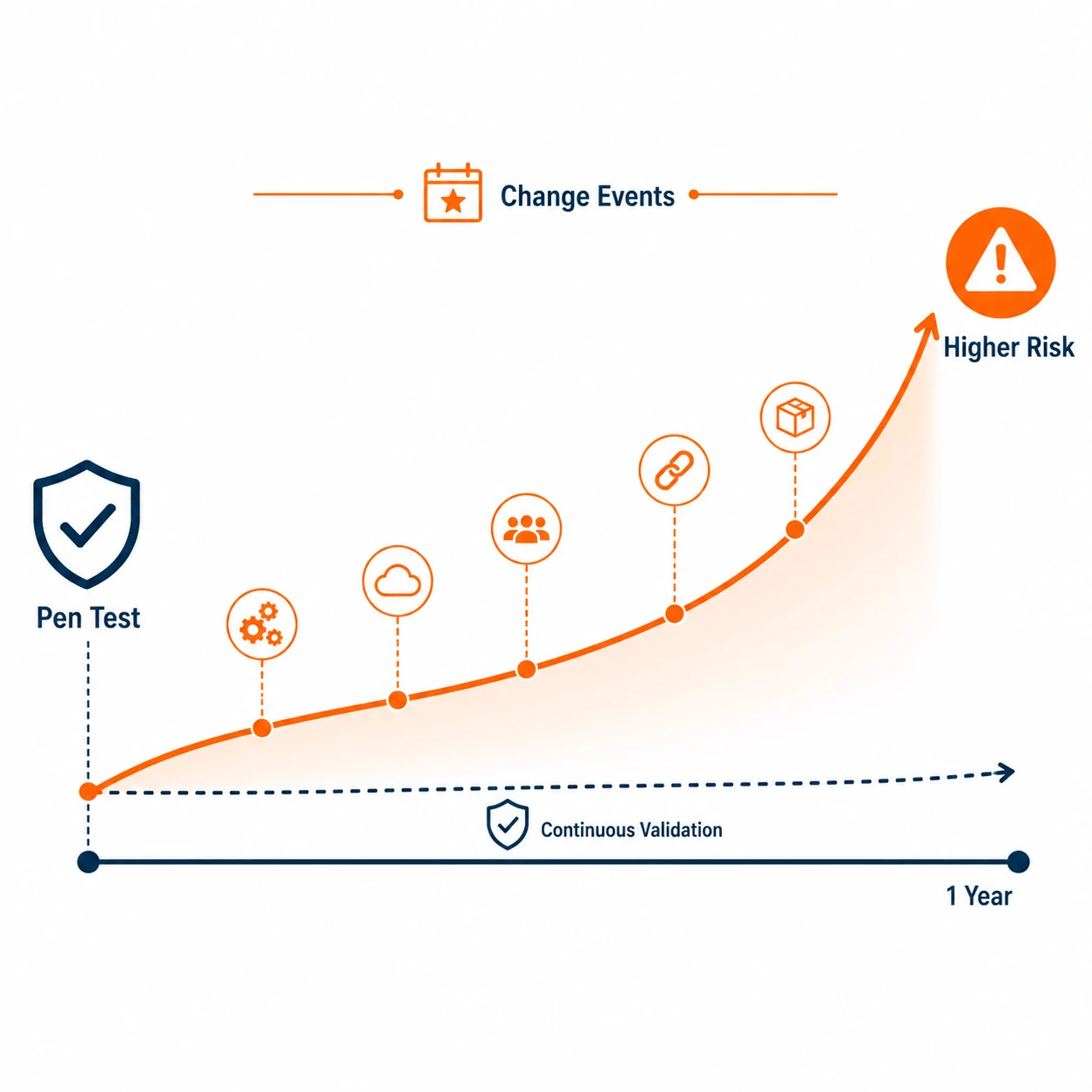
When a manufacturer runs a pen test in Q4 and receives the report in January, they have a snapshot of their security posture at a single point in time. By March, three new vendor remote access connections have been set up for equipment commissioning. By June, a new operational technology (OT) system has been connected to the historian, the database that archives process data. By September, a network reconfiguration has changed the segmentation between IT and OT. The next pen test is still three months away.
Every one of those changes is a potential new exposure that the last test did not see, and the next test has not yet found. Annual testing does not mean you are tested annually. It means you have a documented security posture once a year and an undocumented one for the other eleven months. Whether that is acceptable depends on how much your environment changes and how consequential a breach would be during the gap. The consequences can be severe: the August 2023 cyberattack on Clorox slowed production, caused significant product outages, and was blamed for most of a $356 million (20%) net sales decline the following quarter, on top of $49 million in direct response costs reported through December 2023.
What Compliance Frameworks Actually Require
Cybersecurity Maturity Model Certification (CMMC) Level 2 requires periodic assessments but does not prescribe a specific frequency beyond the triennial Certified Third-Party Assessment Organization (C3PAO) cycle. National Institute of Standards and Technology (NIST) 800-171 requires periodic testing of security controls without defining the interval. International Electrotechnical Commission (IEC) 62443 calls for security assessments aligned to risk but leaves cadence to the organization. None of these frameworks mandate annual testing. Most of them allow, and some implicitly encourage, more frequent testing for high-risk or high-change environments.
The compliance minimum is a floor, not a recommendation. Meeting the minimum keeps you compliant. It does not necessarily keep you secure, and regulators and frameworks are increasingly explicit about that distinction. An organization that tests annually and documents it is compliant. An organization that tests more frequently and can demonstrate a systematic approach to security validation is in a stronger position for both compliance purposes and actual risk management.
The Factors That Should Drive Your Cadence
Rate of change is the most important variable. A manufacturer running a stable, mature OT environment with minimal vendor access and infrequent network changes faces a different risk profile than one actively commissioning new equipment, integrating Industry 4.0 platforms or expanding remote access for operational efficiency. The higher the rate of change, the shorter the interval between tests needs to be to maintain meaningful visibility into the current security posture.
Previous findings and remediation completion rate matter as well. An organization that consistently closes findings between tests and maintains a low open finding count has demonstrated that its testing program is connected to its remediation process. An organization with a growing backlog of unaddressed findings from previous tests has a different problem than cadence and increasing testing frequency without fixing the remediation process will not help.
Trigger-Based Testing as a Complement to Scheduled Testing
The most mature manufacturing security programs combine a scheduled baseline test with trigger-based testing for specific changes. A new vendor remote access path gets tested when it is set up, not at the next scheduled test. A significant network reconfiguration gets validated before it goes into production. A new OT system gets assessed as part of its commissioning process.
This approach does not require a dramatically larger testing budget. It requires a testing partner with the flexibility to engage on shorter notice and a change management process that includes a security testing gate for high-risk changes. The payoff is a security posture that reflects the current environment rather than the environment as it existed at the last scheduled test date.
Building a Cadence That Works for Your Program
There is no universal right answer for pen test frequency in manufacturing. A single-site manufacturer with a stable OT environment and annual compliance requirements may be well-served by annual testing supplemented by trigger-based assessments for major changes. A multi-site manufacturer with active Industry 4.0 integration and CMMC obligations is almost certainly underserved by annual testing regardless of how well the test is executed.
The starting point is an honest assessment of your environment: how much it changes, what your current testing program is capturing and where the gaps between your last test and your current environment are largest. That assessment tells you what cadence makes sense for your specific situation, rather than what fits the budget cycle.
Your environment changed since your last test. Request a cadence assessment and find out whether your testing program still matches the way your plant operates.