Pharmaceutical Pen Testing: What 21 CFR Part 11 and cGMP Require

Contributors

Shantanoo Govilkar
Shantanoo Govilkar
SVP Strategic Solutions Risk & Cybersecurity Solutions
Image
21-CFR-Part-11-and-cGMP-Requirements

21 CFR Part 11 and current Good Manufacturing Practice (cGMP) regulations do not use the words penetration testing. That absence leads some pharma compliance teams to treat security testing as a separate obligation from regulatory compliance, one that sits in the IT security program rather than the quality system. That separation is a mistake. The controls that Part 11 and cGMP require, specifically around electronic record integrity, audit trail protection, access control and system reliability, are exactly the controls that penetration testing is designed to validate. Understanding the connection is necessary for building a testing program that satisfies both security and regulatory objectives. The cost of failing on the regulatory side is documented: in 2013, Ranbaxy paid $500 million in the largest drug safety settlement of its kind after pleading guilty to federal charges that included cGMP violations and false statements to the FDA. 

What Part 11 and cGMP Require

21 CFR Part 11 requires that electronic records be trustworthy, reliable and equivalent to paper records in terms of integrity and authenticity. It requires audit trails that capture who did what and when, access controls that limit system use to authorized individuals and electronic signatures that are uniquely linked to the signer. None of these requirements are met by policy alone. They require technical controls that function correctly under adversarial conditions, not just under normal operating conditions. 

cGMP requirements, particularly as they apply to computer systems under 21 CFR Parts 211 and 212, require that computerized systems used in drug manufacturing are validated, that data generated by those systems is accurate and complete and that access to those systems is controlled and logged. The Food and Drug Administration's (FDA) data integrity guidance documents, while not regulations themselves, make clear that the agency expects these controls to be tested and verified, not just documented. 

The Systems That Require Testing

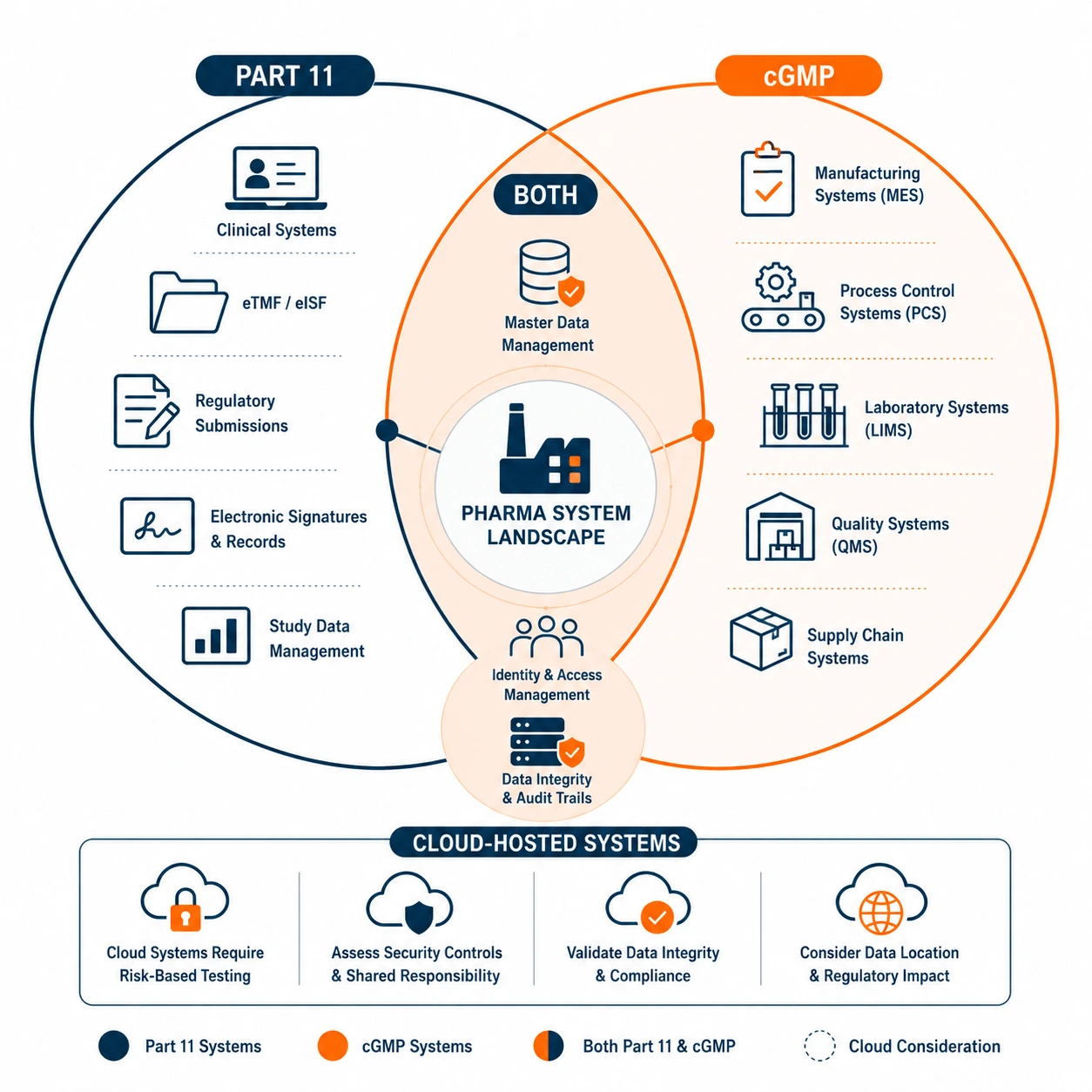
The systems in scope for compliance-driven pen testing in pharma are those that create, modify, maintain or transmit regulated electronic records. Manufacturing execution systems that generate electronic batch records. Laboratory information management systems (LIMS) that produce analytical data supporting release decisions. Enterprise resource planning (ERP) systems that manage regulated manufacturing documentation. Distributed control systems (DCS) and supervisory control and data acquisition (SCADA) systems that control and record process parameters in drug manufacturing. 

Cloud-hosted regulated systems require particular attention. The FDA's position on cloud hosting for GxP (good practice) systems is that the pharmaceutical company retains responsibility for data integrity and access control regardless of where the system is hosted. That means the pen test scope for a cloud-hosted LIMS needs to include the cloud environment configuration and the access controls governing who can reach the system from outside the corporate network. 
Pharma-System-Landscape

How to Test Without Violating Validated State

The central challenge of pen testing validated pharma systems is that the testing itself can constitute a change to the validated system. An active scan that modifies configuration, a test that writes to an audit trail or an exploitation attempt that alters system state may require revalidation before the system can be used for regulated activities. This is not a theoretical concern. Pharma companies have had to revalidate systems after security testing that was conducted without adequate planning.

The solution is a qualified test environment: a mirror of the production system built to the same specification and qualified through the same installation, operational and performance qualification (IQ, OQ, PQ) process. Active testing occurs in the test environment. Production systems receive only passive reconnaissance, which can be conducted without risk to validated state. The test environment findings are treated as representative of production, with documented justification for any differences between the two environments. 

What Your Report Must Demonstrate for Compliance

A pen test report that satisfies FDA compliance requirements for Part 11 and cGMP systems needs to demonstrate more than vulnerability findings. It needs to demonstrate that audit trail integrity was tested: that an attacker cannot modify or delete audit trail entries without detection. It needs to demonstrate that access controls were tested under adversarial conditions: that privilege escalation, credential theft and unauthorized access attempts were made and their outcomes documented. It needs to demonstrate that data integrity controls function correctly when the system is under attack, not just under normal operating conditions. 

The report should map each test category to the specific regulatory requirement it validates. That mapping is what allows the report to function as compliance evidence, not just as a security assessment. It is also what allows the quality team to use pen test findings in their risk management process rather than treating them as IT security findings that have no bearing on the quality system.

Preparing for Your Next FDA Inspection

FDA inspectors conducting data integrity inspections are increasingly asking about cybersecurity controls and how they are tested. An organization that can produce pen test reports demonstrating that audit trail integrity, access controls and electronic record protections were tested against adversarial scenarios is in a significantly stronger position than one that can only produce policy documentation and system validation records. 

Building that capability requires aligning the pen test program with the quality system, not running it as a parallel IT security activity. That alignment starts with scoping that reflects regulatory requirements, extends through a testing methodology that validates the controls regulators care about and ends with reporting that speaks the language of compliance, not just security. 

Your next inspection will ask how your controls were tested, not just how they were documented. Request a compliance-aligned scoping session and build a pen test program your quality team can stand behind. 

 

Get the latest insights straight from our desk to your inbox.

Other Featured Articles

Explore More
Manufacturing-Penetration-Testing-Frequency

How Often Should Manufacturers Run OT Penetration Testing?

Annual pen testing fits a budget cycle but it doesn't reflect how fast manufacturing environments actually change.

Shantanoo Govilkar
SVP Strategic Solutions Risk & Cybersecurity Solutions view
21-CFR-Part-11-and-cGMP-Requirements

Pharmaceutical Pen Testing: What 21 CFR Part 11 and cGMP Require

21 CFR Part 11 and cGMP don't mention penetration testing but the controls they require depend on it.

Shantanoo Govilkar
SVP Strategic Solutions Risk & Cybersecurity Solutions view
RD-and-Regulated-Systems-Penetration-Testing-Scopes

Pharmaceutical Pen Testing: Why R&D and GxP Need Different Scopes.

R&D and GxP regulated environments have different risk profiles, compliance requirements, and testing constraints.

Shantanoo Govilkar
SVP Strategic Solutions Risk & Cybersecurity Solutions view
Nation-State-Cyber-Threats-in-Pharma

Why Pharmaceutical Pen Testing Must Address Nation-State Threats

Nation-state actors treat pharma like critical infrastructure targeting formulation data, synthesis routes, and clinical IP with patience and precision.

Shantanoo Govilkar
SVP Strategic Solutions Risk & Cybersecurity Solutions view
IT-OT-Boundary-Ransomware-Risk

How Ransomware Crosses the IT-OT Boundary (And How to Stop It)

Ransomware operators target the IT-OT boundary deliberately and they know manufacturing economics well.

Shantanoo Govilkar
SVP Strategic Solutions Risk & Cybersecurity Solutions view
Where-Industry-4-0-Exposed-OT

Where Industry 4.0 Left Your OT Attack Surface Wide Open

Industry 4.0 connected OT environments were never built for. Learn why traditional IT security tools fall short and what OT penetration testing reveals that audits miss.

Shantanoo Govilkar
SVP Strategic Solutions Risk & Cybersecurity Solutions view
What-AS4-Actually-Solves-Banner-Image

What AS4 Actually Solves: Real Outcomes Companies See After Migration

Discover what AS4 actually solves for modern businesses. Learn the real outcomes companies achieve after migration, from stronger security to better B2B integration performance.


EDI Solutions Group
Marketing Group view
AS4-migration-pitfalls-Banner-image

7 Migration Pitfalls That Derail AS4 Upgrades (and How to Avoid Them)

Avoid costly AS4 upgrade mistakes. Discover 7 migration pitfalls that delay projects, create risk, and disrupt B2B messaging, plus practical ways to avoid them.

EDI Solutions Group
Marketing Group view
pen-testing-in-cloud-enviroment-banner-image

How to Perform Penetration Testing in Cloud Environments (AWS, Azure, and GCP) - 2026 Edition

A practical guide to cloud penetration testing across AWS, Azure, and GCP. Learn methods, tools, and best practices to identify vulnerabilities and improve security.

Cybersecurity Solutions Group
Marketing Group view
when-to-switch-legacy-edi-to-as4

5 Signs It's Time to Move Legacy EDI Environment to AS4 Protocol

Partner onboarding delays, compliance gaps, and rising maintenance costs are signals your EDI infrastructure is reaching its limits. Learn the five signs it is time to evaluate a move to AS4.

EDI Solutions Group
Marketing Group view
How-to-Design-Custom-Chatbots-Banner-Image

How to Design Custom Chatbots That Cannot “Make Stuff Up”

Confident AI answers without traceable sources create institutional risk. Learn how Grounded RAG architecture retrieves real documents first and attaches verifiable citations to every response.

Data and AI Solutions Group
Marketing Group view
Conversational-AI-blog-banner

How Citation-Backed Conversational AI Improves Public Access and Internal Decision-Making

AI without source citations creates real liability. Learn how citation-backed AI brings traceable sources, version awareness, and audit-ready outputs to every institutional decision.

Data and AI Solutions Group
Marketing Group view
Network-penetration-testion-blog-banner

How to Perform a Successful Network Penetration Test: Comprehensive Guide for 2025

Learn how to perform a successful network penetration test to identify vulnerabilities, simulate real cyberattacks, and strengthen your organization’s network security.

Cybersecurity Solutions Group
Marketing Group view
Penetration-testing-banner-image

What Is Penetration Testing? A 2026 Expert Guide

A 2026 expert guide to penetration testing for security leaders and IT teams seeking proactive defense, compliance, and stakeholder trust.

Cybersecurity Solutions Group
Marketing Group view
ot-ransomware-prevention-banner-image

OT Ransomware Prevention: Practical Best Practices for Industrial Cybersecurity

Explore enterprise grade OT ransomware prevention strategies, including segmentation, identity control, threat informed detection, and resilient recovery design to protect industrial operations fro

Cybersecurity Solutions Group
Marketing Group view
OT-Ransomware-Risks-and-Response-Banner

10 Myths About OT/ICS Security That Put Your Business at Risk

Think your OT network is secure? Learn the 10 most dangerous myths about OT and ICS cybersecurity that leave industrial operations exposed to attacks.

Cybersecurity Solutions Group
Marketing Group view
OT-ransomeware-risk-and-responses-banner-image

OT Ransomware Risks and Response for Industrial Systems

Learn why OT environments face higher ransomware risk, how attackers gain access, and how effective detection and response reduce operational impact.

Cybersecurity Solutions Group
Marketing Group view
AI-Risk-Assessment-Best-Practices-Banner

AI Risk Assessment: Risk Types, Best Practices & More

Explore AI risk types, essential assessment frameworks, and proven best practices to mitigate threats in AI deployment. Learn actionable strategies for secure AI systems today.

Cybersecurity Solutions Group
Marketing Group view
AI Risk Assessment Banner Image

AI Risk Assessment: Everything You Need to Know

Learn essential processes, methodologies, risk types, regulatory requirements, and practical implementation strategies for safe AI deployment.

Cybersecurity Solutions Group
Marketing Group view
Whitepaper: Ransomware Threat Management

Whitepaper: Ransomware Threat Management

Ransomware continues to be a real threat to business operations across all industries, no organization is safe from this threat.

Laszlo S. Gonc
CISSP, First Senior Fellow, DivIHN Cybersecurity Center of Excellence view
Cybersecurity Incident Response Preparedness

Cybersecurity Incident Response Preparedness

An incident response framework provides a structure to support incident response operations. A framework typically provides guidance on what needs to be done, but not on how it is done.

Laszlo S. Gonc
CISSP, First Senior Fellow, DivIHN Cybersecurity Center of Excellence view
Internet of Things

IoT Medical Device Cybersecurity

Healthcare data and medical devices would be aggressively targeted by ransomware attacks since early 2017 has proven to be true

Laszlo S. Gonc
CISSP, First Senior Fellow, DivIHN Cybersecurity Center of Excellence view
Back
to Top