
Organizations with long-standing EDI environments may still rely on IBM Sterling Gentran to manage established trading partner relationships and transaction flows. Established Gentran environments may continue supporting critical transaction flows while organizations evaluate their long-term platform modernization strategy. As these environments mature, modernization planning can help organizations address evolving support, infrastructure, skills, security, and trading partner requirements.
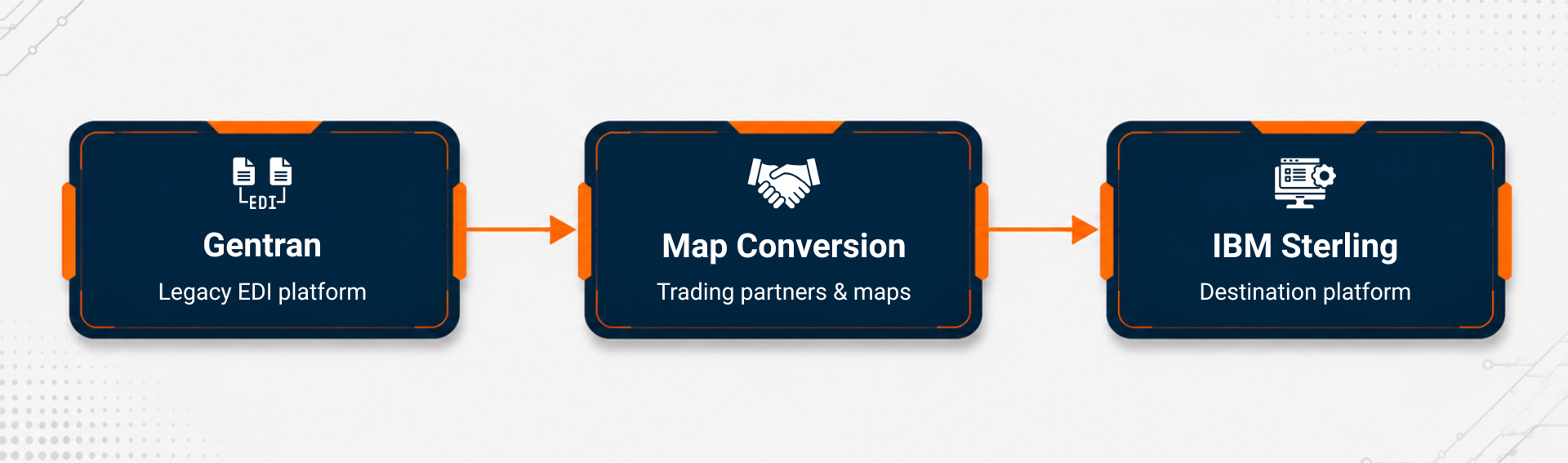
This guide focuses on organizations evaluating a migration from Gentran to IBM Sterling B2B Integrator, including the planning, map conversion, trading partner validation, testing, and cutover considerations involved in the transition.
Organizations should verify current Gentran and Sterling support timelines directly with IBM, since platform lifecycle and support policies get updated periodically, and specific end-of-support dates matter significantly for how urgently a migration should be planned.
The migration principles covered here also apply, with adjustment, to teams considering a different destination platform entirely, though this guide focuses specifically on the Sterling path given how common it is as a landing point for organizations leaving Gentran.
Also Read: What Is EDI? A Plain-English Guide to Electronic Data Interchange for EDI Revenue Protection
Why Legacy Gentran Environments Carry Growing Risk
Gentran's age works against it in several compounding ways:
People and Institutional Knowledge
Gentran expertise tends to concentrate in a small number of long-tenured staff, so losing even one meaningfully raises the risk of a system nobody else can modify safely. That risk compounds over time, too: fewer EDI professionals entering the field today have deep Gentran experience compared to more current platforms, so the available talent pool for supporting a legacy environment keeps shrinking independent of any specific staff departure.
Trading Partner Drift
Trading partner requirements don't stand still while a legacy platform ages in place. Retailers periodically update implementation guides, add required fields, or shift preferred transmission protocols, and a Gentran environment last substantially updated years ago carries meaningfully higher risk of silently falling out of compliance than a platform on active, ongoing maintenance.
Strengthening Infrastructure and Lifecycle Planning
Vendor support and patch availability for older platforms tend to narrow over time, raising security and compliance exposure. Gentran deployments running on aging on-premises hardware add the further exposure of hardware failure, since replacement parts and platform-compatible operating system versions get progressively harder to source the longer the underlying infrastructure stays unchanged.
What to Assess Before a Gentran to IBM Sterling Migration
Migrating from Gentran to IBM Sterling is more than a platform upgrade; it requires a clear understanding of your existing integrations, workflows, dependencies, and business requirements. A thorough pre-migration assessment helps uncover potential risks, define the right migration approach, and ensure a smoother transition with minimal disruption to business operations.
| Assess | Document |
|---|---|
| Trading partners | Active/inactive partners, volume, criticality |
| Maps | Format, complexity, custom rules |
| Standards | X12, EDIFACT, XML, etc. |
| Protocols | AS2, SFTP, FTP, VAN, etc. |
| Partner profiles | IDs, envelopes, certificates |
| Code lists | Cross-references and lookup logic |
| Business processes | Routing and processing logic |
| Infrastructure | Servers, databases, dependencies |
| Security | Certificates, keys, credentials |
| Operations | Monitoring, alerts, support workflows |
Also Read: IBM Sterling, Boomi, or Cleo: A Vendor-Neutral Comparison for 2026
Gentran to IBM Sterling Migration Planning: Maps, Partners, and Business Processes
The core technical challenge in a Gentran to Sterling migration is map conversion: translating Gentran's map format and logic into Sterling's equivalent structure for every active trading partner. Map conversion usually requires deliberate translation rather than a simple mechanical process, since Gentran maps accumulated over years often contain custom logic, workarounds, and trading-partner-specific exceptions that need deliberate reproduction rather than an assumption that they'll translate automatically.
A full trading partner inventory should precede any map conversion work, confirming which connections are genuinely still active, which standards and protocols each one uses, and which documented requirements are current versus outdated. Building this inventory first, rather than migrating an unverified list forward, is what actually resolves accumulated drift instead of carrying it into the new platform.
Map conversion planning should also account for undocumented customizations, workarounds-built years earlier to handle a specific trading partner exception that the conversion process itself often brings to light for the first time. Documenting each discovered workaround and the business reason behind it, rather than simply replicating it silently in the new platform, gives the organization a genuinely better understanding of its own trading partner requirements than existed before the migration started.
Migrating Gentran Trading Partner Data to Sterling
Another crucial component of the migration strategy is the trading partner configuration. To ascertain what has to be moved, what needs to be reconfigured, and what needs to be updated for the Sterling environment, teams should examine active partner profiles, IDs, envelopes, control data, code lists, certificates, and connectivity settings.
Before validation starts, this evaluation offers a chance to match trade partner setups with current requirements. Testing may be made easier and a more controlled transition into Sterling can be supported by keeping a recorded inventory of partner-specific variables.
Also Read: Build vs. Buy an EDI Platform: How to Choose the Right Solution for Your Business
Testing a Gentran to IBM Sterling Migration Before Cutover
Real Transaction Data
Teams should validate every converted map against a meaningful sample of recent production transactions, run through the new Sterling configuration, and compare against known-good Gentran output for the same underlying data. Differences between the two outputs deserve deliberate investigation and resolution, since they represent real configuration differences rather than migration noise.
Phased, Wave-based Migration
This is where the phased approach earns its value, just as it does for any EDI platform change. Starting with lower-risk trading partners lets the migration team catch conversion issues while the consequences of a mistake stay contained, before extending the validated process to higher-volume, higher-risk retail relationships.
An Unplanned Audit Benefit strong
Reconciling Gentran and Sterling output side by side frequently surfaces discrepancies in the original Gentran configuration that had gone unnoticed simply because no clean comparison point existed to check it against before.
Defined Acceptance Criteria
Specific, measurable conditions that must be met for each wave, before a trading partner's old Gentran connection is retired, keep the validation process objective and grounded in evidence rather than a general sense that things seem to be working.
What Sterling Offers Beyond Migration Parity
A Gentran to Sterling migration is an opportunity to gain more than platform continuity. Sterling's more current standard support, broader protocol coverage, and active vendor maintenance address the core risk factors that made the Gentran environment a liability in the first place, and modern monitoring and acknowledgment tooling on Sterling typically gives significantly better visibility into transaction health than what most aging Gentran deployments were ever configured to provide.
Organizations completing this migration get the most value by treating it as a chance to clean up accumulated trading partner and map drift, questioning whether each legacy workaround is still necessary rather than replicating it automatically. Approached this way, a Gentran to Sterling migration becomes as much a modernization and risk-reduction project as a platform swap, and organizations that treat it that way tend to come out the other side with a meaningfully more resilient EDI operation than the one they started with.
For organizations weighing whether now is the right time to move, the clearest answer is usually that acting sooner reduces risk more than waiting, since none of the factors driving that risk, staff turnover, vendor support narrowing, hardware aging, trading partner requirements evolving, tend to reverse on their own.
Also Read: 5 Hidden Risks of Staying on Legacy EDI in 2026
From Legacy Risk to Modern Resilience
Gentran's risk doesn't announce itself with a single failure. It accumulates quietly through staff turnover, narrowing vendor support, aging hardware, and trading partner requirements that keep moving while the platform stays still. None of those factors resolve themselves, which is what makes the timing question less about whether to migrate and more about how much accumulated risk to carry forward before starting.
A structured, vendor-neutral EDI platform evaluation gives organizations a clear view of exactly where Gentran-specific risk concentrates today, and how a Sterling migration plan can retire that risk in a controlled, phased way rather than in response to an unplanned failure.