Choosing the wrong EDI platform can lead to more than just implementation delays it can increase maintenance costs, limit scalability, create integration challenges, and slow business growth for years to come. Because of this, companies assessing their EDI strategy frequently have to choose between developing a proprietary EDI platform and purchasing a commercial EDI solution. Depending on your long-term needs, technical resources, and company objectives, each strategy offers unique benefits and trade-offs.
In this guide, we'll compare both options, examine the key factors that influence the decision, and help you determine which approach best fits your organization.
Also Read: What Is EDI? A Plain-English Guide to Electronic Data Interchange for EDI Revenue Protection
Understanding the Build vs. Buy EDI Platform Approach
Organizations typically have two options when choosing an EDI platform: purchasing a commercial EDI platform from a reputable vendor or developing a custom EDI solution internally. The best option is determined by several variables, including budget, scalability objectives, long-term maintenance expectations, available technical skills, and business requirements.
Utilizing your own development team, a build strategy entails creating an EDI platform internally. This offers total control over user experience, workflows, integrations, and customization. But it also means that platform development, infrastructure, upkeep, security upgrades, compliance, and continuing support fall under the purview of your company.
A buy approach involves implementing a commercial EDI platform that already includes core capabilities such as document translation, communication protocols, monitoring, and trading partner management. Pre-built ERP and business application interfaces, frequent vendor-managed upgrades, technical support, and help with deployment are all common features of these solutions.
| Build | Buy |
|---|---|
| Developed and maintained internally | Commercial EDI platform from a vendor |
| Fully customizable to business requirements | Highly configurable with built-in capabilities |
| Managed by internal IT and development teams | Supported through vendor updates and technical assistance |
| Custom integrations developed in-house | Pre-built connectors for common ERP and business systems |
| Longer implementation and testing timeline | Faster deployment and onboarding |
Build vs. Buy EDI Platforms: Key Decision Factors
It takes more than just comparing features to decide whether to create or purchase an EDI platform; you also need to consider your company's long-term business goals, implementation schedule, total cost of ownership, and available expertise. Maximum flexibility is provided by a custom-built solution, but it requires substantial development and maintenance expenditure. Conversely, a commercial EDI platform is a feasible option for many firms because to its established features, quicker deployment, and ongoing vendor support.
The following comparison highlights the key factors to consider before making your decision.
| Decision Factor | Build an EDI Platform | Buy an EDI Platform |
|---|---|---|
| Initial Cost | Higher upfront investment for development, infrastructure, and implementation. | Lower upfront cost with licensing or subscription-based pricing. |
| Long-term Cost | Ongoing expenses for maintenance, enhancements, security, and internal support. | Predictable recurring costs that often include updates, maintenance, and support. |
| Deployment Time | Longer implementation due to design, development, testing, and integration. | Faster deployment using pre-built capabilities and implementation accelerators. |
| Customization | Complete control over features, workflows, and integrations to meet unique business requirements. | Extensive configuration options, though deep customization may be limited by the platform. |
| Scalability | Scalability depends on internal architecture and continuous investment. | Designed to scale with growing transaction volumes, users, and trading partners. |
| Maintenance | Internal teams are responsible for upgrades, bug fixes, monitoring, and ongoing platform management. | Vendor manages software updates, patches, and platform enhancements, reducing operational effort. |
| Security & Compliance | Security controls and regulatory compliance must be implemented and maintained internally. | Security features, compliance updates, and industry best practices are typically built into the platform and maintained by the vendor. |
| Trading Partner Onboarding | New partner integrations often require custom development and testing. | Pre-built templates, standardized workflows, and implementation support accelerate onboarding. |
| Technical Expertise | Requires experienced developers, integration specialists, and EDI experts for long-term success. | Requires fewer internal technical resources, with vendor guidance available throughout implementation and operations. |
| Vendor Support | No external support unless third-party consultants are engaged. | Access to technical support, product updates, documentation, and implementation expertise from the vendor. |
Also Read: Target's Perfect Order Program: What Changed and What It Means for Suppliers
When Building an EDI Platform Is the Right Choice
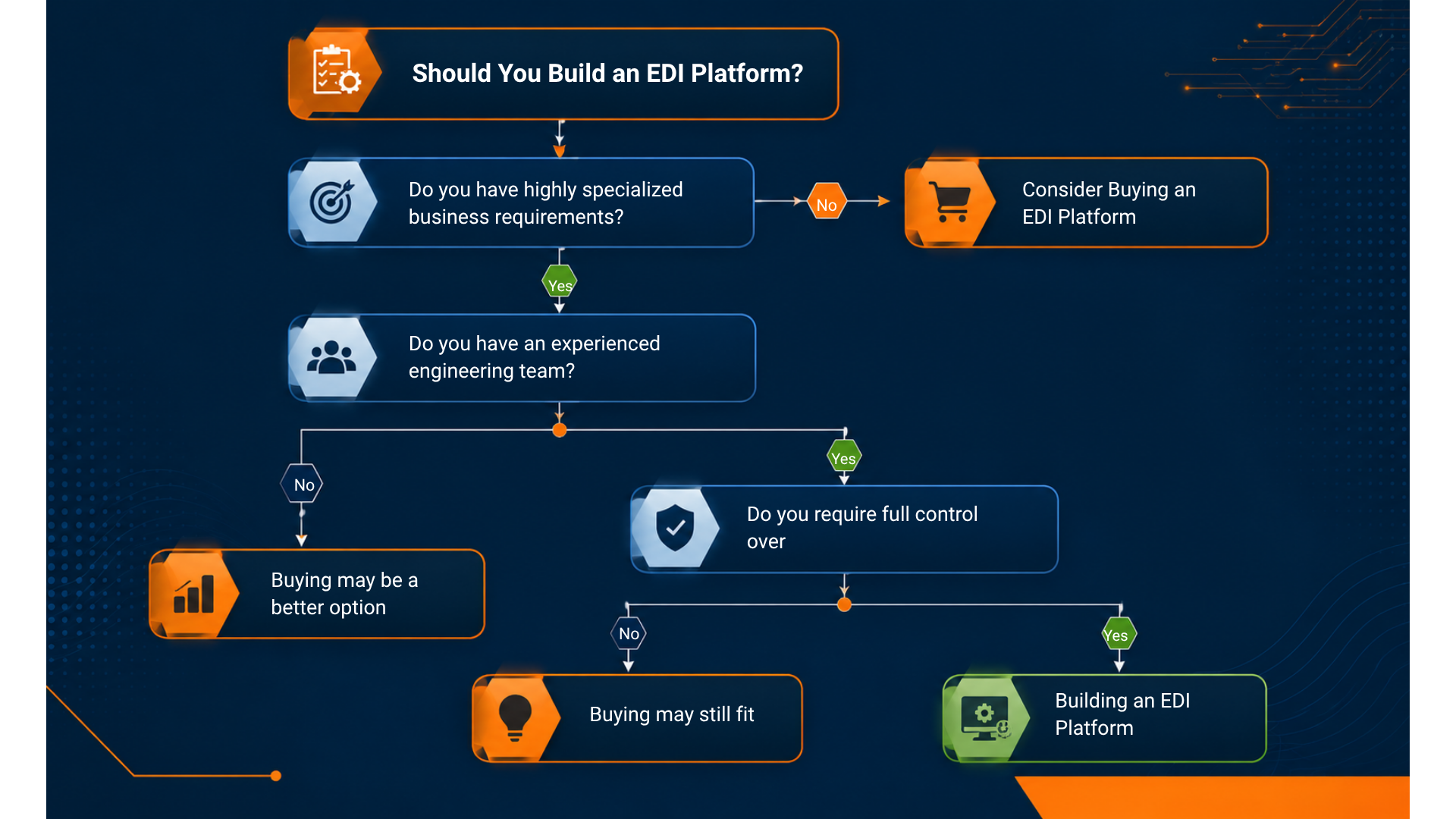
Developing an EDI platform is usually the best option for businesses with extremely specific needs that are not fully met by commercial alternatives. A custom-built platform offers total control over features, integrations, and future improvements, but it necessitates a larger time, financial, and technical investment.
Building an EDI platform may be the best option if your organization:
- Has highly unique business processes that require custom workflows, document handling, or industry-specific integrations.
- Maintains a large internal engineering team with experience in EDI standards, application development, and platform support.
- Has significant investments in existing middleware or proprietary systems that require deep, customized integrations.
- Must meet specialized compliance or regulatory requirements that demand tailored security controls or reporting capabilities.
- Requires full control over platform architecture, allowing complete ownership of technology decisions, deployment models, and product evolution.
Potential Challenges to Consider
Although creating an EDI platform gives you the most freedom, there are long-term obligations involved. The continuous effort needed to maintain and develop the platform should be carefully assessed by organizations.
Common challenges include:
- Continuous maintenance to keep the platform secure, reliable, and compatible with changing business requirements.
- Higher total cost of ownership, including development, infrastructure, testing, and ongoing support.
- Version upgrades and technology refreshes, which must be planned and executed internally.
Dependency on skilled internal resources, making long-term success closely tied to the availability of experienced developers and EDI specialists.
When Buying an EDI Platform Is the Right Choice
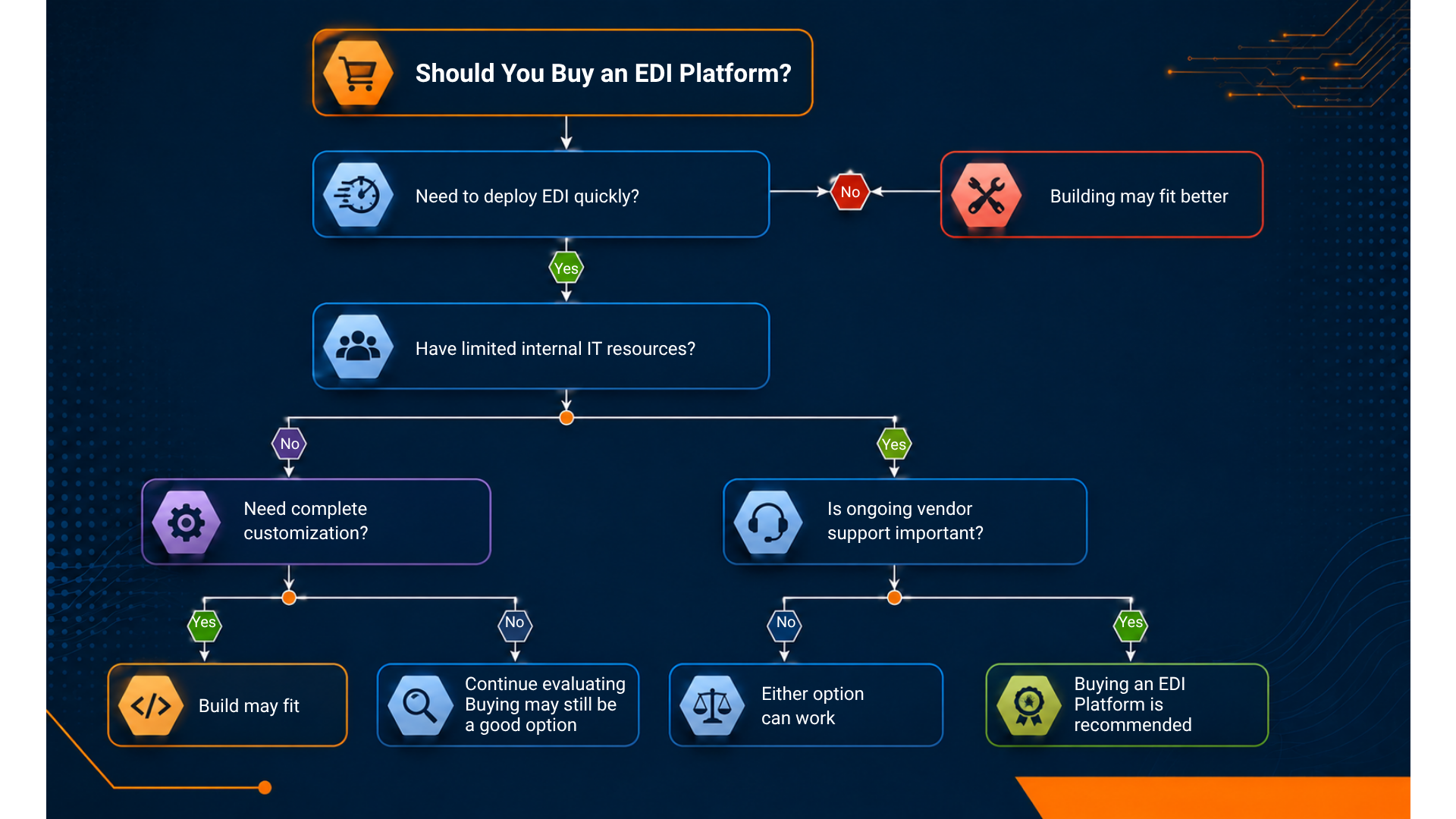
For businesses wishing to deploy EDI swiftly, simplify operations, and take advantage of tested capabilities without spending money on bespoke development, purchasing a commercial EDI platform is frequently the best option. With pre-configured integrations, built-in functionality, and continuous vendor support, modern EDI solutions free up organizations to concentrate on their core competencies rather than platform management.
Buying an EDI platform is typically the right option if your organization:
- Needs rapid implementation to meet business deadlines or accelerate digital transformation initiatives.
- Has a growing trading partner network that requires faster onboarding and standardized integrations.
- Has limited internal IT or EDI resources and prefers a solution that minimizes development and maintenance efforts.
- Is planning a cloud migration and needs a scalable, cloud-ready EDI platform with modern integration capabilities.
- Wants a faster return on investment (ROI) by reducing implementation time and avoiding extensive in-house development.
- Values ongoing vendor support for implementation, troubleshooting, platform optimization, and technical guidance.
Additional Benefits of Buying an EDI Platform
Beyond faster deployment, commercial EDI platforms offer several long-term advantages:
- Regular software updates that introduce new features, performance improvements, and security enhancements.
- Built-in compliance support to help meet evolving trading partner requirements and industry regulations.
Reduced operational overhead by shifting platform maintenance, upgrades, and monitoring responsibilities to the vendor.
Also Read: EDI Health Assessment: What It Uncovers and What It Doesn't
EDI Platform Build vs. Buy Decision Matrix
When selecting an EDI platform, there is no one-size-fits-all method. The technological skills, business priorities, implementation schedule, and long-term growth strategy of your company all influence the best choice. To quickly evaluate which strategy is most likely to meet your needs, use the matrix below.
| Business Requirements | Consideration |
|---|---|
| Maximum customization and complete control over the platform | Build |
| Fast implementation and quicker time to value | Buy |
| Limited internal IT or EDI resources | Buy |
| A large, experienced development and integration team | Build |
| Rapid scalability to support business growth | Buy |
| Complex proprietary workflows and highly specialized integrations | Build |
| Lower maintenance and operational overhead | Buy |
Moving Ahead
When deciding between developing and purchasing an EDI platform, it's important to choose the strategy that best suits the requirements of your company rather than trying to discover a universally superior solution. The best choice is influenced by various factors, including company objectives, integration complexity, internal EDI knowledge, compliance needs, growth plans, and long-term maintenance obligations. Buying can speed up deployment and save operating costs, while creating offers more control and customization. Organizations can invest in an EDI platform that facilitates dependable B2B communication, adjusts to future development, and provides long-term business value by assessing both the initial implementation effort and the total cost of ownership.
Also Read: The Hidden Cost of EDI Chargebacks Explained