Electronic Data Interchange sits underneath nearly every transaction that moves goods from a supplier to a retailer's shelf, yet many business teams benefit from a clear explanation of how it works in practice in plain terms. If you have ever seen a document with a name like an 850 or an 856 land in a queue and disappear into systems that operate quietly behind everyday business processes, you have already met EDI.
This guide starts from zero and builds a working understanding of what EDI is, how it moves documents between companies, and why getting it wrong costs real money. You will also learn how accurate document exchange supports EDI revenue protection, reduces EDI compliance risk, and strengthens relationships with trading partners.
A Brief History of EDI
EDI has existed in some form since the 1960s, originally built to move shipping manifests and transportation documents between railroads and freight carriers. It has since become the connective tissue of modern retail, manufacturing, healthcare, and logistics, precisely because it solved a problem that predates computers themselves: how do two independent organizations exchange business documents fast enough, and accurately enough, to keep goods moving at commercial scale.
Although the early systems were restricted and proprietary, they soon created a demand for universal languages. Important turning points in its development include:
| Time Period | Milestone | Impact on EDI |
|---|---|---|
| 1968 | The Transportation Data Coordinating Committee (TDCC) was founded to develop the first standard formats for the transportation industry. | Established the first standardized formats for electronic data exchange in transportation. |
| 1979 | The American National Standards Institute (ANSI) chartered ASC X12. | Introduced a uniform standard for inter-industry business transactions, extending and replacing the TDCC frameworks. |
| 1980s | Major retailers and manufacturers such as Walmart, Sears, and General Motors mandated EDI for their suppliers. | Accelerated EDI adoption and made it an essential requirement for conducting business globally. |
| 1988 | The United Nations chartered UN/EDIFACT. | Created a globally recognized standard structure for international electronic information exchange. |
| 2000s to Present | Businesses transitioned from dial-up Value-Added Networks (VANs) to secure internet protocols such as AS2. Modern cloud EDI solutions also integrate directly with ERP and CRM systems through APIs. | Improved security, scalability, and seamless integration with enterprise business applications. |
What Is EDI? Understanding Electronic Data Interchange for EDI Revenue Protection
Electronic Data Interchange is the computer-to-computer exchange of standard business documents between two trading partners in a structured format that both systems can read automatically without manual data entry. A purchase order, an invoice, and a shipping notice each have a defined structure. EDI lets a retailer system generate one of these documents and hand it directly to a supplier system in a format that system already knows how to parse. This standardized approach supports EDI implementation, improves document accuracy, and strengthens EDI revenue protection by reducing manual processing errors across trading partner networks.
The key word is structured. An email with an attached spreadsheet is not EDI, even if it contains the same information, because a spreadsheet has no guaranteed structure a computer can read reliably every time. EDI documents follow a published standard, so the same document type follows the same structure no matter which supplier sends it or which retailer receives it. Standardized document structures also reduce EDI compliance risk by helping organizations exchange accurate information across multiple trading partners.
Each EDI document type has a name, and under the ANSI X12 standard used across North America, a three-digit number- an 850 is a purchase order; an 856 is an advance ship notice; an 810 is an invoice. These numbers function as a shared vocabulary between trading partners. When a retailer tells a supplier to send an 856 within a certain window after shipment, both sides know precisely what document and what data; that requirement refers to.
Also Read: 5 Hidden Risks of Staying on Legacy EDI in 2026
How EDI Works: Exchange Mechanics, EDI Platform Support, and Document Mapping
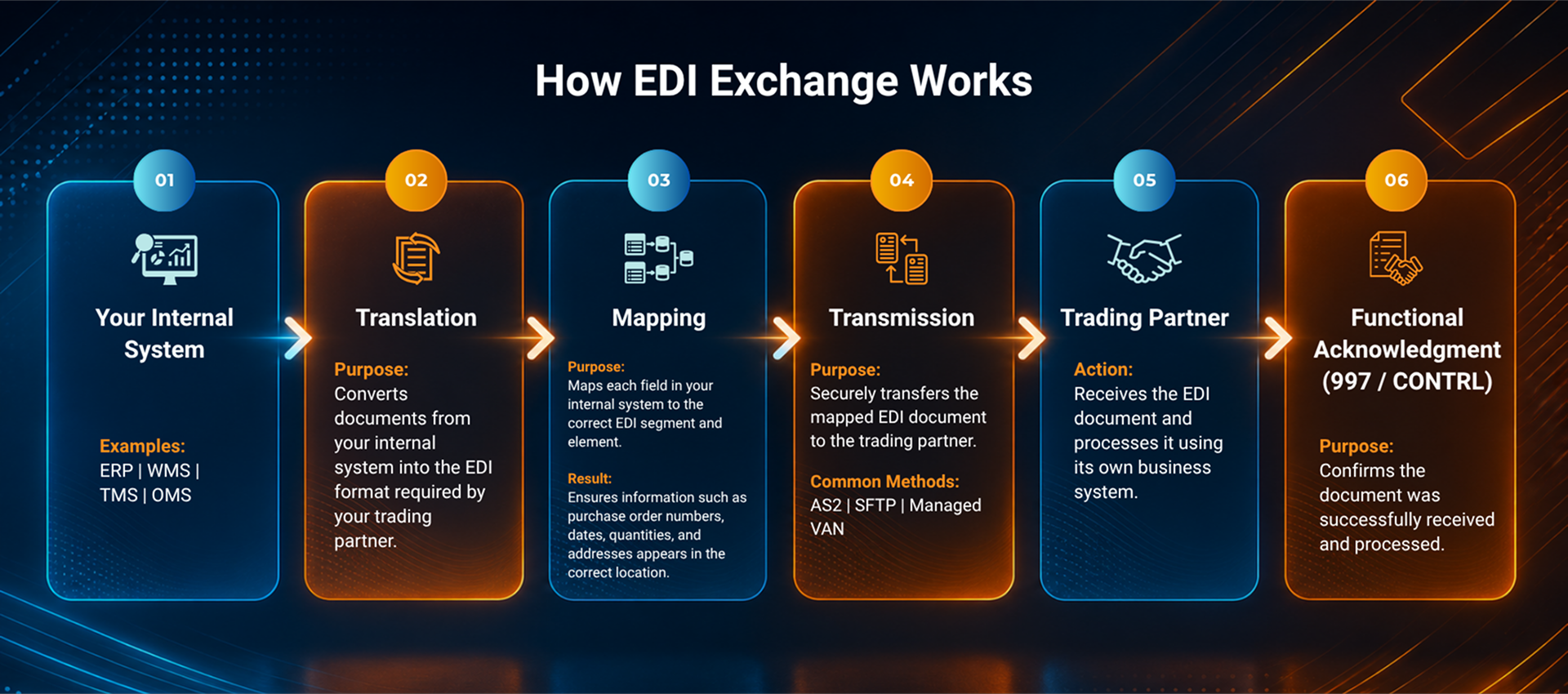
Every EDI exchange has three moving parts: translation, mapping, and transmission. These capabilities are typically provided through modern EDI platform support, allowing organizations to automate document exchanges at scale.
1. Translation
Business records from an organization's internal application design are translated by the EDI translation engine into the EDI standard needed by a trade partner. The translator converts conventional EDI data back into a structure that ERP, WMS, TMS, or other business applications can comprehend upon receiving incoming documents. This facilitates smooth communication between systems that use various data formats.
2. Mapping
Mapping establishes the correspondence between segments and items in an EDI document and data fields in one system. For instance, in an ANSI X12 or EDIFACT transaction, an internal purchase order number needs to be translated to the appropriate field. Every piece of data appears in the right place thanks to accurate mapping, which enables trading partners to handle documents error-free.
3. Transmission
Once translated and mapped, the EDI document is securely transmitted to the trading partner using communication protocols such as AS2, SFTP, OFTP, FTP/S, or a managed value-added network (VAN). These protocols protect data integrity while ensuring reliable delivery between organizations.
4. Functional Acknowledgment
The EDI system creates a Functional Acknowledgment and verifies the document structure after the trading partner gets it. EDIFACT utilizes the CONTRL message, although ANSI X12 implementations usually use the 997 Functional Acknowledgment. These acknowledgments give insight into possible processing problems before they have an impact on business operations by confirming that documents were successfully received and whether or not it passed preliminary validation checks.
Why EDI Matters: Efficiency, Accuracy, and Retailer Compliance Requirements
Manual order processing requires someone to re-enter purchase order information, increasing the chance of incorrect quantities, SKUs, or delivery timelines. EDI removes that retyping step entirely, which is why the efficiency argument for EDI has been settled for decades. Documents move automatically between systems, allowing organizations to exchange information much faster than manual processes while preserving data accuracy and supporting EDI revenue protection.
The accuracy gain matters just as much as the speed gain. A single mistyped digit on a manually entered purchase order can trigger a fill rate miss, a wrong shipment, or a rejected invoice, any of which can turn into a chargeback. Large retailers typically require suppliers to support EDI as part of their trading partner requirements. Walmart, Target, Amazon, and most major retail and distribution partners require EDI as a condition of doing business, with specific document sets, transmission methods, and compliance timelines written into their supplier agreements. According to Research and Markets, the global Electronic Data Interchange market is projected to reach approximately USD 38.75 billion in 2026 as organizations continue expanding digital supply chain automation.
Speed and accuracy also compound over volume. A supplier processing a handful of orders a week can absorb the occasional manual error without much financial consequence. A supplier processing thousands of transactions a month across multiple retail partners cannot, because even a small error rate translates into a meaningful number of failed or disputed transactions every cycle, each one carrying its own administrative cost to research and resolve, increasing EDI exposure and reducing EDI revenue protection.
Also Read: Unleashing Business Potential- The Power of Adaptive Enterprise Architecture
Common Misconceptions: More Than an IT Footnote
- EDI is only an IT responsibility.
EDI supports far more than system integrations. It directly affects finance, operations, supply chain performance, and EDI revenue protection. A malformed Advance Ship Notice (ASN) can trigger retailer deductions before operations even realizes a document failed.
- EDI errors are always obvious.
Many EDI issues remain invisible for weeks or months. An outdated trading partner profile or incorrect EDI mapping can continue generating compliance penalties until finance identifies a recurring pattern.
- Once EDI is implemented, it takes care of itself.
Trading partner requirements evolve, retailer specifications change, and EDI platforms age. Without regular EDI configuration reviews, configurations gradually drift out of alignment, increasing the risk of rejected transactions and chargebacks.
- Successful document transmission means everything is working.
A document can be transmitted successfully and still contain incorrect or outdated data that violates a trading partner's requirements. Successful delivery does not guarantee compliance.
- EDI problems only affect technical teams.
EDI failures often lead to delayed shipments, payment delays, retailer deductions, customer service issues, and lost revenue. Their impact extends across the entire business, not just IT.
Next Step: Evaluate Your EDI Health Assessment
Understanding what EDI is matters less than understanding whether your own EDI environment is performing the way it should be. As trading partner requirements evolve, organizations benefit from reviewing EDI platform configurations, EDI maps, and trading partner setups regularly. Periodic EDI health assessments help maintain reliable performance, support ongoing EDI compliance, and strengthen EDI revenue protection.
Most EDI environments do not require a complete replacement to deliver better results. Targeted improvements often address the underlying issues that lead to deductions, failed transactions, and operational inefficiencies. Before investing in a new platform or migration, organizations benefit from understanding the current state of their EDI environment. That visibility helps prioritize the right improvements and avoid unnecessary spending.
Also Read: EDI Transaction Sets Explained: What 850, 856, and 810 Actually Do