
A single purchase order can trigger multiple business documents before a transaction is complete, from confirming an order and notifying a shipment to sending an invoice for payment. Delays, mistakes, and expensive manual labor are unavoidable when these documents are not standardized. EDI transaction sets are useful in this situation. The majority of procure-to-pay and order-to-cash workflows are driven by EDI 850 (Purchase Order), EDI 856 (Advance Ship Notice), and EDI 810 (Invoice), even though ANSI X12 contains hundreds of transaction types.
In this guide, we'll break down what each transaction set does, how they work together, and why they're essential for efficient B2B operations.
Also Read: EDI Standards Explained: ANSI X12, EDIFACT, and What Actually Differs
What Are EDI Transaction Sets?
Standardized electronic documents that depict particular business transactions between trading partners are called EDI transaction sets. Businesses employ these structured documents to automate information sharing between ERP systems, suppliers, customers, logistics providers, and financial institutions rather than exchanging paper forms, emails, or PDFs. Every transaction set complies with the ANSI X12 standard, guaranteeing that all trading partners regardless of the software they employ to interpret the document uniformly.
| Transaction Set | Business Document | Primary Purpose |
|---|---|---|
| 850 | Purchase Order | Places an order with a supplier |
| 855 | Purchase Order Acknowledgment | Confirms acceptance or changes to an order |
| 856 | Advance Ship Notice (ASN) | Notifies the buyer that goods have been shipped |
| 810 | Invoice | Requests payment for delivered goods or services |
| 820 | Payment Order/Remittance Advice | Communicates payment details |
| 997 | Functional Acknowledgment | Confirms successful receipt of an EDI document |
Each set of EDI transactions serves as a distinct function. When combined, they produce a standardized process that facilitates correct information interchange, operational automation, and business-to-business communication.
How EDI Transaction Sets Support the Order-to-Cash Process
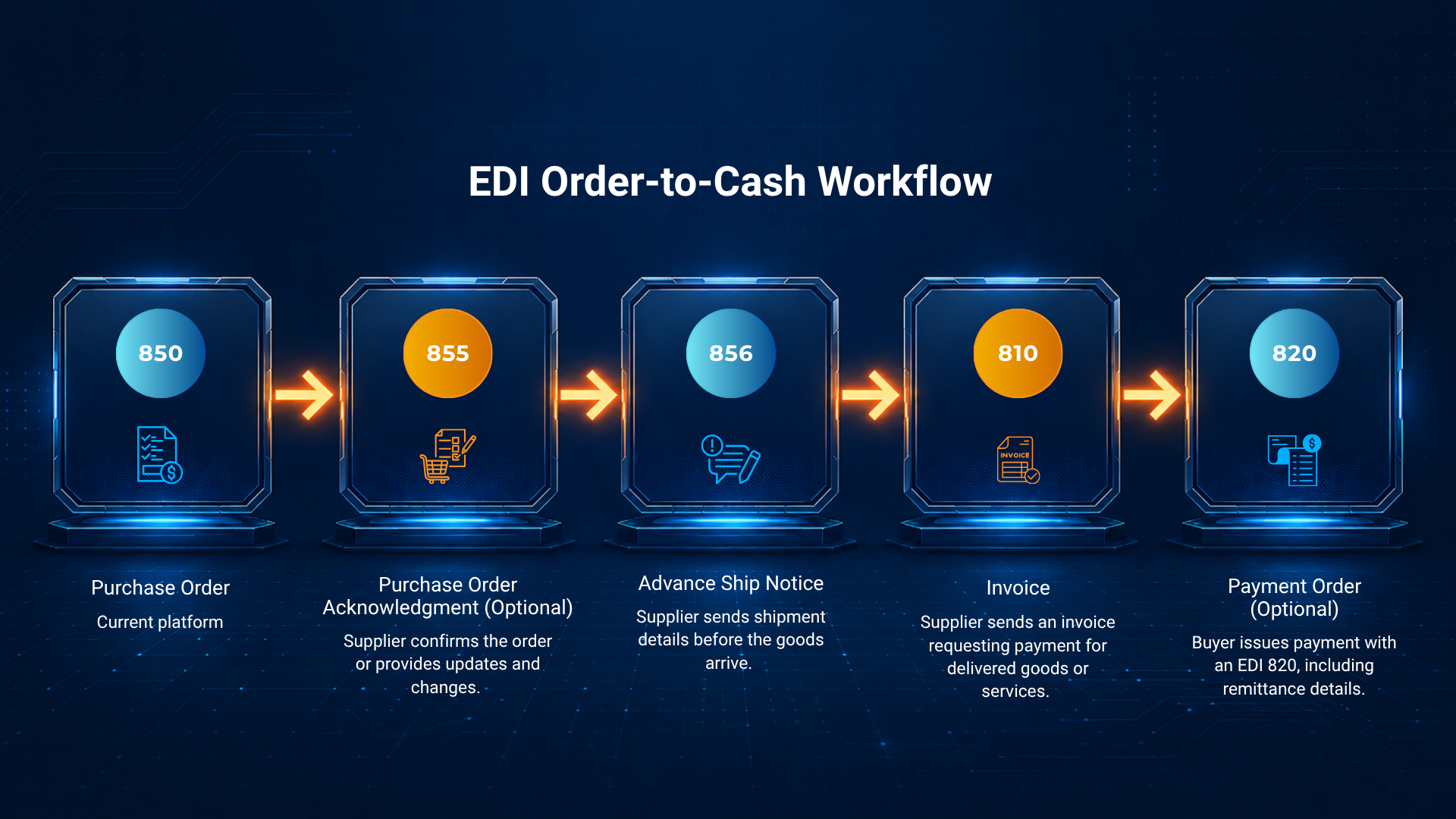
Several standardized transaction types make up the EDI order-to-cash process, which automates the information flow from order placement to payment. Each document in the EDI pipeline has a specific purpose and initiates the subsequent stage of the business process, as opposed to depending on emails, paper documents, or human data entry. This methodical strategy minimizes delays and errors by facilitating the real-time interchange of precise information between customers, suppliers, logistics companies, and financial systems.
An EDI 850 Purchase Order, in which the buyer makes an order with the supplier, usually starts the process. To confirm or amend the order, the supplier may reply with an EDI 855 Purchase Order Acknowledgment. An EDI 856 Advance Ship Notice (ASN) gives shipment details prior to delivery once the products are prepared for transport. The supplier sends an EDI 810 invoice asking for payment after the order is completed. To finalize the EDI order process and provide payment details, an EDI 820 Payment Order/Remittance Advice may be transmitted.
Also Read: AS2 vs. SFTP vs. VAN: Which EDI Communication Protocol Is Right for Your Business?
EDI 850 Purchase Order: What It Is and How It Works
One of the most popular ANSI X12 transaction sets is the EDI 850 Purchase Order. In order to digitally make an order for products or services, a buyer sends it to a provider. Organizations use the EDI 850 to send standardized order information directly between corporate systems, eliminating manual data entry and processing mistakes, rather than sending buy orders via emails, PDFs, or paper documents.
All the information a supplier needs to complete an order is included in the transaction set, including buyer and supplier details, product identifiers, quantities, pricing, preferred delivery dates, shipping instructions, and terms of payment. Regardless of the ERP or business application used, trading partners can streamline order processing because all EDI 850s adhere to a consistent ANSI X12 format.
An EDI 850 contains the essential business information required to process an order accurately.
| Contains | Examples |
|---|---|
| Buyer Information | ABC Ltd. |
| Supplier Information | XYZ Inc. |
| Purchase Order Number | PO-458921 |
| Items Ordered | SKU, Product Description, Quantity |
| Pricing | Unit Price, Discounts |
| Delivery Information | Ship Date, Delivery Location |
| Payment Terms | Net 30, Payment Method |
| Shipping Instructions | Carrier, Freight Terms |
Industries That Commonly Use EDI 850 and Their Business Benefits
Because it gives purchasers a uniform method of communicating their purchasing requirements to suppliers, the EDI 850 Purchase Order is a fundamental transaction across supply chains. Organizations use EDI 850 to automate procurement, increase order accuracy, and expedite supplier engagement in a variety of industries, including manufacturing, retail, healthcare, and logistics. The industries that frequently employ EDI 850 are shown in the table below, along with the main advantages it offers for each industry.
| Industry | Common EDI 850 Use Case | Key Business Benefits |
|---|---|---|
| Retail & eCommerce | Inventory replenishment and supplier purchase orders | Automates order creation, reduces stock shortages, and improves inventory accuracy. |
| Manufacturing | Procuring raw materials, components, and production supplies | Speeds procurement, reduces manual errors, and integrates with ERP systems for efficient production planning. |
| Distribution & Wholesale | Purchasing products from suppliers for resale | Standardizes supplier communication, improves purchase order accuracy, and accelerates order fulfillment. |
| Healthcare | Ordering medical supplies, pharmaceuticals, and equipment | Improves procurement accuracy, supports compliance, and reduces delays in supply replenishment. |
| Automotive | Ordering vehicle components and replacement parts | Enables high-volume, standardized purchasing while improving visibility across the supply chain. |
| Food & Beverage | Managing recurring supplier orders for ingredients and packaged goods | Accelerates purchasing cycles, minimizes manual processing, and helps maintain consistent inventory levels. |
| Logistics & Supply Chain | Coordinating procurement across suppliers and distribution networks | Improves trading partner collaboration, automates purchase order processing, and creates a faster procure-to-pay workflow. |
EDI 856 Advance Ship Notice (ASN): What It Is and How It Works
An ANSI X12 transaction set called the EDI 856 Advance Ship Notice (ASN) alerts a customer that a shipment is en-route. The EDI 856, which is sent prior to the items' arrival, gives buyers comprehensive shipping information to assist them get ready for receiving, unloading, and inventory processing.
The EDI 856 conveys precisely what has been shipped, in contrast to a purchase order, which makes a request for items. It contains information such item quantities, serial numbers, carrier details, tracking numbers, carton and pallet configuration, and anticipated delivery dates. Warehouses and distribution centers can schedule receiving operations prior to the shipment arriving at the pier thanks to this standardized electronic document.
The EDI 856 provides detailed shipment information that enables buyers to accurately prepare for incoming deliveries.
| Contains | Examples |
|---|---|
| Shipment Number | ASN-458921 |
| Purchase Order Reference | PO-458921 |
| Carrier Information | FedEx, UPS, DHL, LTL Carrier |
| Tracking Number | 1Z999AA10123456784 |
| Ship Date | July 28, 2026 |
| Expected Delivery Date | July 30, 2026 |
| Carton Information | Carton IDs, Number of Boxes |
| Pallet Information | Pallet IDs, SSCC Labels |
| Products Shipped | SKU, Quantity, Lot Number |
| Shipping Location | Warehouse Address |
Industries That Commonly Use EDI 856 and Their Business Benefits
In businesses where shipment visibility, inventory accuracy, and effective receiving procedures are crucial, the EDI 856 Advance Ship Notice (ASN) is frequently utilized. The EDI 856 assists companies in streamlining warehouse operations, cutting down on receiving delays, and enhancing supply chain coordination by offering comprehensive shipment information prior to items arriving.
| Industry | How EDI 856 Is Used | Business Benefits |
|---|---|---|
| Retail & eCommerce | Notifies retailers of incoming inventory and store replenishment shipments. | Faster receiving, improved inventory accuracy, reduced stockouts. |
| Manufacturing | Shares shipment details for raw materials and production components. | Better production planning, fewer material shortages, reduced downtime. |
| Wholesale & Distribution | Provides advance visibility into supplier deliveries across distribution centers. | Faster order fulfillment, optimized warehouse operations, improved inventory management. |
| Healthcare | Communicates shipments of medical devices, pharmaceuticals, and healthcare supplies. | Improved inventory control, quicker receiving, enhanced supply availability. |
| Automotive | Supports just-in-time (JIT) delivery of vehicle parts and assemblies. | Reduced production delays, accurate parts tracking, efficient inventory replenishment. |
| Food & Beverage | Sends shipment details for perishable goods and packaged products. | Faster receiving, better inventory rotation, improved product traceability. |
| Logistics & Transportation | Shares shipment information between carriers, warehouses, and customers. | Enhanced shipment visibility, better delivery coordination, improved customer service. |
Also Read: EDI vs. API vs. JSON: Key Differences and When to Use Each
EDI 810 Invoice: What It Is and How It Works
Suppliers can seek payment for goods or services given to a buyer using the EDI 810 Invoice, an ANSI X12 transaction set. It functions as the electronic counterpart of a paper invoice, enabling companies to transfer billing data between their accounting and ERP systems without the need for human intervention.
Invoice numbers, purchase order references, product specifications, pricing, taxes, shipping charges, conditions of payment, and total amounts payable are all included in the EDI 810. Buyers can automatically validate and process invoices since they adhere to the established ANSI X12 format, which minimizes manual data entry, billing errors, and payment delays.
The EDI 810 contains all the billing information required to verify and process an invoice accurately.
| Invoice Data | Examples |
|---|---|
| Invoice Number | INV-458921 |
| Purchase Order Number | PO-458921 |
| Supplier Information | XYZ Inc. |
| Buyer Information | ABC Ltd. |
| Item Details | SKU, Description, Quantity |
| Unit Price | $125.00 |
| Taxes | Sales Tax, VAT (where applicable) |
| Freight Charges | Shipping Costs |
| Payment Terms | Net 30, Net 45 |
| Total Invoice Amount | $12,580.00 |
Industries That Commonly Use EDI 810 and Their Business Benefits
Many industries that handle a lot of invoices and need precise, automated billing between suppliers and buyers use the EDI 810 Invoice. The EDI 810 expedites payment cycles, increases invoice accuracy, and simplifies accounts payable procedures by doing away with human data entry and paper invoices.
| Industry | How EDI 810 Is Used | Business Benefits |
|---|---|---|
| Retail & eCommerce | Exchanges invoices for inventory purchases and supplier shipments. | Faster invoice processing, improved payment accuracy, reduced manual effort. |
| Manufacturing | Processes invoices for raw materials, components, and production supplies. | Automated invoice matching, fewer billing disputes, better cost control. |
| Wholesale & Distribution | Manages invoicing between suppliers, distributors, and retailers. | Quicker payment approvals, streamlined accounts payable, improved cash flow visibility. |
| Healthcare | Exchanges invoices for pharmaceuticals, medical devices, and healthcare supplies. | Accurate billing, faster reimbursement processes, improved financial compliance. |
| Automotive | Supports invoicing for vehicle parts, assemblies, and manufacturing components. | Efficient supplier payments, automated reconciliation, stronger supplier relationships. |
| Food & Beverage | Processes invoices for food products, beverages, and distribution orders. | Reduced invoice errors, improved payment efficiency, enhanced financial tracking. |
| Logistics & Transportation | Handles freight invoices, transportation charges, and shipping services. | Faster freight payment processing, better cost management, simplified invoice reconciliation. |
EDI 850 vs. EDI 856 vs. EDI 810: Key Differences Explained
Despite their close relationship, the EDI 850, EDI 856, and EDI 810 each have a specific function in the procure-to-pay and order-to-cash lifecycle. After the order is shipped, the EDI 856 sends advance shipment details, the EDI 810 finishes the transaction by asking payment, and the EDI 850 starts the purchase process. When combined, these transaction sets produce an automated, end-to-end workflow that enhances supply chain efficiency, accuracy, and visibility.
| Feature | EDI 850 | EDI 856 | EDI 810 |
|---|---|---|---|
| Transaction Name | Purchase Order | Advance Ship Notice (ASN) | Invoice |
| Purpose | Places an order for goods or services | Notifies the buyer that goods have been shipped | Requests payment for delivered goods or services |
| Sent By | Buyer | Supplier | Supplier |
| Sent To | Supplier | Buyer | Buyer |
| When Sent | Before order fulfillment begins | After shipment leaves the supplier and before delivery | After goods are shipped or delivered |
| Primary Information | Products ordered, quantities, pricing, delivery requirements | Shipment details, cartons, pallets, tracking numbers, carrier information | Invoice number, PO reference, item pricing, taxes, payment terms |
| Business Function | Procurement | Shipment visibility | Billing and payment |
| Supports Automation | Order creation and procurement | Warehouse receiving and inventory planning | Accounts payable and invoice processing |
| Common Follow-Up Transaction | EDI 855 Purchase Order Acknowledgment | Goods Receipt or Inventory Update | EDI 820 Payment/Remittance Advice |
Other Common EDI Transaction Sets You Should Know
- EDI 820 - Payment Order/Remittance Advice: Transmits payment information, such as payment amounts, remittance details, and the invoices being paid, from the buyer to the supplier. It facilitates the automation of payment reconciliation and accounts receivable.
- EDI 846 - Inventory Inquiry/Advice: Enables improved inventory planning and quicker purchase decisions by sharing product status, stock levels, and inventory availability with trading partners.
- EDI 855 - Purchase Order Acknowledgment: Confirms receipt of an EDI 850 Purchase Order and indicates whether the supplier accepts, rejects, or modifies the order before fulfillment begins.
- EDI 860 - Purchase Order Change Request: Allows buyers to modify an existing purchase order by updating quantities, pricing, delivery dates, shipping instructions, or other order details.
- EDI 940 - Warehouse Shipping Order: Instructs a warehouse or third-party logistics (3PL) provider to pick, pack, and ship products to the designated customer or delivery location.
- EDI 945 - Warehouse Shipping Advice: Confirms that a warehouse has completed the shipment and provides shipment details, allowing inventory and order management systems to stay up to date.
- EDI 997 - Functional Acknowledgment: Verifies that an EDI transaction has been successfully received and passed basic syntax validation.
Moving Ahead
Building effective, automated, and dependable B2B operations requires an understanding of the functions of each EDI transaction set. The purchase process is started by the EDI 850, shipment visibility is enhanced by the EDI 856, and invoicing and payment processes are streamlined by the EDI 810. When used with complementary transaction sets like the EDI 855, EDI 820, and EDI 997, they help companies automate crucial business procedures, enhance data precision, and increase supply chain cooperation. The implementation and management of these transaction sets may get more complicated as your network of trading partners expands. Collaborating with seasoned EDI experts can facilitate onboarding, guarantee adherence to trading partner specifications, and create a scalable integration plan that promotes sustained business expansion.