The wrong EDI communication protocol can quietly become your biggest integration bottleneck. Selecting between AS2, SFTP, and VAN has a direct impact on security, expense, scalability, and operational efficiency, whether you're upgrading a legacy platform, modifying your EDI environment, or onboarding new trading partners. Every protocol has a distinct function, and the best option is determined by your company's needs rather than by market trends.
This guide compares AS2, SFTP, and VAN to help you understand their strengths, limitations, and the scenarios where each delivers the greatest value.
AS2: The Secure EDI Communication Protocol
Applicability Statement 2, better known as AS2, is a point-to-point protocol that transmits EDI documents directly between trading partners over the internet. Using digital certificates for encryption, authentication, and Message Disposition Notifications (MDNs), it provides verified, reliable document delivery without relying on a third-party network.
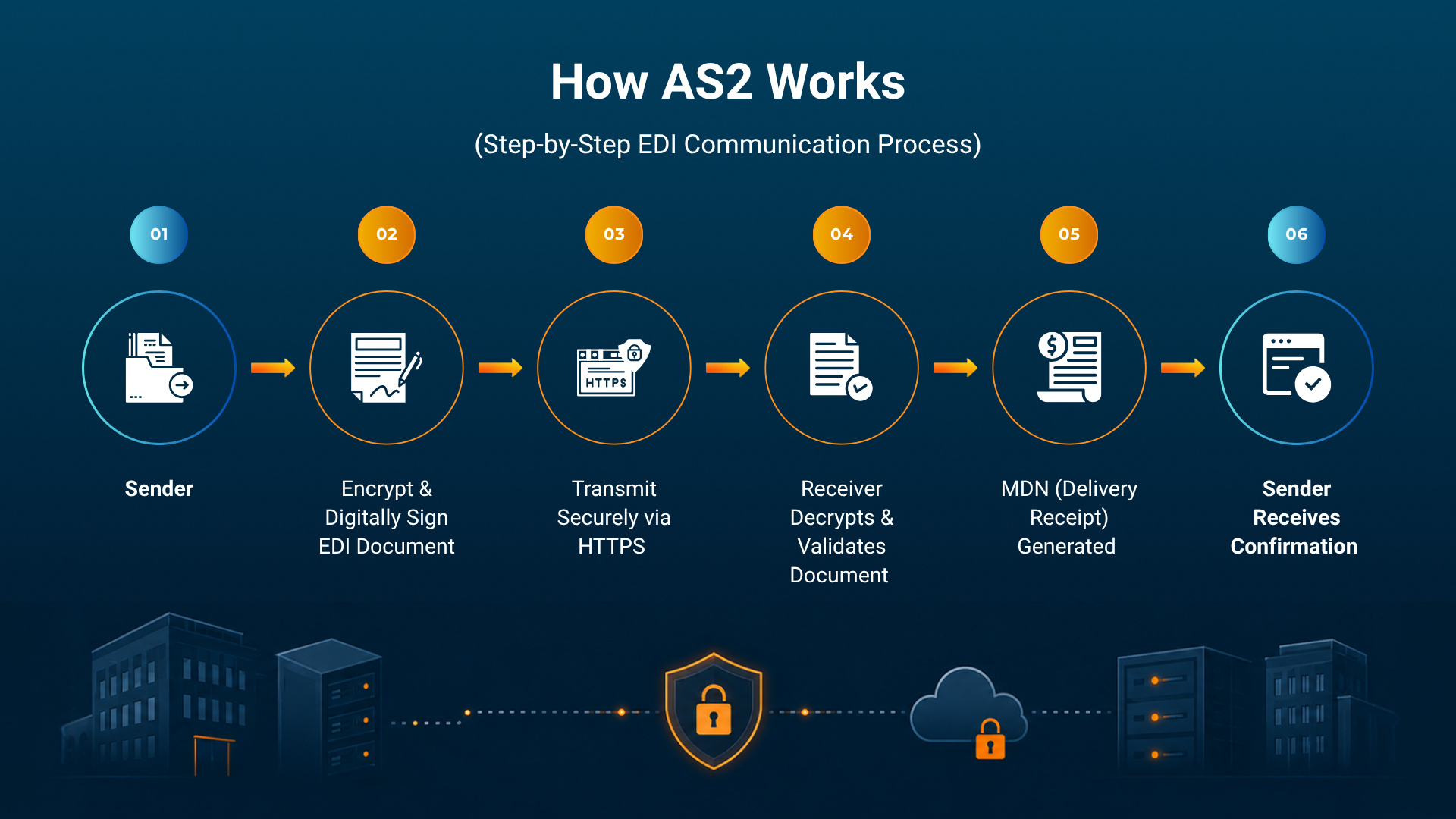
How AS2 Works: Step-by-Step EDI Communication Process
Step 1: Encrypt and Sign the Document
Using the sender's public certificate, the sender encodes the EDI document and adds a digital signature. This confirms the sender's identity and safeguards private data while it is being transmitted.
Step 2: Secure Transmission
Through an HTTPS connection, an encrypted document is sent straight to the trading partner. The document uses a direct, point-to-point communication route in contrast to a VAN.
Step 3: Validate the Document
The recipient decrypts the file and confirms the digital signature after getting it. This verifies that the document came from a reliable sender and hasn't been altered.
Step 4: Generate an MDN
The receiving server immediately transmits a Message Disposition Notification (MDN) after validation is successful. This electronic receipt serves as an unbiased record of the payment and verifies successful delivery.
Why Organizations Choose AS2 for Secure EDI Communication
Businesses choose AS2 because it combines secure EDI document exchange with verified delivery confirmation. Digital certificates encrypt and authenticate every transmission, while Message Disposition Notifications (MDNs) provide proof that EDI documents were delivered successfully and without modification. This helps improve EDI compliance and supports reliable EDI implementation.
AS2 is widely used by manufacturers, healthcare providers, logistics companies, and major retailers such as Walmart to exchange purchase orders, invoices, Advance Ship Notices (ASNs), and other critical EDI documents. Defined by the IETF and backed by more than two decades of interoperability testing, AS2 remains one of the most trusted protocols for secure, high-volume B2B communication and dependable EDI platform support.
Also Read: What Is EDI? A Plain-English Guide to Electronic Data Interchange for EDI Revenue Protection
SFTP: A Secure File Transfer Protocol for EDI
Secure File Transfer Protocol (SFTP) enables secure EDI document exchange by transferring files over an encrypted connection without the digital certificate and Message Disposition Notification (MDN) framework required by AS2. Because SFTP is easier to deploy and maintain, it is a popular choice for organizations with fewer trading partners, lower transaction volumes, or straightforward EDI implementation requirements.
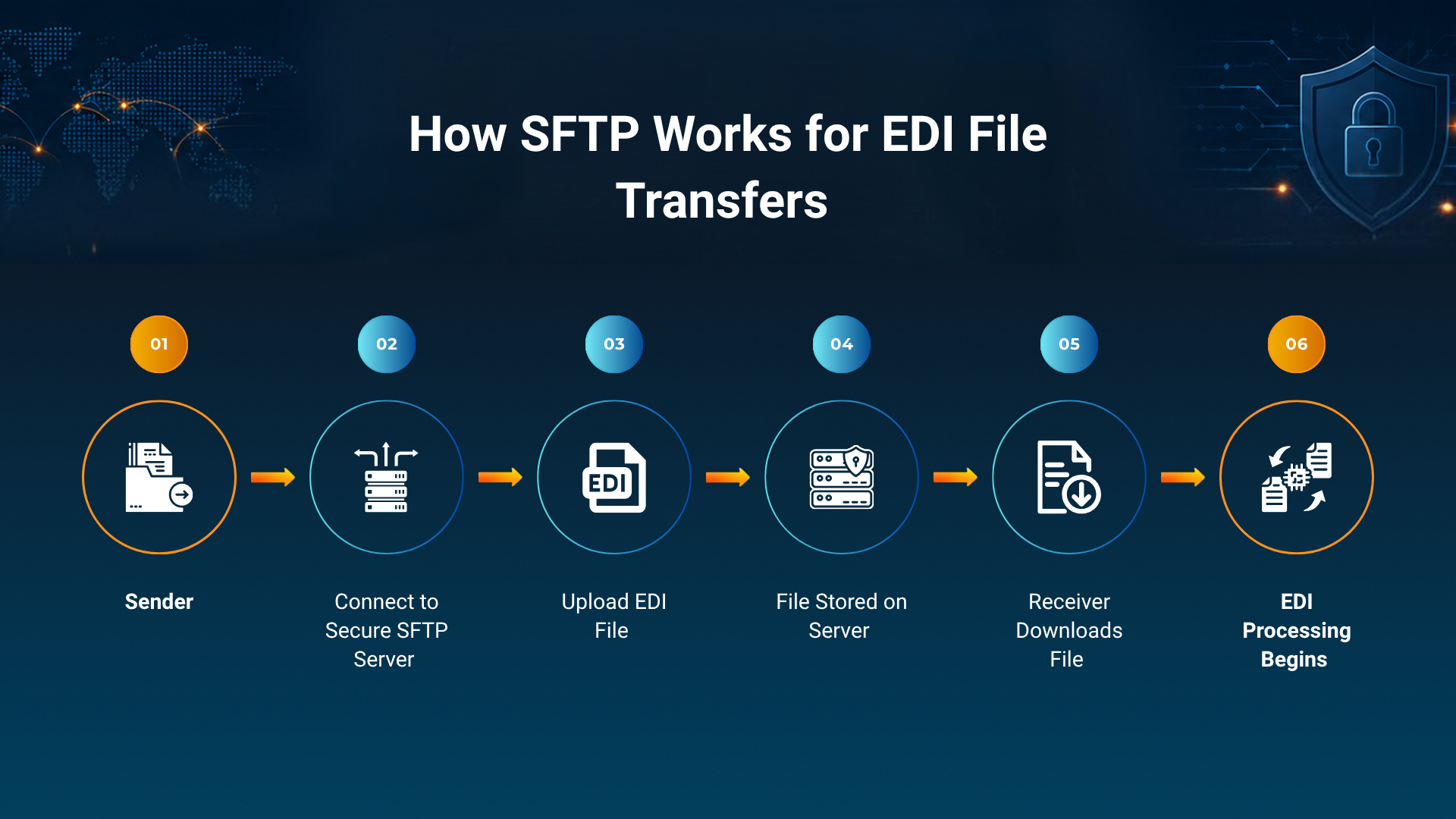
How SFTP Works for EDI File Transfers
Step 1: Establish a Secure Connection
Passwords or SSH keys are used by the sender to establish a Secure Shell (SSH) connection to an SFTP server. While files are being exchanged over the internet, they are protected by the encrypted connection.
Step 2: Upload the EDI File
The EDI file is uploaded to the SFTP server's specified folder. The file stays on the server till the recipient downloads it.
Step 3: Retrieve the File
The receiving system receives new files, processes them via the EDI platform, and frequently checks the server. The company's polling schedule determines how frequently information is retrieved.
Step 4: Process the Document
After downloading, the EDI file is processed, translated, and validated within the organization's workflow. Organizations frequently rely on application-level alerts or monitoring tools because SFTP does not automatically create delivery of acknowledgments like AS2.
Why Organizations Choose SFTP for EDI
Organizations choose SFTP because it provides secure EDI document exchange over the Secure Shell (SSH) protocol without requiring specialized EDI infrastructure or the certificate-based framework used by AS2. NIST recognizes SSH as a secure protocol for file transfers, software distribution, disaster recovery, and automated system administration, making SFTP a reliable option for EDI implementation and ongoing EDI platform support.
Manufacturers, healthcare organizations, financial institutions, suppliers, and retailers commonly use SFTP to exchange payment files, purchase orders, invoices, and inventory updates with trading partners. According to SSH.com, enterprise environments perform thousands to more than 5 million automated SSH logins every day, demonstrating SFTP's scalability for secure, high-volume EDI document exchange.
VAN: A Managed Network for EDI Communication
A Value-Added Network (VAN) acts as an intermediary for EDI document exchange, receiving documents from one trading partner and routing them to another while managing protocol translation, mailboxing, validation, and delivery confirmation. Before AS2 and SFTP became widely adopted, VANs were the primary method for exchanging EDI documents. They continue to support organizations with legacy EDI infrastructure, complex trading partner requirements, or a preference for outsourced EDI platform support.
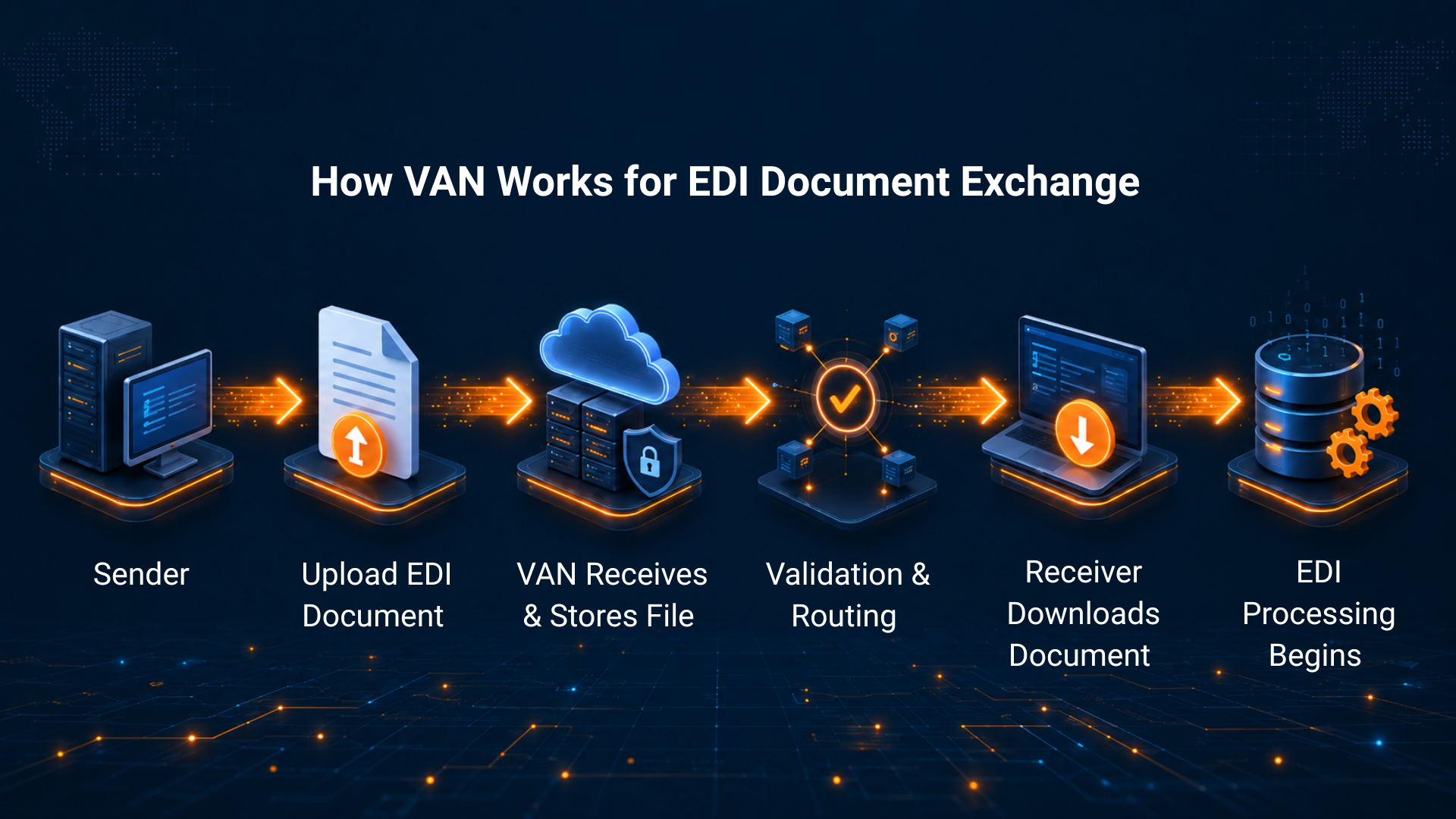
How VAN Works for EDI Document Exchange
Step 1: Upload the EDI Document
Rather than sending the EDI document straight to the trading partner, the sender sends it via the Value-Added Network (VAN). Several communication protocols, such as AS2, SFTP, or secure APIs, may be used by the connection.
Step 2: Validate and Route the File
After applying routing rules and verifying the file, the VAN sends it to the designated trade partner. Prior to delivery, a lot of VAN providers also carry out format checking, document tracking, and problem reporting.
Step 3: Store and Forward
If the receiving system is temporarily unavailable, the VAN securely stores the document until it can be delivered. This "store-and-forward" capability improves delivery reliability and minimizes transmission failures.
Step 4: Deliver the Document
After obtaining the document from the VAN, the recipient enterprise uses its EDI system to handle it. To assist enterprises in keeping an eye on document exchanges, the majority of VAN providers also keep audit logs and delivery reports.
Why Organizations Choose VAN for EDI
Organizations choose VAN services because they simplify EDI document exchange by managing connectivity, routing, document management, and trading partner onboarding through a single managed network. This reduces the complexity of maintaining multiple partner connections, supports EDI platform support, and improves visibility into document delivery and transmission status.
VANs remain widely used across retail, healthcare, manufacturing, logistics, and automotive industries, where organizations exchange high volumes of purchase orders, invoices, shipment notices, and remittance documents. According to GS1 US, many businesses continue to rely on VANs to support reliable EDI implementation, meet diverse trading partner requirements, and enable standardized B2B EDI document exchange across large partner networks.
Also Read: 5 Hidden Risks of Staying on Legacy EDI in 2026
Choosing the Right EDI Communication Protocol
The starting point is rarely a free choice. Most large retailers specify AS2 or a VAN in their trading partner's onboarding requirements, and a supplier has little room to negotiate. Without suggesting that one protocol is always superior to another, this table offers a fair comparison. Rather, it highlights that company needs, trade partner expectations, transaction volume, and available IT resources all play a role in making the best decision. Additionally, it enhances rather than duplicates the information in the earlier sections on VAN, SFTP, and AS2.
| Comparison Factor | AS2 | SFTP | VAN |
|---|---|---|---|
| Communication Model | Direct point-to-point connection | Secure file transfer via SFTP server | Managed third-party network |
| Primary Purpose | Secure, real-time EDI exchange | Secure file-based document transfer | Managed EDI routing and document exchange |
| Security | End-to-end encryption, digital signatures, MDNs | SSH encryption with secure authentication | Provider-managed encryption and security controls |
| Delivery Confirmation | Yes, through Message Disposition Notifications (MDNs) | No built-in acknowledgment mechanism | Yes, through provider tracking and delivery reports |
| Setup Complexity | High (certificates and partner configuration) | Low to moderate (server and user setup) | Low (provider manages connectivity) |
| Ongoing Cost | Low after implementation | Low | Higher due to subscription or transaction fees |
| Scalability | Excellent for high-volume, direct trading partner relationships | Suitable for small to medium transaction volumes | Excellent for large trading partner ecosystems |
| Best Suited For | Organizations with high transaction volumes and partner-mandated AS2 | Businesses seeking simple, secure file transfers | Organizations managing numerous partners with varying technical capabilities |
| Common Industries | Retail, Manufacturing, Healthcare, Logistics | Manufacturing, Healthcare, Financial Services | Retail, Automotive, Healthcare, Logistics |
| Example Use Case | A supplier exchanging EDI documents directly with Walmart using AS2 | A distributor securely uploading invoices to an SFTP server for retrieval | A global manufacturer using a VAN to communicate with hundreds of suppliers using different communication methods |
| Ideal When | Security, compliance, and non-repudiation are top priorities | Simplicity, affordability, and secure file exchange are the primary requirements | Outsourcing EDI connectivity and simplifying partner onboarding are key business objectives |
Moving Ahead
No single EDI communication protocol is right for every organization. The best choice depends on your security requirements, transaction volume, trading partner requirements, and operational resources. AS2, SFTP, and VAN each offer distinct advantages, from secure EDI document exchange and simplified file transfers to managed connectivity across large partner networks. Evaluating your current business needs, EDI implementation goals, and long-term growth strategy helps ensure EDI revenue protection, reduces EDI compliance risk, and provides the EDI platform support needed for scalable, reliable B2B communication.
Also Read: EDI Standards Explained: ANSI X12, EDIFACT, and What Actually Differs