
It is a common assumption in integration conversations that APIs are the modern replacement for EDI, the same way a smartphone eventually replaced a flip phone. That framing does not hold up against how B2B commerce operates today. EDI and APIs solve overlapping but distinct problems, and understanding where each one wins keeps a business from ripping out a working EDI relationship in pursuit of a technology upgrade it does not actually need.
This guide explains the key differences between EDI, API, and JSON, showing where EDI continues to excel, where APIs provide greater flexibility, how JSON supports modern integrations, and why many organizations combine EDI and APIs to improve EDI platform support and long-term EDI implementation.
EDI vs. API vs. JSON: Core Differences Explained
| Feature | EDI (Electronic Data Interchange) | API (Application Programming Interface) | JSON (JavaScript Object Notation) |
|---|---|---|---|
| Primary Purpose | Standardized B2B document exchange between trading partners | Enables applications to communicate and exchange data in real time | Lightweight data format used to structure and exchange information |
| What It Is | A complete business communication standard | A communication method or interface | A data serialization format |
| Communication Style | Batch processing or scheduled exchanges (can also support near real-time) | Real-time request-response communication | Does not communicate by itself; carried through APIs, files, or messaging systems |
| Data Format | Standardized formats such as ANSI X12 and EDIFACT | Can use JSON, XML, or other formats | Text-based key-value format |
| Standardization | Governed by accredited standards organizations (ANSI, UNECE) | Defined by the API provider | Only defines data syntax, not business rules |
| Structure | Fixed and highly structured | Flexible and customizable | Highly flexible and developer-defined |
| Governance | Industry-wide implementation guides and trading partner agreements | Managed individually by each API owner | No governing body for business implementation |
| Interoperability | High, when both parties follow the same EDI standard | Depends on API design and compatibility | Depends entirely on the application using it |
| Typical Use Cases | Purchase orders, invoices, advance shipping notices, healthcare claims | Real-time inventory, payment processing, customer portals, shipping updates | API payloads, configuration files, web and mobile applications |
| Speed | Typically scheduled or event-triggered | Near real-time or real-time | Depends on the transport mechanism |
| Error Handling | Standardized acknowledgments (997, 999, CONTRL, etc.) with consistent rejection codes | Error responses vary by API (HTTP status codes plus custom messages) | No built-in error handling mechanism |
| Trading Partner Onboarding | Requires mapping, validation, and agreement on document standards | Requires API documentation, authentication, and endpoint integration | Simply defines the data structure; onboarding depends on the API or system |
| Scalability | Excellent for managing large trading partner ecosystems | Scales well but often requires separate integrations for each API | Scales as a data format but not as an integration framework |
| Security | Commonly secured through AS2, SFTP, VAN, encryption, and digital certificates | Uses HTTPS, OAuth, API keys, JWTs, and other authentication methods | No built-in security; relies on the transport layer |
| Maintenance | Updates follow published EDI standard versions | API providers can change versions independently | Minimal maintenance as it is only a formatting standard |
| Best For | High-volume, standardized B2B transactions across many partners | Real-time application integration and event-driven workflows | Representing structured data exchanged between applications |
When EDI Is the Best Choice for Business Integration
EDI continues to be the cornerstone of high-volume B2B trade, even as APIs and JSON enable real-time integrations. According to IBM, EDI systems continue to support more than 66% of supply chain transactions, highlighting their ongoing importance in retail, manufacturing, healthcare, logistics, and distribution. Organizations modernizing their EDI platform and EDI implementation are also seeing measurable operational gains. IBM reports that modern EDI platforms deliver 55% faster trading partner onboarding, 48% faster document delivery, and 59% fewer unplanned outages, demonstrating how ongoing EDI platform support strengthens business performance and EDI revenue protection.
The influence on business is similarly strong. EDI decreased order-to-cash and procure-to-pay document exchange times by 78%, reducing the average processing cycle from 93 minutes to 20 minutes, according to the 2026 GS1 Italy and Politecnico di Milano EDI Observatory. The study also revealed a 78% decrease in operating expenses per document cycle, highlighting the benefits of EDI for businesses that deal with a lot of purchase orders, invoices, shipment alerts, and other regular business documents.
Also Read: What Is EDI? A Simplified Guide for EDI Revenue Protection
When APIs Are Better Than EDI
APIs are essential to contemporary digital experiences because they allow real-time information sharing across systems. APIs are made to provide immediate data access across applications, in contrast to EDI, which is excellent at standardized, document-based B2B operations. Customer portals, real-time inventory checks, payment gateways, CRM interfaces, mobile apps, and SaaS platforms where users anticipate prompt responses—all frequently use them. APIs are becoming a crucial part of app connectivity rather than a substitute for tried-and-true B2B integration techniques as businesses speed their digital transformation.
This growing adoption is reflected in recent industry research. The 2025 Postman State of the API Report highlights the business value of APIs for digital products and services, with 82% of organizations adopting an API-first approach, up 12% from 2024, and 65% reporting revenue generated through their API programs. The report also found that 69% of engineers spend more than ten hours each week on API-related work, demonstrating the expanding role of APIs in modern software development and real-time integration.
The growing use of APIs does not reduce the importance of EDI. Many organizations use APIs to power real-time applications while relying on EDI for secure EDI document exchange of purchase orders, invoices, Advance Ship Notices (ASNs), remittance documents, and other standardized business transactions with suppliers and trading partners. Together, EDI and APIs enable reliable EDI implementation, strengthen EDI platform support, and deliver both dependable B2B commerce and real-time digital experiences.
How JSON Fits into Modern API and EDI Integration
JSON (JavaScript Object Notation) has become the preferred data format for modern application integration because it is lightweight, human-readable, and supported by virtually every programming language. Unlike APIs, which define how systems communicate, or EDI, which standardizes EDI document exchange, JSON simply defines how data is structured and exchanged. Its simplicity makes it the preferred format for REST APIs, cloud services, microservices, mobile applications, and SaaS platforms that rely on fast, efficient data exchange and real-time integration.
The ongoing expansion of REST-based APIs is directly correlated with widespread adoption of JSON. The 2025 Postman State of the API Report states that 82% of organizations have embraced an API-first strategy, reflecting the growing need for portable, interoperable data formats like JSON in contemporary application development, while REST continues to be the most popular API architecture, utilized by 93% of organizations.
JSON, on the other hand, does not define standardized business papers, enforce trading partner agreements, or offer the governance necessary for enterprise B2B transactions. Instead, it arranges application data. While using EDI to securely exchange purchase orders, invoices, advance ship notices (ASNs), and other essential company documents across supply chains, organizations frequently employ JSON to power online and cloud applications.
Also Read: Gentran to IBM Sterling: A Migration Guide for Teams Running Legacy EDI
Why EDI and APIs Work Better Together in Modern Integration
EDI and APIs are no longer the only options available to modern businesses. Rather, they satisfy various integration requirements by utilizing both technologies. While EDI offers a consistent and dependable structure for sharing corporate documents with trading partners, APIs provide real-time communication between applications. When combined, they build an adaptable environment for integration that promotes both digital transformation and operational effectiveness.
| Business Need | How APIs Help | How EDI Helps |
|---|---|---|
| Real-time data exchange | Instantly shares inventory, pricing, and order status | Processes standardized business documents after transactions are initiated |
| Customer-facing applications | Powers websites, mobile apps, and customer portals | Supports backend order fulfillment and supply chain communication |
| Internal system integration | Connects ERP, CRM, and cloud applications | Exchanges purchase orders, invoices, ASNs, and remittance documents with trading partners |
| B2B transactions | Enables application connectivity where needed | Delivers secure, standardized, and compliant document exchange across partner networks |
| Modern integration strategy | Connects applications in real time | Provides the trusted backbone for enterprise B2B commerce |
Over 66% of worldwide supply chain transactions still rely on EDI, according to IBM, whereas 82% of enterprises have embraced an API-first strategy, according to the 2025 Postman State of the API Report. All of these changes demonstrate that while EDI continues to be the cornerstone of enterprise B2B data exchange, APIs improve contemporary application integration.
How to Choose Between EDI, API, and JSON
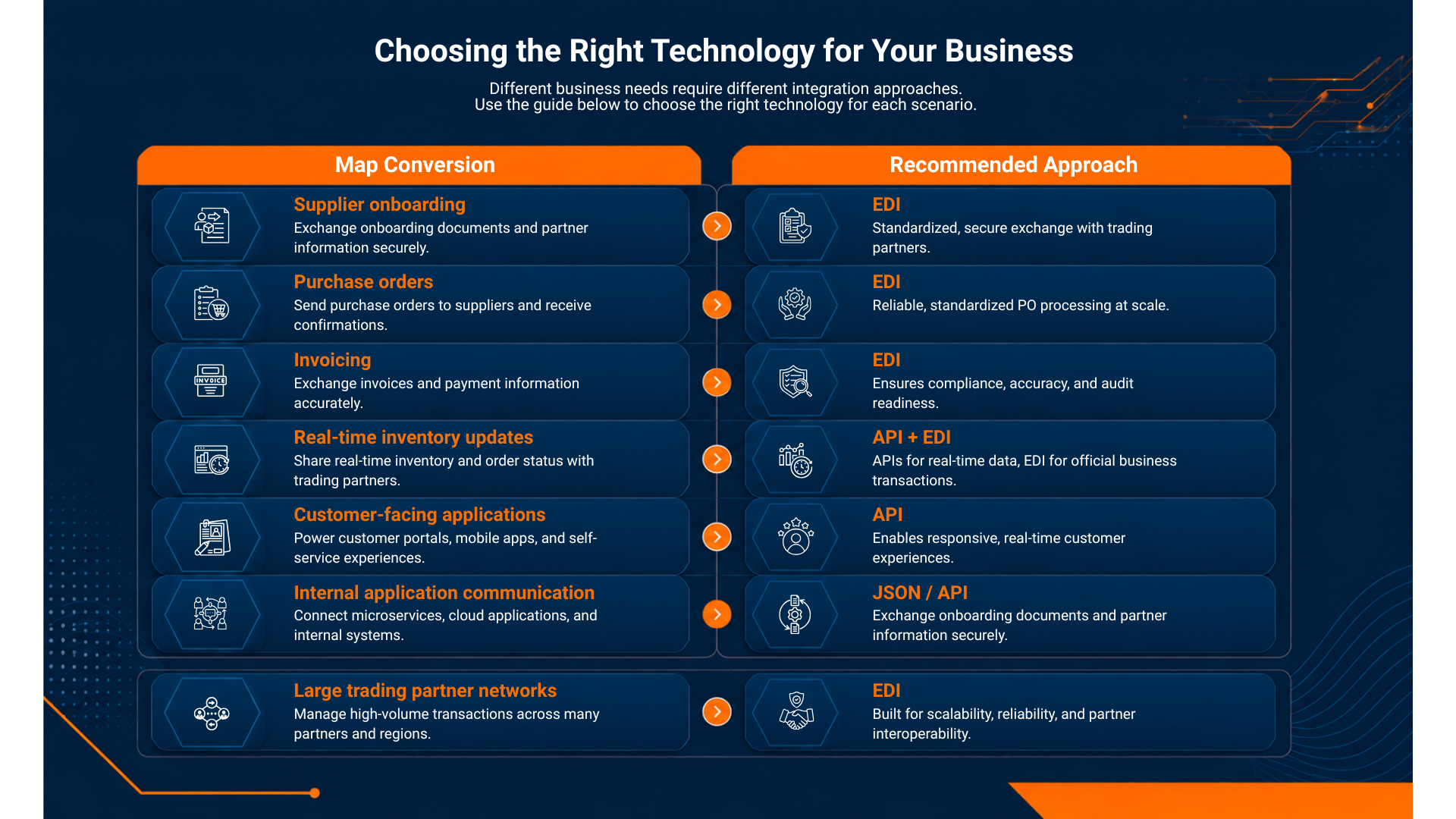
The right integration solution depends on the systems you need to connect, the data you exchange, your trading partner requirements, and your business goals. EDI, APIs, and JSON each play a distinct role in modern enterprise integration. EDI remains the standard for secure EDI document exchange with trading partners, APIs enable real-time communication between applications, and JSON serves as the lightweight data format used by many modern APIs. Rather than choosing a single technology, many organizations combine all three to support scalable EDI implementation, strengthen EDI platform support, and improve EDI revenue protection while accelerating digital transformation and operational efficiency.
Common business scenarios are as follows:
Moving Ahead
EDI, APIs, and JSON each solve different integration challenges, but all three are essential to modern business connectivity. EDI provides the standardized framework for secure, high-volume EDI document exchange with trading partners, APIs enable real-time communication between applications, and JSON serves as the lightweight data format that powers many modern APIs. Rather than replacing one another, these technologies work best together. Understanding when and how to use each helps organizations build a scalable EDI implementation strategy, strengthen EDI platform support, reduce EDI compliance risk, and support long-term digital transformation.
Also Read: Boomi vs. Cleo: Which IBM Sterling Alternative Fits Your EDI Migration?