
Your EDI platform may already support ANSI X12 or EDIFACT, but do you know which standard your trading partners require and why it matters? Selecting the appropriate EDI standard affects everything from EDI mapping and ongoing maintenance to trading partner onboarding and long-term EDI platform support, particularly as companies enter new markets.
Organizations can electronically exchange organized business documents using both ANSI X12 and EDIFACT. However, they differ in terms of document structure, regulation standards, and regional adoption. Teams may plan integrations, meet trading partner requirements, and prevent needless rework during implementation by being aware of these variations.
This guide describes the differences between ANSI X12 and EDIFACT, where each standard is frequently used, and what organizations should take into account while supporting one or both standards.
Also Read: What Is EDI? A Simplified Guide for EDI Revenue Protection
ANSI X12: The Leading EDI Standard in North America
ANSI X12 is the EDI standard developed and maintained by the Accredited Standards Committee X12, and it is the dominant standard for business transactions across the United States and is widely used throughout North America. Retailers such as Walmart and Target, along with many US distributors and manufacturers, transact using X12 transaction sets identified by three-digit numbers. For example, an 850 represents a purchase order, an 856 represents an Advance Ship Notice (ASN), and an 810 represents an invoice, enabling standardized EDI implementation across trading partners.
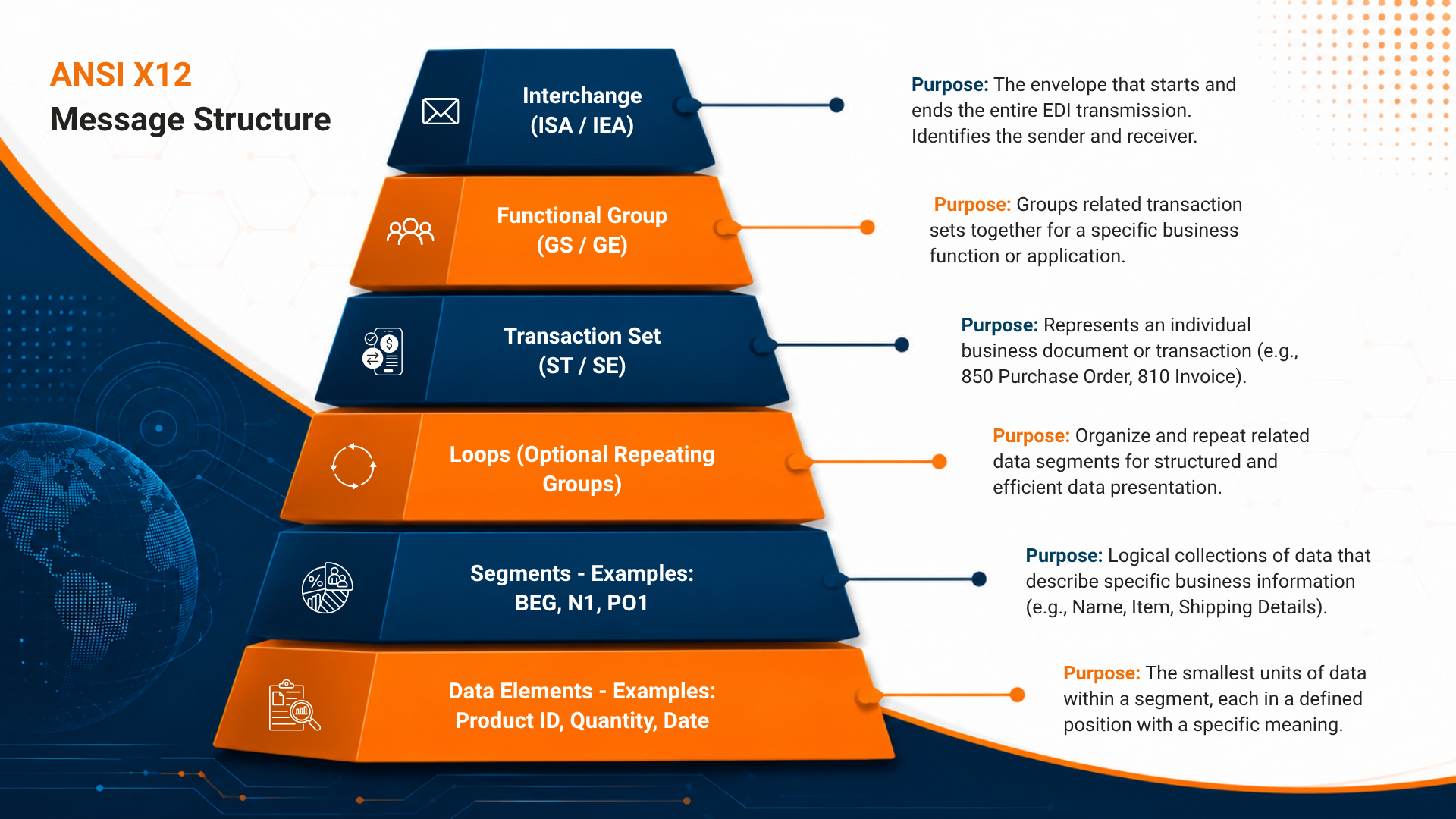
ANSI X12 EDI Message Structure Explained
ANSI X12 uses a hierarchical structure that organizes business data into predictable layers, allowing EDI systems to exchange information consistently across trading partners.
1. Interchange (ISA / IEA)
An ANSI X12 transmission's outermost container, the interchange, provides a structure for trading partners to exchange business papers. It guarantees that the entire transmission is transmitted as a whole, recognizes the sender and recipient, and sets communication parameters.
2. Functional Group (GS / GE)
Purchasing, shipping, and invoicing are examples of business activities that are supported by related event sets that are grouped together in a functional group. Receiving systems can better organize incoming documents by grouping comparable transactions, which also increases processing performance.
3. Transaction Set (ST / SE)
A transaction set is a single business document, like an invoice or purchase order, that is traded between trading partners. Regardless of the software being used, each transaction adheres to a predetermined structure that enables both systems to understand the data consistently.
4. Loops (Optional Repeating Groups)
Loops prevent duplication of the overall message format by grouping relevant segments into recurring business structures. They commonly organize contacts, addresses, and line items, making complex EDI documents easier to represent and process.
5. Segments
Standardized collections of related data pieces that describe certain business information inside a transaction are called segments. Starting with a distinct identity, each segment conveys information about the consumer, goods, shipment, or terms of payment.
6. Data Elements
The tiniest bits of information shared in an ANSI X12 document are called data elements. They include the actual business values that together determine each segment's contents, such as product numbers, quantities, dates, prices, and codes.
Common ANSI X12 EDI Message Types and Transaction Sets
Each of the more than 300 standardized transaction sets included in ANSI X12 is uniquely identified by a three-digit code. By implementing only the document formats that are pertinent to their business operations and industry, organizations enable partners to transmit information effectively and reliably. Common ANSI X12 document types include:
- Purchase Order (850): Sent by buyers to place orders for goods or services.
- Purchase Order Acknowledgment (855): Confirms whether the supplier accepts, rejects, or modifies the purchase order.
- Advance Ship Notice (856): Provides shipment details before goods arrive, including carton, pallet, and tracking information.
- Invoice (810): Requests payment for goods or services delivered.
- Payment Order/Remittance Advice (820): Communicates payment details and explains which invoices are being paid.
- Inventory Inquiry/Advice (846): Shares inventory availability, stock levels, and product status.
- Purchase Order Change Request (860): Updates an existing purchase order by modifying quantities, dates, or other details.
- Functional Acknowledgment (997): Confirms successful receipt of an EDI transaction and identifies any processing errors.
- Transportation Documents (204, 214, 210): Support freight operations through load tenders, shipment status updates, and freight invoices.
- Healthcare Transactions (270, 271, 276, 277, 837): Exchange eligibility inquiries, claim status, and healthcare claims between providers and payers.
Also Read: 5 Hidden Risks of Staying on Legacy EDI in 2026
EDIFACT: The Global EDI Standard for International Trade
EDIFACT, formally the United Nations rules for Electronic Data Interchange for Administration, Commerce, and Transport, are the standard most used outside North America, particularly across Europe and in international shipping and logistics. While ANSI X12 identifies documents with three-digit transaction set numbers, EDIFACT uses named message types such as ORDERS for a purchase order, DESADV for an Advance Ship Notice, and INVOIC for an invoice, enabling consistent EDI implementation across global trading partners.
The underlying structure is conceptually similar to X12, segments and elements arranged in a defined sequence, but the syntax rules, segment names, and code lists differ enough that a system built to parse X12 cannot read EDIFACT without a separate mapping and translation layer.
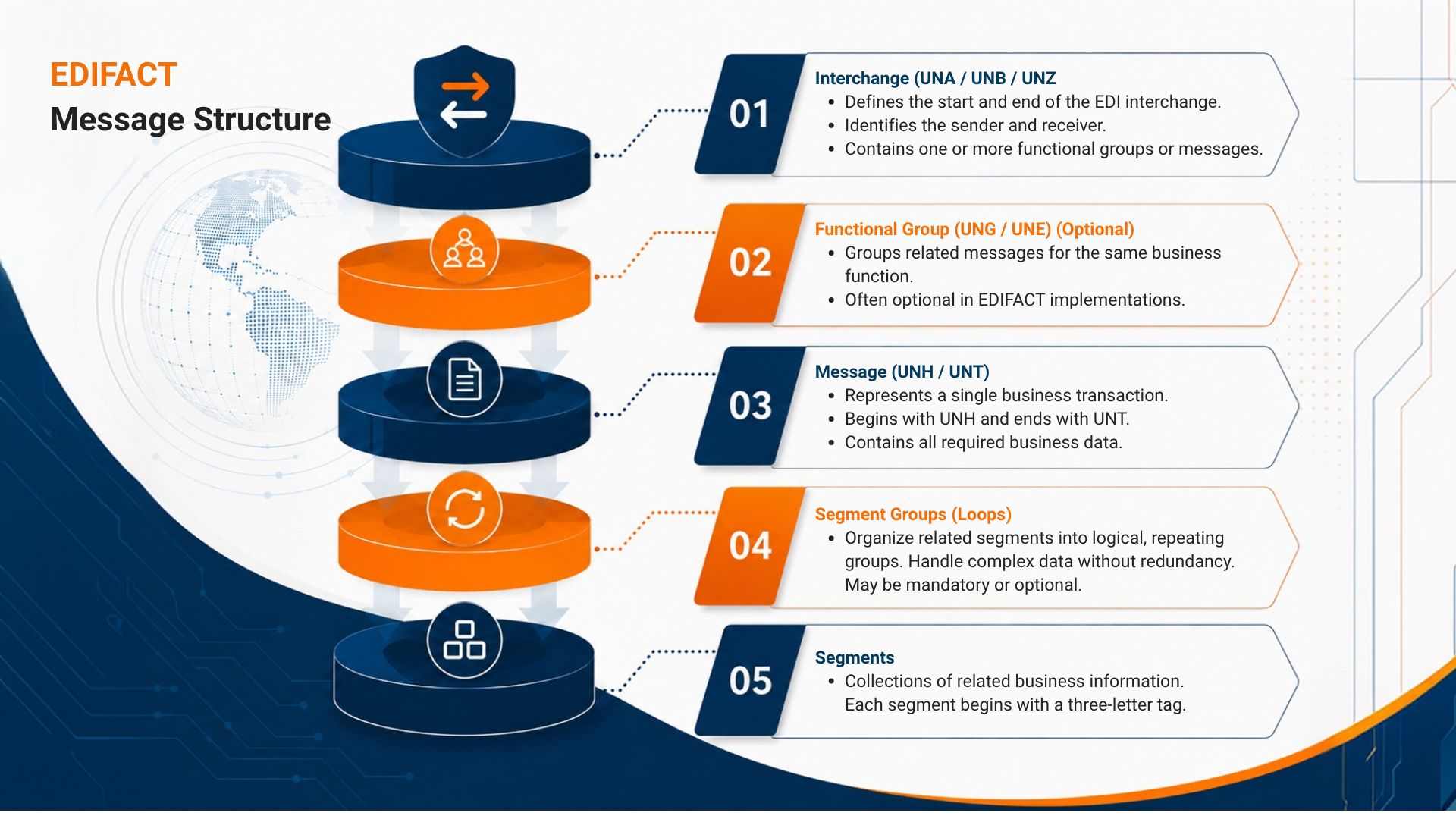
EDIFACT Message Structure Explained
UN/EDIFACT messages follow a hierarchical structure that organizes data from the interchange level down to individual data elements. Every layer gives the business transaction transfer context and control.
1. Interchange (UNA / UNB / UNZ)
All of the messages being exchanged are contained in the interchange, which is the outermost component of an EDIFACT transfer. By identifying the sender, recipient, and transmission details, it creates exchanges between trading partners and guarantees that the interchange can be properly routed and processed.
2. Functional Group (UNG / UNE) (Optional)
Related EDIFACT messages that are part of the same company procedure, like purchasing or invoicing, are arranged by a functional group. This layer facilitates processing when different message types are transmitted inside a single interchange, even though it is optional and not utilized in all implementations.
3. Message (UNH / UNT)
A message represents a single business document, such as a purchase order, invoice, or shipment notice, exchanged between trading partners. It is enclosed by a message header (UNH) and trailer (UNT), which preserve message integrity and ensure accurate EDI document exchange during processing.
4. Loops or Segment Groups
Related segments are arranged into logical, consistent structures by segment groups, which mirror actual business situations. They permit information to appear more than once without repeating the general message structure, like customer data, address details, product lines, or shipment information.
5. Segments
A particular feature of the transaction is described by segments, which are standardized groupings of related business data. Dates, parties, product specifications, quantities, and prices are all included in each segment, which starts with a distinct three-letter identity.
Common EDIFACT Message Types and Business Messages
Rather than numeric transaction sets like ANSI X12, EDIFACT identifies business documents using six-character message names. Each message follows the same hierarchical syntax rules while carrying data specific to a particular business process.
ORDERS: Purchase Order
ORDRSP: Purchase Order Response
DESADV: Dispatch (Advance Shipping) Advice
RECADV: Receiving Advice
INVOIC: Invoice
REMADV: Remittance Advice
INVRPT: Inventory Report
PRICAT: Price/Sales Catalogue
IFTMIN: Transport Instruction
IFTSTA: Transport Status Message
CUSDEC: Customs Declaration
CUSRES: Customs Response Message
ANSI X12 vs. EDIFACT: Key Differences Explained
Based on the eZCom article, supplemented with the official differences documented by Microsoft and EDIDev, here's the difference between EDI X12 and EDIFACT.
| Feature | ANSI X12 | UN/EDIFACT |
|---|---|---|
| Full Name | Accredited Standards Committee X12 | Electronic Data Interchange for Administration, Commerce, and Transport |
| Developed By | Accredited Standards Committee (ASC) X12, accredited by ANSI | United Nations (UN/CEFACT) under UNECE |
| Year Introduced | 1979 | 1986 |
| Primary Region | North America (U.S. and Canada) | Europe, Asia, and international trade |
| Primary Use | Domestic and regional B2B transactions | Cross-border and global B2B transactions |
| Document Naming | Uses numeric transaction set codes (e.g., 850, 810, 856) | Uses descriptive message names (e.g., ORDERS, INVOIC, DESADV) |
| Message Terminology | Business documents are called Transaction Sets | Business documents are called Messages |
| Interchange Structure | ISA/IEA → GS/GE → ST/SE | UNA (optional)/UNB/UNZ → UNG/UNE (optional) → UNH/UNT |
| Functional Group | Required in most implementations | Optional in many implementations |
| Character Separators | Uses characters such as * (element separator) and ~ (segment terminator) | Uses + (data element separator), : (component separator), and ' (segment terminator) |
| Composite Data Elements | Supported but less frequently used | Commonly used throughout messages |
| Acknowledgment Message | TA1 and 997 Functional Acknowledgment | CONTRL message |
| Industries | Retail, healthcare, logistics, automotive, finance, government | Manufacturing, retail, transportation, customs, shipping, international trade |
| Best Suited For | Organizations trading primarily within North America | Organizations exchanging EDI documents with international trading partners |
Also Read: Unleashing Business Potential- The Power of Adaptive Enterprise Architecture
Operational Best Practices for Supporting ANSI X12 and EDIFACT
Mapping teams need separate map sets for X12 and EDIFACT trading partners, since a single map cannot serve both syntaxes. Onboarding a new international trading partner takes longer than onboarding a domestic one, because EDIFACT implementations often carry more country-specific and industry-specific variation than X12 does.
Organizations that treat EDIFACT as a rare exception, built once and never revisited, tend to accumulate outdated maps that fail quietly when a European trading partner updates their implementation guide. Standard-aware maintenance, reviewing both X12 and EDIFACT maps on a regular cadence, prevents that kind of silent drift.
Staffing is the other practical implication worth naming directly. A team fluent in X12 mapping is not automatically fluent in EDIFACT, and the reverse is equally true. Organizations expanding into international trading relationships for the first time often underestimate the ramp-up time this requires and end up leaning on outside expertise for the first several EDIFACT onboardings while internal staff build that capability.
Moving Ahead
Although ANSI X12 and EDIFACT support different business environments and trading partner ecosystems, both enable secure, standardized electronic data interchange. Understanding each standard's structure, common use cases, and implementation requirements helps organizations make informed decisions when onboarding new trading partners or expanding into new markets. Long-term EDI revenue protection depends on reliable EDI implementation, well-maintained EDI maps, regular EDI configuration reviews, and consistent governance that reduces EDI compliance risk while supporting scalable EDI platform support.