Once an EDI platform is running, someone has to keep it running: monitoring transactions, maintaining maps, onboarding new trading partners, troubleshooting failures. Who does that work, a dedicated in-house team, a fully outsourced managed services provider, or a fractional model blending both, shapes cost, responsiveness, and risk for years after the decision gets made.
This guide walks through what each model looks like day to day and what kind of organization each one tends to fit, since the right choice depends on transaction volume, trading partner complexity, and how core EDI is to the organization's competitive position.
Also Read: What Is EDI? A Plain-English Guide to Electronic Data Interchange for EDI Revenue Protection
In-House: Full Control, Full Cost
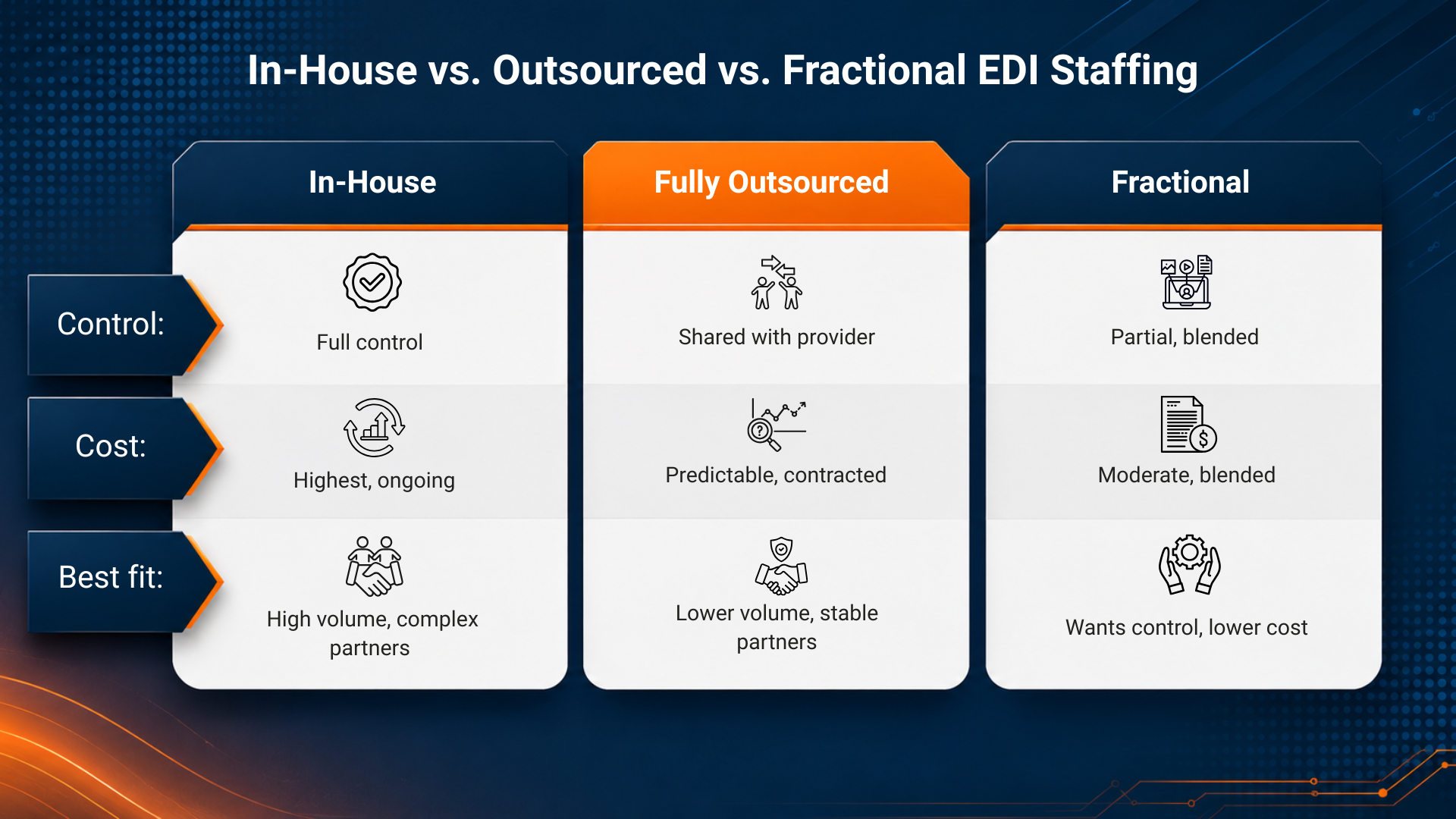
- Control and institutional knowledge: An in-house EDI team gives an organization direct control over prioritization and response time, since no vendor relationship or service level agreement mediates how quickly an issue gets addressed. Institutional knowledge stays internal, and staff develop deep familiarity with specific trading partner relationships that generic outsourced support often lacks.
- Cost and key-person risk: The cost of that control is real and ongoing. EDI expertise is specialized enough that hiring and retaining qualified staff is genuinely difficult in many markets, and a small in-house team carries concentrated key-person risk, since losing one experienced EDI administrator can leave a capability gap that takes months to rebuild.
- Where it fits best: In-house tends to make the most sense for organizations with high transaction volume, complex or unusual trading partner requirements, and enough scale to keep a dedicated team productively busy on EDI operations specifically, rather than splitting time across unrelated responsibilities.
Fully Outsourced: Predictable Cost, Shared Priority
- The core tradeoff: A fully outsourced managed services arrangement hands day-to-day EDI operations, monitoring, map maintenance, trading partner onboarding, troubleshooting, to an external provider under a defined service agreement. Cost becomes predictable and scales with a contracted service level rather than headcount, and the organization avoids the hiring and retention challenge of specialized in-house staff entirely.
- What that predictability costs: An outsourced provider manages multiple clients simultaneously, and response priority during a shared high-demand period, several clients experiencing issues at once, can mean less immediate attention than an in-house team would give its own organization's problem. Vendor selection matters enormously here, since service quality varies significantly across providers.
- Where it fits best: Fully outsourced arrangements tend to fit organizations without the scale or strategic reason to build internal EDI expertise, where predictable cost and reduced hiring burden outweigh the tradeoff in response prioritization.
- The SLA is the real product: The service level agreement is the single most important document in an outsourcing decision, since it defines the response time, escalation process, and scope of work the organization can actually expect. A vague agreement without concrete response commitments is a common source of dissatisfaction once a real incident occurs.
- What to ask before signing: It's worth asking a prospective provider directly how many other clients share the same support team, and what their actual average response time has been during recent high-demand periods, rather than accepting general service level language at face value.
Also Read: EDI Chargebacks Explained: Hidden Costs, Common Causes, and Prevention
Fractional: A Middle Path
A fractional model blends a smaller internal presence, often a single EDI-literate staff member or a part-time internal owner, with outside expertise brought in for specific projects: platform migrations, complex trading partner onboardings, or overflow capacity during peak periods. This keeps some institutional knowledge and prioritization control internal while avoiding the cost of a full dedicated team for organizations whose EDI operations don't require constant full-time specialized attention.
The model works best when the internal role is genuinely capable of managing day-to-day operations and knowing when to escalate to outside expertise, rather than serving as an administrative placeholder with no real EDI capability. A fractional model without that internal competence tends to drift toward de facto full outsourcing, minus the formal structure and service agreement that make full outsourcing predictable.
A fractional model also requires clarity on decision rights: who owns the relationship with each trading partner, and who has final authority on prioritization when internal and outside expertise disagree on urgency. Without that clarity defined up front, a fractional arrangement can create confusion about accountability precisely when a fast decision matters most.
Fractional works best as a deliberate design choice, built around a clear plan for how outside expertise gets engaged, rather than a default fallback adopted simply because full in-house staffing felt too expensive.
Also Read: Phased EDI Migration: Implementation Without Downtime
Choosing Based on Volume, Complexity, and Strategic Priority
Transaction volume and trading partner complexity are the clearest signals. High volume across many complex trading partner relationships justifies dedicated in-house capacity, since the ongoing workload alone supports a full-time role or team. Lower, more stable volume with well-established trading partner relationships is often well served by full outsourcing or a fractional model, since the workload does not require constant full-time attention.
Strategic priority matters just as much as volume. An organization where EDI operations are closely tied to competitive advantage, extremely fast onboarding of new retail partners, for example, may justify in-house investment even at moderate volume, simply because response speed and internal knowledge translate directly into business outcomes that outsourcing cannot match as reliably.
It can also be useful to model the cost of a bad outcome under each model, not just the cost of routine operations. A missed compliance deadline under an in-house model is a direct reflection of internal capacity; the same miss under an outsourced model raises a question about the service agreement and vendor accountability instead, and the two failure modes have different remediation paths.
Whichever model an organization chooses today, it is worth revisiting periodically rather than treating it as permanent. Volume, complexity, and strategic priority all shift over time, and a staffing model that fit well three years ago may no longer match the organization's current EDI operations.
Also Read: AS2 vs. SFTP vs. VAN: Which EDI Communication Protocol Is Right for Your Business?
At a Glance: In-House vs. Outsourced vs. Fractional
| Dimension | In-House | Fully Outsourced | Fractional |
|---|---|---|---|
| Control over prioritization | Full | Shared with provider's other clients | Partial, depends on decision-rights clarity |
| Cost structure | Ongoing salary and benefits | Predictable, contracted service level | Lower fixed cost plus variable outside-expertise spend |
| Key-person risk | High, concentrated in a small team | Low, distributed across provider's staff | Moderate, depends on internal role's depth |
| Response time | Fastest, no SLA mediation | Depends on shared demand and SLA terms | Fast for routine work, slower for escalations |
| Best fit | High volume, complex partners, EDI tied to competitive advantage | Lower volume, stable partners, no strategic reason to build internal expertise | Moderate volume, wants some internal control without full team cost |
| Biggest risk | Hiring and retention difficulty | Vendor selection and vague SLA terms | Internal role lacking real EDI competence |
The Model Follows the Business, Not the Other Way Around
None of these three models is a default best choice. Volume, trading partner complexity, and how directly EDI ties to competitive advantage decide the fit, and that fit shifts as the business does. Treating the staffing model as a periodic decision rather than a one-time setup keeps the organization from outgrowing a model that served it well at a different size.