Organizations weighing an EDI platform migration usually share the same concern: a cutover that goes wrong and takes trading partner connections down with it. A retailer's relationship where a purchase order fails to arrive doesn't pause while a migration gets sorted out.
This guide explains how a properly phased migration avoids that risk, moving trading partners in controlled waves rather than a single high-risk cutover. The core principle stays simple: never depend on a single point of failure and never move faster than you can verify.
Why All-At-Once Migrations Fail
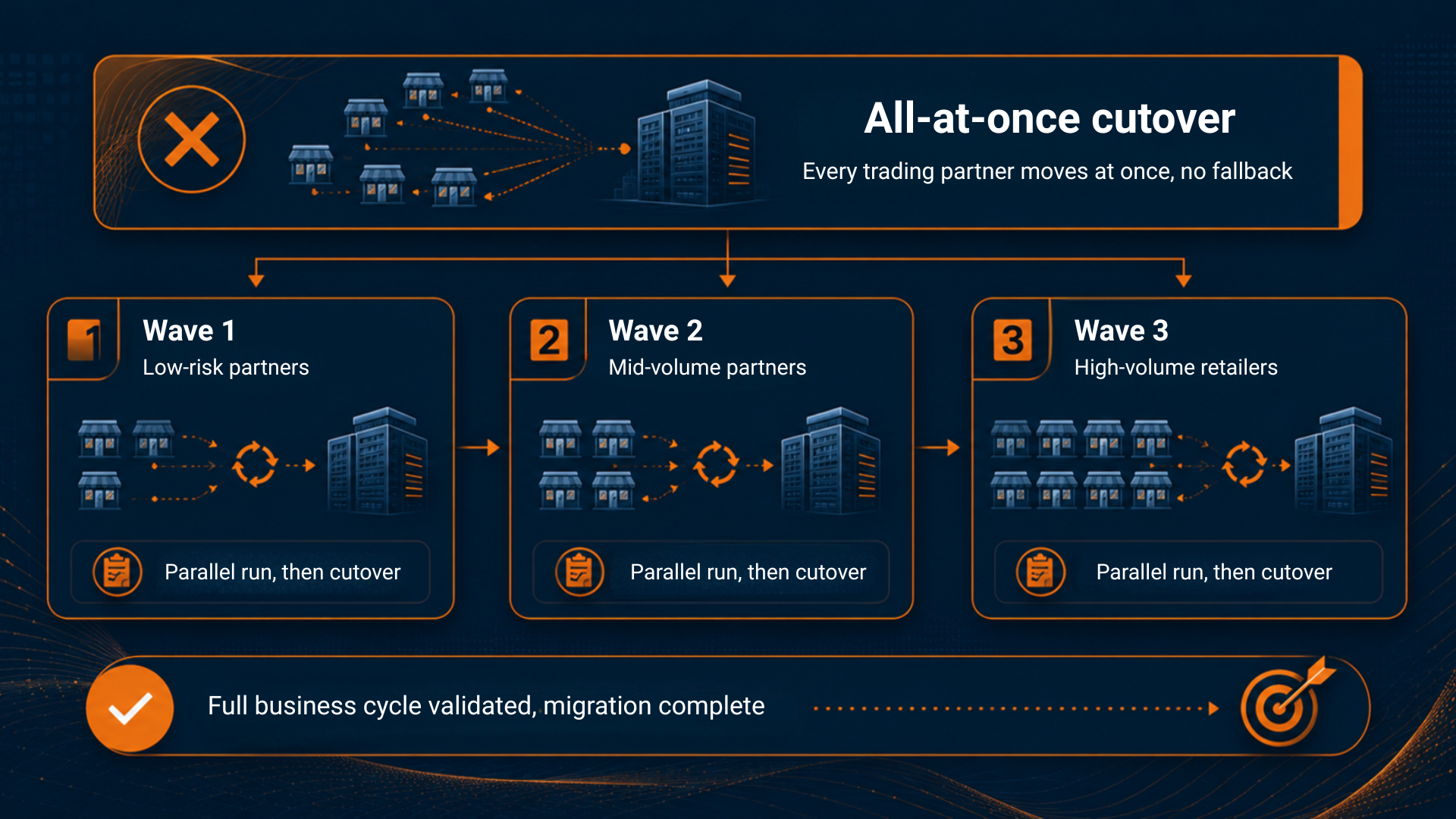
A single-cutover migration moves every trading partner connection from the old platform to the new one at the same moment, typically over a single weekend or maintenance window. The appeal is obvious: one event, one clear before-and-after line.
Four risks compound once something goes wrong:
- No fallback path. If a configuration error surfaces only after the team has already decommissioned the old platform, there's no way back.
- Compressed validation. Every trading partner map, protocol connection, and certificate needs testing before go-live. Running that testing under time pressure across dozens or hundreds of trading partners at once is where mistakes slip through rather than surface.
- Compounding financial exposure. Every hour a major retail connection stays down translates directly into delayed orders, shipments, and invoices, each of which can independently trigger a compliance penalty depending on the retailer's requirements.
- Reputational cost beyond the incident. A retailer that experiences an unexplained outage during a supplier's migration may apply closer scrutiny to that supplier's compliance going forward, well beyond the immediate financial penalty.
Also Read: Gentran to IBM Sterling Migration: A Legacy EDI Modernization Guide
The Phased Approach: Wave-Based Migration
A single "big bang" migration asks an organization to move every trading partner, transaction set, and integration point at once. A wave-based model spreads that work across defined phases, each with its own scope, testing cycle, and success criteria. This structure builds confidence early and creates a repeatable playbook for every wave that follows.
Wave 1: Discovery and Foundation
The first wave maps the current EDI landscape: trading partners, transaction types, mapping specifications, and existing integration points. This wave establishes the target environment and validates the migration approach with a small, low-risk group of partners before scaling further.
Wave 2: Pilot Migration
A pilot group of trading partners moves to the new environment first. This wave confirms that mapping logic, acknowledgments, and error handling perform as expected in production conditions. Lessons from the pilot shape the runbook for every subsequent wave, strengthening the process before broader rollout.
Wave 3: Scaled Rollout
With the pilot validated, additional trading partners migrate in structured groups, often organized by transaction volume, business criticality, or partner readiness. Running parallel environments during this wave keeps business continuity intact while the new platform takes on more of the transaction load.
Wave 4: Optimization and Decommissioning
The final wave retires legacy infrastructure and fine-tunes the new environment for performance and monitoring. Automated alerting, dashboards, and support processes come fully online, extending the reliability of day-to-day EDI operations.
Also Read: What Walmart's OTIF Penalty Actually Costs You (and How to Avoid It)
The Safety Net: Parallel Running
During each wave, the old and new platforms run in parallel for a defined validation period, with the new platform's output checked against the old platform's known-good behavior before the old connection is formally retired. This parallel period is what actually eliminates downtime risk, since the fallback path, reverting to the old platform for that specific trading partner, stays available until confidence in the new configuration is fully established.
Two things determine how well parallel running actually protects the migration:
- Treat the overlap cost as the price of safety, not an expense to cut. Parallel running means carrying the operational and licensing cost of two platforms at once for a period of time. Keeping that overlap in the plan, rather than shortening it to save cost, is what protects against the very downtime the whole approach exists to avoid.
- Scale the length to trading partner risk, not a fixed timeline. A low-volume, low-complexity trading partner might need only a few days of parallel validation, while a high-volume retailer relationship with strict compliance timelines warrants a longer, more thorough period before the old connection is retired.
Cutover and Validation: Confirming Success Before Moving On
Cutover is a checklist, not a moment. Each wave clears cutover only after confirming every map produces correct output, every acknowledgment is received and processed correctly, and every trading partner has been notified of any change to connection details on their end. Only once that checklist clears does the old connection for that wave get formally retired.
Completion means a full business cycle, not just a cutover date. Post-migration monitoring continues beyond cutover, watching for delayed-onset issues like a data pattern that only appears with a rare transaction type, or a trading partner that only sends a particular document infrequently. A migration isn't complete when the last wave cuts over; it's complete once a full business cycle has run cleanly on the new platform.
For seasonal businesses, that cycle should include peak season. Transaction patterns and volume during peak periods can surface issues that never appeared during a lower-volume validation window earlier in the migration.
Rollback triggers get decided in advance, not under pressure. A migration plan worth trusting names an explicit rollback trigger for every wave ahead of time, a defined set of conditions under which the team reverts to the old connection rather than pushing forward and hoping an issue resolves itself. Deciding those triggers in the moment is how avoidable outages happen even within an otherwise well-planned phased approach.
Also Read: Build vs. Buy an EDI Platform: How to Choose the Right Solution for Your Business
Ending Thoughts: Risk You Can See Coming
A phased migration doesn't eliminate risk; it makes risk visible early, in small, contained increments, rather than concentrated in a single high-stakes weekend. Every wave that clears validation builds the confidence needed for the next one, and every rollback trigger defined in advance removes the need to make a hard call under pressure. That's the actual value of the approach: not zero risk, but risk an organization can see, size, and control before it becomes an outage.