
Even while your EDI system processes transactions on a daily basis, it may not be performing at its peak efficiency. Long before they become apparent, hidden problems like out-of-date mappings, customary workarounds, integration of bottlenecks, and compliance gaps can subtly affect productivity, scalability, and customer happiness. These risks can be found, and areas for improvement can be identified with the aid of an EDI Health Assessment.
This guide will walk you through what an EDI Health Assessment looks at, what it doesn't look at, the typical problems it finds, and how it helps companies create an EDI environment that is more resilient and prepared for the future.
Understanding an EDI Health Assessment
A thorough analysis of a company's EDI environment to ascertain the efficiency of its systems, integrations, procedures, and trading partner relationships is called an EDI Health Assessment. The assessment looks at the overall health of the EDI ecosystem, detecting inefficiencies, operational threats, compliance gaps, and potential for optimization, rather than just determining whether EDI papers are being transported correctly. Making ensuring the EDI environment is dependable, scalable, and in line with present company requirements is the aim.
Before problems become expensive for business interruptions, organizations usually perform an EDI evaluation to have a comprehensive picture of their present environment. EDI systems frequently develop out-of-date maps, manual workarounds, bespoke connectors, inconsistent docs, and legacy settings over time, all of which can lower productivity and raise operational risk.
An EDI Health Assessment helps organizations:
- Identify performance bottlenecks and recurring transaction failures
- Evaluate the quality of EDI maps, integrations, and workflows
- Improve trading partner onboarding and management
- Reduce compliance risks, chargebacks, and processing errors
- Support modernization, cloud migration, or platform upgrades
Build a roadmap for a more scalable and resilient EDI environment
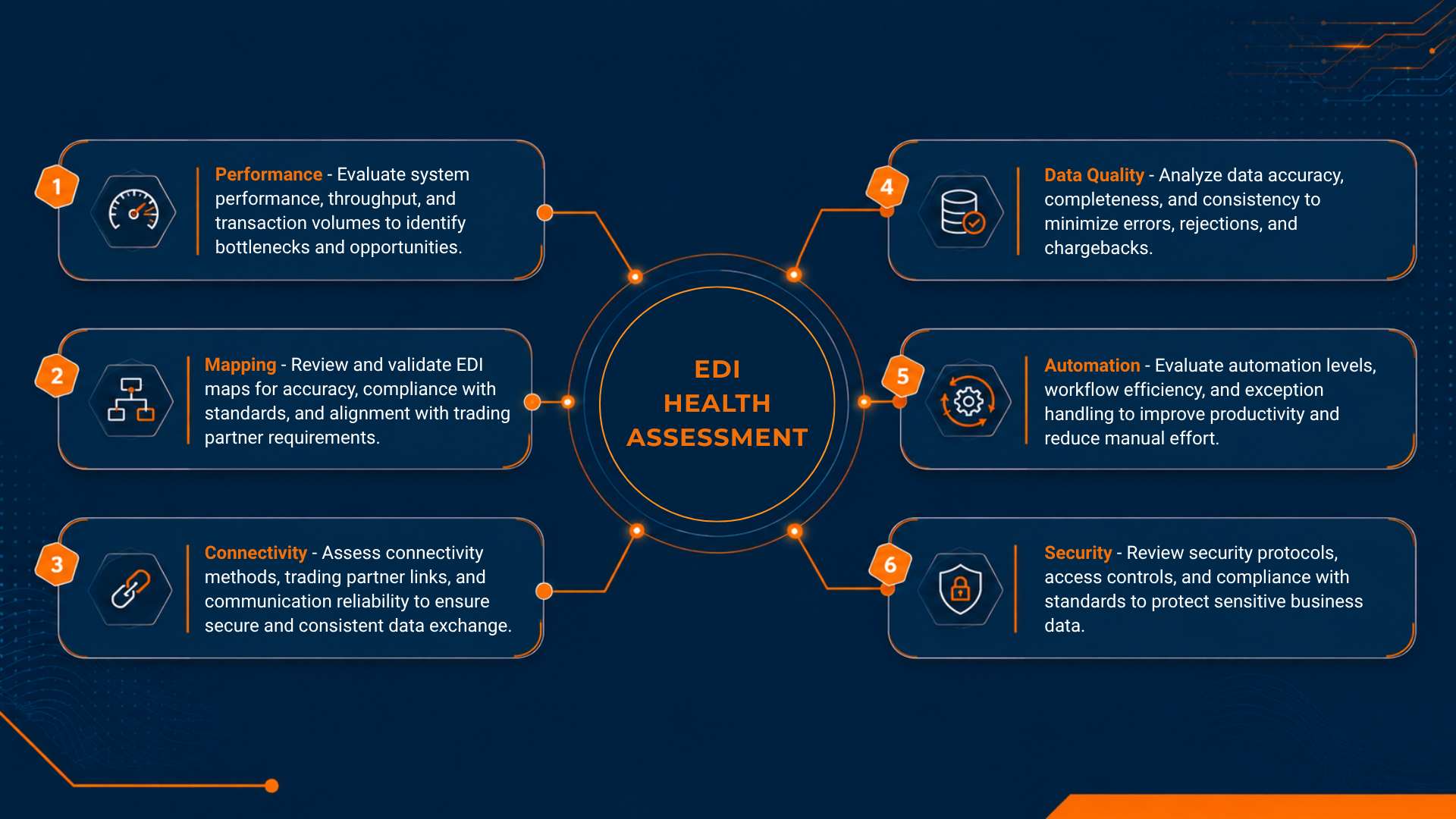
Why Businesses Invest in an EDI Health Assessment
Making sure your EDI ecosystem can continue to meet changing business needs is the goal of an EDI Health Assessment, which goes beyond simply detecting current problems. Even a stable EDI system may eventually develop hidden inefficiencies as transaction volumes increase, trading partner requirements shift, and technological landscapes change. A thorough evaluation offers insightful information on the state of your EDI ecosystem, assisting businesses in enhancing performance, lowering risk, and being ready for expansion.
Organizations typically conduct an EDI Health Assessment to:
- Identify hidden inefficiencies in EDI mappings, workflows, and integrations before they affect business operations.
- Reduce transaction errors and chargebacks by uncovering data quality, mapping, and compliance issues.
- Improve trading partner onboarding by streamlining integration processes and reducing implementation time.
- Optimize EDI performance by identifying bottlenecks that slow transaction processing or increase manual intervention.
- Evaluate system scalability to ensure the EDI environment can support business growth and increasing transaction volumes.
- Prepare for ERP or cloud migrations by assessing existing integrations, dependencies, and potential migration risks.
- Modernize legacy EDI platforms by understanding the current environment before implementing new technologies.
- Strengthen compliance with trading partner requirements, industry standards, and implementation guides.
- Increase visibility into the overall health of the EDI environment through a comprehensive operational review.
- Reduce operational costs by eliminating redundant processes, outdated mappings, and inefficient workflows.
- Improve business continuity by identifying risks before they result in transaction failures or system disruptions.
- Develop a strategic roadmap for EDI optimization, modernization, and long-term digital transformation.
Also Read: EDI Standards Explained: ANSI X12, EDIFACT, and What Actually Differs
What an EDI Health Assessment Actually Uncovers
Even though thousands of transactions can be processed daily in an EDI environment without any visible problems, there are still unseen inefficiencies that impair operational effectiveness, raise expenses, and create needless business risk. Below are some of the most important areas evaluated during an EDI Health Assessment.
Platform Performance
Transactions should be processed consistently, effectively, and at scale using a high-performing EDI platform. Performance problems that previously appeared minor can develop into serious operational bottlenecks as transaction volumes rise.
An EDI Health Assessment evaluates:
- Document processing speed
- Queue delays and processing backlogs
- System resource utilization
- Transaction throughput
- Scalability to support future growth
- Performance bottlenecks affecting business operations
The objective is to find performance limitations before they cause shipment delays, order processing delays, or unhappy business partners.
Mapping Quality
The translation of company data between internal processes and standardized EDI documents is determined by EDI maps. Organizations frequently develop duplicate or out-of-date mappings over time, which increases maintenance costs and decreases productivity.
An assessment reviews:
- Outdated or obsolete maps
- Duplicate mapping logic
- Data transformation accuracy
- Unnecessary customizations
- Reusable mapping components
- Mapping consistency across trading partners
Mapping optimization increases maintainability, lowers errors, and makes system updates and onboarding easier in the future.
Trading Partner Connectivity
Continuous document interchange requires dependable communication with trading partners. Crucial business transactions may be delayed by connection issues, expired certifications, or improperly configured communication protocols.
An EDI Health Assessment evaluates:
- AS2 connectivity
- SFTP connections
- VAN communications
- Certificate validity and renewal processes
- Communication failures
- Retry and recovery mechanisms
Organizations can enhance transaction dependability and lessen disruptions brought on by connectivity problems by examining these areas.
Data Quality Issues
Poor data quality can lead to rejected orders, invoice discrepancies, compliance problems, and manual revisions even when docs are successfully transferred.
An assessment identifies:
- Missing mandatory fields
- Invalid or inconsistent values
- Duplicate records
- Translation and validation failures
- Master data inconsistencies
- Data integrity issues across systems
Enhancing data quality promotes more dependable business processes and lowers downstream mistakes.
Process Automation Gaps
Manual tasks are still used in many EDI setups, which slows down operations and raises the possibility of human error. These inefficiencies frequently appear gradually and permeate daily operations.
An assessment looks for:
- Manual file uploads
- Spreadsheet-based processes
- Manual data validation
- Email-driven approvals
- Repetitive administrative tasks
- Unnecessary human intervention
Organizations can increase productivity, save operating costs, and speed up transaction processing by identifying automation options.
Error Handling and Visibility
EDI problems could go unnoticed until they have an impact on clients or trading partners if there are insufficient monitoring and visibility. An organization's ability to recognize, look into, and fix transaction issues is assessed through a health assessment.
Areas reviewed include:
- Transaction monitoring
- Automated alerting
- Operational dashboards
- System logging
- Exception management
- Root cause analysis capabilities
Increasing visibility lowers downtime, increases operational trust, and facilitates quicker issue resolution.
Security and Compliance
Sensitive company data is shared by EDI systems, thus security and compliance are crucial elements of a successful integration environment. An evaluation looks at whether the right measures are in place to support legal requirements and safeguard data.
Typical review areas include:
- User access controls
- Data encryption
- Audit trails
- Digital certificate management
- Authentication mechanisms
- Compliance with HIPAA, PCI DSS, SOX, GDPR, and other applicable industry requirements
Reducing organizational risk while upholding confidence with clients and business partners is made possible by addressing security flaws.
Integration Architecture
Hardly do contemporary EDI platforms function independently. They are usually integrated with middleware, CRM apps, transportation platforms, warehouse management systems, ERP systems, and APIs.
An EDI Health Assessment reviews:
- ERP integrations
- WMS connectivity
- TMS integrations
- CRM connections
- API integrations
- Middleware architecture
- Integration scalability and maintainability
A well-thought-out integration architecture facilitates long-term digital transformation projects, enhances data flow, and makes future improvements easier.
Operational Readiness
An EDI environment's health cannot be determined solely by technology. For a platform to remain robust and scalable, operational procedures, documentation, and governance are all equally crucial.
An assessment evaluates:
- System documentation
- Ownership and governance
- Support responsibilities
- Service Level Agreements (SLAs)
- Disaster recovery plans
- Business continuity readiness
- Operational procedures
Organizations may respond to disasters more successfully, enroll new trading partners more quickly, and maintain stable service levels with strong operational preparedness.
Also Read: Gentran to IBM Sterling: A Migration Guide for Teams Running Legacy EDI
What an EDI Health Assessment Doesn't Cover
An EDI Health Assessment is not a restoration or implementation project, but it does offer a thorough examination of your EDI ecosystem. Finding inefficiencies, identifying hazards, and suggesting areas for improvement are its main goals.
An EDI Health Assessment does not:
- Rewrite or optimize EDI maps: It identifies outdated, duplicate, or inefficient mappings but does not redesign or rebuild them.
- Migrate EDI platforms: It evaluates migration readiness and potential risks but does not execute the migration process.
- Onboard new trading partners: It reviews onboarding processes and identifies improvement opportunities without performing new partner integrations.
- Fix ERP customizations: It highlights integration or compatibility issues related to ERP systems but does not modify ERP configurations or custom code.
- Replace legacy infrastructure: It assesses whether existing platforms are limiting performance or scalability but does not deploy new hardware or software.
- Clean historical data: It identifies data quality issues and inconsistencies without correcting or migrating historical business data.
- Redesign business processes: It uncovers process inefficiencies and automation gaps but does not implement new workflows or operational procedures.
Common Issues Identified During an EDI Health Assessment
Despite the fact that every EDI system is different, many businesses face comparable difficulties regardless of their sector or technology stack. By identifying these persistent problems, an EDI Health Assessment enables companies to focus on enhancements that increase performance, lower operational risk, and promote long-term scalability.
| Assessment Area | Common Finding | Business Impact |
|---|---|---|
| Mapping | Redundant or outdated EDI maps | Increased maintenance effort and higher support costs |
| Connectivity | Expired AS2 certificates or unstable communication protocols | Failed transmissions and disrupted document exchange |
| Monitoring | Limited alerts and inadequate transaction visibility | Longer issue detection and resolution times |
| Data Quality | Missing mandatory fields, invalid values, or inconsistent master data | Rejected transactions, compliance issues, and manual rework |
| Automation | Manual file uploads, validations, or approval workflows | Slower processing, reduced productivity, and increased human error |
| Documentation | Outdated trading partner implementation guides and process documentation | Longer onboarding cycles and inconsistent partner integrations |
| Platform Performance | Processing bottlenecks and transaction queue delays | Slower order processing and reduced operational efficiency |
| Integration Architecture | Point-to-point integrations and legacy middleware dependencies | Limited scalability and increased complexity during system changes |
| Security & Compliance | Weak access controls, expired certificates, or incomplete audit trails | Higher security risks and potential compliance violations |
| Operational Readiness | Undefined ownership, outdated support procedures, or missing disaster recovery plans | Slower incident response and increased business continuity risk |
Signs It's Time for an EDI Health Assessment
When an EDI Health Assessment is conducted before significant business or technological changes, rather than after issues start to impact operations, it yields the best results. Organizations may better plan, identify risks early, and make sure their EDI environment is ready to support future projects with the least amount of disturbance by scheduling an evaluation at the appropriate time.
| When to Schedule | Why It Matters |
|---|---|
| Before an ERP Migration | Assess existing integrations, mappings, and dependencies to reduce migration risks and ensure a smoother transition. |
| Before a Cloud Migration | Evaluate platform readiness, communication protocols, security, and scalability before moving EDI workloads to the cloud. |
| Before Onboarding Major Retailers or Trading Partners | Ensure your EDI environment can meet new implementation guides, compliance requirements, and increased transaction volumes. |
| Before a Merger or Acquisition | Review existing EDI platforms, trading partner networks, and integration architecture to simplify consolidation and avoid operational disruptions. |
| After a Period of Rapid Business Growth | Confirm your EDI platform can support higher transaction volumes, additional partners, and expanding business operations without performance issues. |
| Before an EDI Modernization Initiative | Establish a clear baseline of your current environment to prioritize improvements and build an effective modernization roadmap. |
| As Part of an Annual Health Review | Conduct a proactive assessment at least once a year to identify emerging risks, maintain compliance, and keep the EDI environment optimized as business needs evolve. |
Also Read: EDI vs. API vs. JSON: Key Differences and When to Use Each
Moving Ahead
The most productive EDI environments are those that are routinely assessed and continuously enhanced, not necessarily those with the fewest obvious problems. Before problems start to impact your company, a regular EDI Health Assessment can help you find ways to improve performance, lower operational risk, and fortify your integration plan. You can make sure your EDI ecosystem is durable, scalable, and prepared for the future by taking the time to assess its current state.