
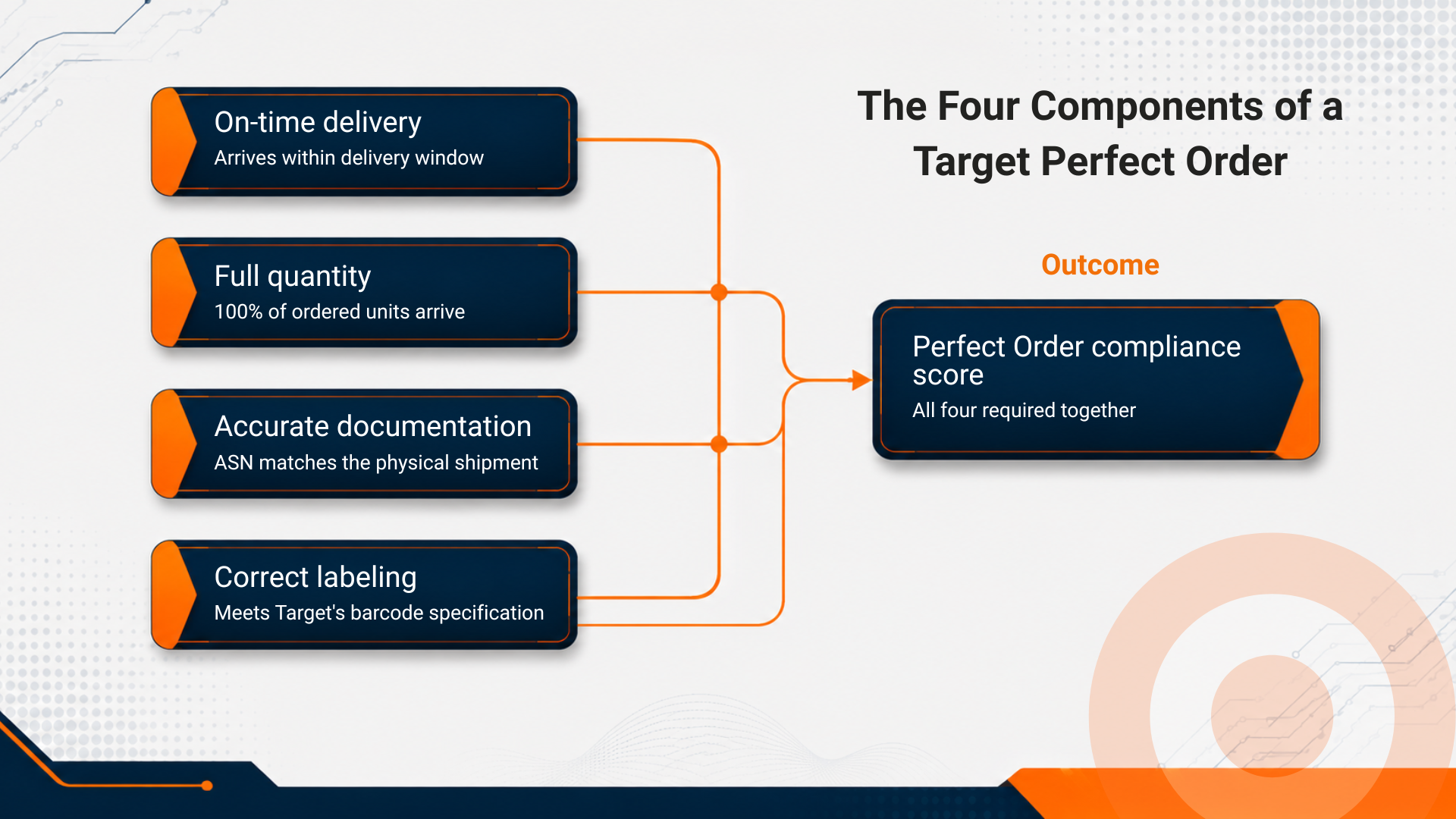
Target's Perfect Order Program brings four requirements together into one compliance score: on-time delivery, full quantity, accurate documentation, and correct labeling. A shipment needs to satisfy all four at once to count as a Perfect Order.
Suppliers who have tracked fill rate or on-time percentage as separate numbers gain a clearer picture once they see how these four pieces combine into a single evaluation.
Target updates the specific requirements and penalty structure within this program periodically, so suppliers can confirm current thresholds, effective dates, and penalty details directly through their Target supplier agreement and vendor portal.
The pattern underneath every version of the program stays consistent: Perfect Order performance traces back to the same EDI document accuracy and timing factors that drive most retailer compliance programs generally.
Building internal reporting that tracks all four components together, rather than a single headline number, gives suppliers the clearest view of Perfect Order performance.
What the Program Evaluates
A Perfect Order requires a shipment to arrive on time, in full quantity, with accurate shipping documentation, and correct labelling, all at once. A shipment can arrive on time and complete and still miss the standard if the ASN data does not line up with the physical shipment, or if labeling does not meet Target's specification.
This four-part structure sets Perfect Order programs apart from single-metric compliance standards.
Because the standard combines four requirements into one pass-or-fail evaluation per shipment, a supplier's aggregate compliance percentage can land lower than each individual component would suggest, even when on-time rate, fill rate, and documentation accuracy each perform reasonably well on their own.
A shift in Perfect Order rate over time reflects this same math rather than necessarily signalling a change in any one component. Comparing Perfect Order rates across periods works best when suppliers also account for shipment mix, since a higher share of complex, multi-carton orders in one period naturally creates more surface area for a labeling or documentation miss, independent of any change in process quality.
Also Read: EDI Standards Explained: ANSI X12, EDIFACT, and What Actually Differs
Where the Four Requirements Connect
Timing, quantity, documentation, and labelling often live with different internal teams. Connecting them under one shared view is what turns four solid individual performances into one strong combined score.
A warehouse team focused on shipment timing and a documentation team focused on ASN accuracy can each perform well on their own measures. Giving one person visibility across all four requirements for every shipment is what closes the loop between them.
Labelling deserves its own attention because label specification updates sometimes arrive through vendor portal bulletins or category-specific notices rather than through the EDI document flow itself. Suppliers who monitor both channels, EDI signals and portal bulletins, catch a labelling requirement change as soon as Target publishes it.
The most durable fix is usually a designated point of accountability: someone whose role explicitly includes tracking Perfect Order performance across all four components and routing findings back to the specific team, warehouse, EDI, or compliance, responsible for each one.
The EDI Connection: ASN and Invoice Accuracy
The EDI documents most directly tied to Perfect Order performance are the 856 advance ship notice and the 810 invoice. Both carry the quantity and item-level data Target's system checks against the physical shipment and the original purchase order.
An ASN that overstates or understates carton contents, or that carries incorrect item-level detail, affects the documentation accuracy component of the score directly, regardless of whether the physical shipment itself was correct.
Because Perfect Order scoring evaluates all four components together, one EDI data quality issue can lower the compliance score even on shipments that were fulfilled correctly and delivered on time. This is exactly why EDI accuracy earns attention as a Perfect Order lever in its own right, not only as an OTFR or ASN-specific concern.
ASN and invoice data feed Target's compliance scoring independent of whatever internal quality checks a supplier runs before transmission. A supplier that verifies shipment accuracy internally and transmits an ASN generated from an outdated map can still see its Perfect Order score affected by a transmission issue rather than an actual fulfillment problem.
Building a Compliance Strategy Around the Full Standard
An effective strategy starts with breaking down Perfect Order misses by which specific component, timing, quantity, documentation, or labelling, caused each one, rather than managing to the aggregate score alone. That breakdown shows clearly whether a fulfilment process, an EDI data accuracy issue, or a labelling and documentation step needs attention, since each call for a different fix.
Cross-functional ownership matters more for a four-part program like this than for a single-metric standard, since no single team, warehouse, EDI, or compliance, can guarantee a Perfect Order outcome alone. A shared view of performance across those functions, tied back to the specific EDI documents driving the score, turns an aggregate percentage into a clear improvement plan.
Suppliers who reach this level of clarity typically find that a small number of fixes, like an updated map, a tightened ASN transmission window, or a corrected label template, close most of the Perfect Order gap, rather than requiring a broad operational overhaul across every function at once.
The underlying goal of Perfect Order, like most retailer compliance programs, is operational reliability the retailer can plan around. Suppliers who build toward that goal directly, rather than treating the score only as a number to manage, find the process discipline easier to sustain over time.
Also Read: EDI Health Assessment: What It Uncovers and What It Doesn't
Conclusion
Target's Perfect Order Program measures more at once than a single-metric standard ever could, and that is exactly what makes it a clearer signal of overall supply chain health. Suppliers who connect timing, quantity, documentation, and labeling under one shared view, tied back to the EDI documents driving each component, build a compliance practice that holds up across Target and carries over directly to Walmart's OTIF, Amazon's Receive Accuracy, and Costco's ASN requirements.
A structured EDI health assessment gives suppliers a clear starting point, showing exactly which of the four components needs attention first and how that fix carries over to every other retailer relationship.