
Walmart's On Time In Full program, known as OTIF, ranks among the most consequential supplier compliance requirements in US retail. The penalty structure carries real financial stakes, and it touches every order a supplier ships to Walmart.
It also reflects a broader pattern in retailer EDI compliance for 2026. Walmart, Target, Amazon, and Costco are each strengthening how closely a shipment's EDI documents need to match the physical shipment for compliance.
This post covers what OTIF measures, what a penalty costs, how OTIF connects to that broader 2026 trend, and how targeted EDI improvements address the root cause directly.
The figures and mechanics here reflect Walmart's publicly reported OTIF framework. Retailers revise these programs regularly, so suppliers can confirm current percentages and thresholds directly with their Walmart supplier agreement, since terms vary by category.
OTIF misses rarely happen at random. They cluster around a short list of identifiable causes, and teams can resolve most of them without a full operational overhaul.
Also Read: EDI Chargebacks Explained: Hidden Costs, Common Causes, and Prevention
What OTIF Actually Measures
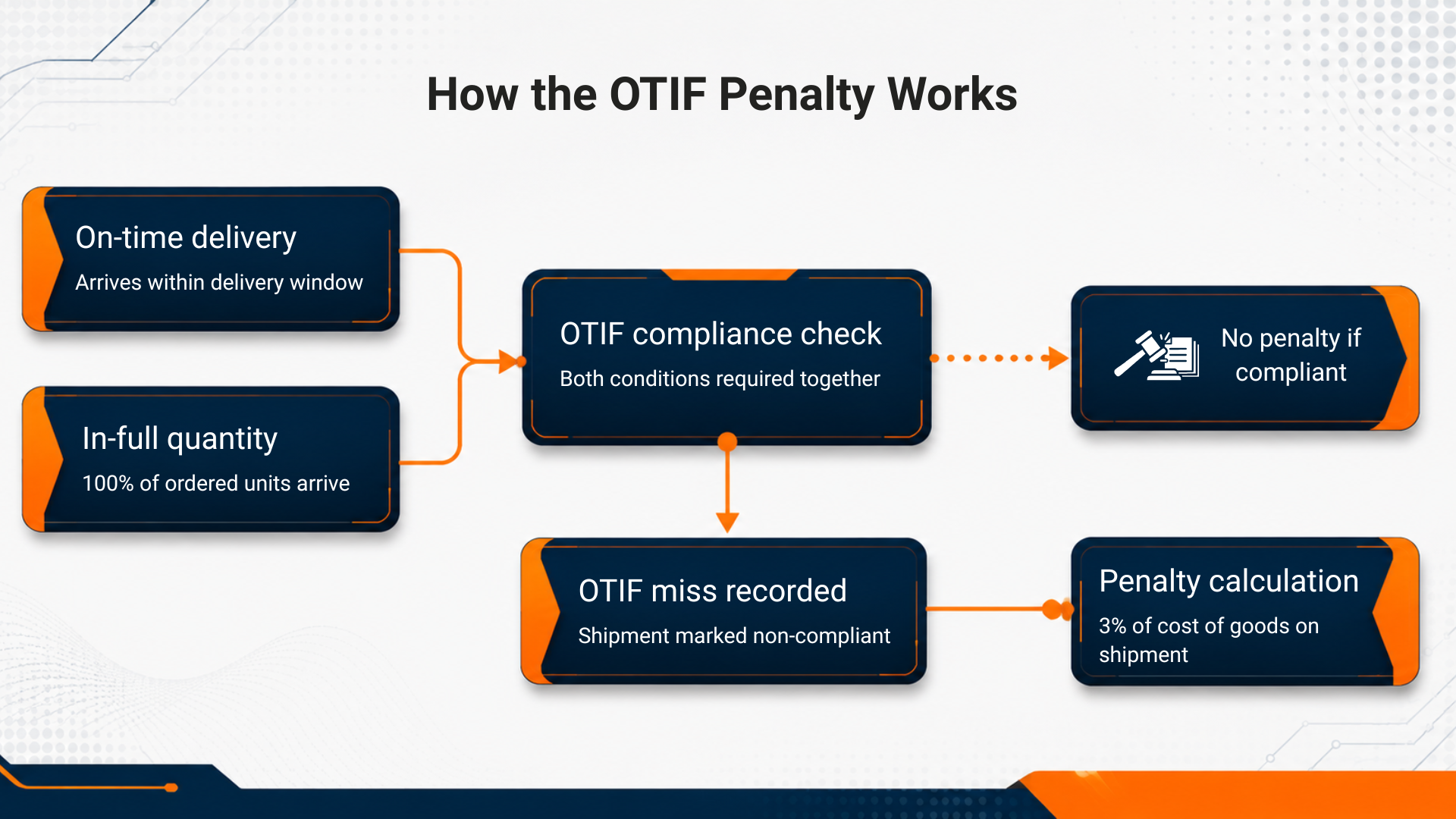
On Time In Full checks two things for every shipment against every purchase order: timing and quantity. A shipment counts as compliant only when it arrives within Walmart's specified delivery window and carries the full ordered quantity together.
This dual check makes OTIF more demanding than tracking either metric alone. A supplier can post strong separate scores for on-time delivery and fill rate, yet see a middling combined OTIF number, because Walmart measures both conditions together on the same shipment rather than averaging them separately across a broader set of orders.
Walmart tracks OTIF at the supplier level and sets a minimum compliance percentage across all shipments. The program rewards suppliers who plan and execute reliably against Walmart's replenishment expectations.
What a Penalty Costs
Walmart typically assesses OTIF penalties as a percentage-based cost of goods sold penalty on any shipment that misses the on-time and in-full standard, and deducts the amount directly from supplier payment.
Because the penalty ties to shipment value rather than a flat fee, cost scales directly with order size. A large order that misses the window by a narrow margin carries a proportionally larger penalty than a small order with the same percentage miss.
This scaling effect means the largest, most valuable orders carry the highest financial stakes, since a small process variance on a high-volume shipment compounds into the largest absolute deduction. The impact also compounds across a supplier's full order volume with Walmart rather than staying isolated to one shipment: a modest percentage on any single order adds up meaningfully across hundreds or thousands of shipments a year. Unlike a one-time chargeback for a documentation error, OTIF penalties recur every shipment cycle a supplier trades with Walmart, which turns a modest per-shipment percentage into a line item worth building into standard financial planning.
Also Read: Build vs. Buy an EDI Platform: How to Choose the Right Solution for Your Business
Where OTIF Failures Actually Originate: The EDI Root Cause
OTIF compliance depends heavily on accurate, timely EDI document exchange. The 850 purchase order sets the delivery window expectation, and the 856 advance ship notice gives Walmart's system the data it needs to track whether a shipment is on time and matches the ordered quantities.
A late or inaccurate 856 carries weight beyond a simple ASN penalty. It can lead Walmart's OTIF tracking to register the shipment as non-compliant, even when the physical goods arrive correctly.
A short list of factors typically explains most OTIF variance:
- An outdated map that generates incorrect quantity or date fields on the 856
- A transmission delay that pushes the ASN outside the required window
- A fulfillment process that runs on a different timeline than the 850 requests
- Each of these traces back to a specific, diagnosable point in the EDI document chain.
Fulfillment planning deserves particular attention because it's the least visible factor in OTIF performance. Aligning warehouse and planning schedules to the specific delivery window on each incoming 850, rather than a standard internal lead time, keeps OTIF risk low on every shipment, regardless of how well the EDI documents themselves are formatted.
Certificate and connection reliability play a role too, though less often than mapping or timing. A stable AS2 connection keeps transmission timing consistent and prevents the kind of intermittent delay that can look like a fulfillment issue but actually originates upstream, in the connection itself.
Building Strong EDI Compliance Across Every Retailer
Strong compliance across OTIF, Perfect Order, Receive Accuracy, or Costco's ASN requirements starts with clear visibility into shipment-level performance. Breaking results down by cause, on-time versus in-full, and by root cause within the EDI chain gives a supplier the detail needed to target remediation effectively.
Segmenting results by cause usually shows that a small number of specific issues, like an outdated map or a delayed ASN transmission window, drive most of the penalty total.
From there, strengthening performance usually means:
- Validating maps against each retailer's current implementation guide
- Tightening 856 transmission timing relative to actual shipment
- Confirming fulfillment planning works directly from the delivery window in the original 850
Suppliers that manage this well across multiple trading partners keep a few numbers in view on an ongoing basis. A deduction dispute rate shows how many penalties are worth contesting, and a chargeback win-back rate shows how many contested deductions get recovered. Tracking both keeps silent deductions on the remittance statement visible early, rather than adding up quietly over time.
A compliance watch board that flags emerging drift by retailer and by root cause protects those gains, catching drift early, well before it accumulates into a quarter's worth of deductions. Suppliers with a stable, well-managed compliance rate across Walmart, Target, Amazon, and Costco build this kind of ongoing monitoring into standard practice, rather than treating compliance as a one-time project.
Also Read: EDI Standards Explained: ANSI X12, EDIFACT, and What Actually Differs
Concluding Thoughts
Walmart's OTIF penalty offers a clear window into a wider shift. Retailers are moving compliance enforcement closer to the data itself, checking not just whether a shipment arrived, but whether every EDI document behind it matches the physical reality of that shipment.
Suppliers who treat this as one connected EDI discipline, rather than four separate retailer relationships, build a stronger position heading into 2026. The same map validation, transmission timing, and fulfillment alignment that reduce Walmart OTIF exposure carry over directly to Target's Perfect Order Program, Amazon's Receive Accuracy scorecard, and Costco's ASN requirements.
A structured EDI health assessment gives suppliers a clear starting point, showing exactly where exposure concentrates today and which fixes deliver the fastest return across every trading partner.