
Organizations planning to migrate off IBM Sterling most often land on one of two destination platforms, Boomi or Cleo. The choice between them shapes not just the migration project itself, but years of operations afterward. This comparison speaks directly to teams already past the build-versus-buy and general platform-selection questions, now weighing these two commercial options directly against each other as a Sterling replacement.
The right answer depends heavily on what the organization needs beyond core EDI capability, and how much migration risk each path carries given the organization's existing trading partner complexity.
Both platforms handle the large majority of trading partner requirements well as Sterling replacements. The differentiation that matters most shows up in integration scope, migration approach, and total cost of ownership rather than in raw EDI capability alone.
This comparison assumes the harder decision, whether to stay on Sterling or migrate at all, has already been made. If that decision is still open, it deserves its own dedicated evaluation before committing to either destination platform discussed here.
Also Read: Gentran to IBM Sterling Migration: A Legacy EDI Modernization Guide
What to Compare When Replacing IBM Sterling
The criteria that now support the organization's trade partner network and integration environment should be taken into consideration while evaluating a Sterling replacement. EDI standards and document categories, communication protocols, trading partner enrollment, mapping and transformation, applications and API integration, monitoring, security, installation options, migration needs, internal administration, assistance, scalability, and total cost of ownership are important factors to take into account.
Teams can assess Boomi and Cleo against the same operational and technical needs by establishing these criteria prior to platform comparison.
Boomi as the Destination: Broader Integration Scope
Boomi makes the most sense as a Sterling replacement for organizations whose integration needs extend meaningfully beyond EDI, connecting internal applications, e-commerce platforms, and API-based trading partners alongside traditional EDI relationships. Migrating to Boomi consolidates what might otherwise be several separate integration tools into a single platform, simplifying the technology stack even though the EDI-specific migration work itself is comparable in scope to migrating to any other platform.
Organizations choosing this path can expect a broader platform learning curve than a narrower EDI-to-EDI move, since Boomi's configuration model and terminology differ from Sterling's in ways that go beyond EDI-specific mapping.
Teams with existing Boomi experience elsewhere in the organization ramp up faster here, and organizations already running Boomi for other integration work benefit from evaluating early whether their existing license and infrastructure can absorb the added EDI workload, or whether a separate environment fits better once real trading partner volume moves onto the platform.
Cost structure is worth comparing directly against current Sterling licensing, since Boomi's pricing model differs meaningfully from Sterling's. A like-for-like comparison means mapping both platforms' pricing units, transactions, connections, or a flat platform fee, onto the organization's actual expected usage rather than comparing list prices at face value.
Cleo as the Destination: Focused EDI Replacement
Cleo fits organizations whose core need is a more manageable, mid-market-oriented EDI platform without a broader integration mandate. Because Cleo is positioned specifically around EDI and B2B trading partner management, the migration conversation stays narrowly focused on trading partner maps, protocols, and document types, without the additional scope of a general integration platform's wider feature set.
This narrower focus typically means a faster, more predictable migration timeline for organizations whose Sterling usage was itself primarily EDI-focused. Cleo's onboarding tooling reduces manual mapping effort compared to a from-scratch rebuild on a more general platform, and its implementation approach leans on guided configuration for common retail trading partner setups, which shortens the timeline further for organizations whose trading partner list consists mostly of well-established, commonly supported retailers.
Organizations without an existing integration platform investment elsewhere in the business, and without a near-term plan to expand significantly beyond EDI, generally find Cleo the lower-risk, lower-complexity migration target of the two.
Migration Planning: What's Common to Both Paths
Regardless of destination, a Sterling migration starts strongest with a full inventory of active trading partners, standards, protocols, and document types currently in use. This inventory becomes the master checklist that keeps every trading partner connection accounted for during the move.
From there, four planning items carry the most weight on either path:
- Phased, wave-based migration. Move lower-risk trading partners first and validate thoroughly before advancing to higher-volume, higher-risk connections.
- Parallel running. Keep Sterling live alongside the new platform during each wave as a safety net, regardless of which destination platform is chosen.
- Certificate and connection changes. A new platform typically means new AS2 identifiers or connection endpoints, and every trading partner needs advance notice to reconfigure on their end. This deserves its own line item and proactive planning across a large trading partner base.
- Early trading partner communication. Building the notification plan early in the migration timeline, rather than once technical cutover dates are set, gives trading partners the lead time they need to make their own changes smoothly.
Also Read: EDI Chargebacks Explained: Hidden Costs, Common Causes, and Prevention
Making the Call: Fit Over Feature Comparison
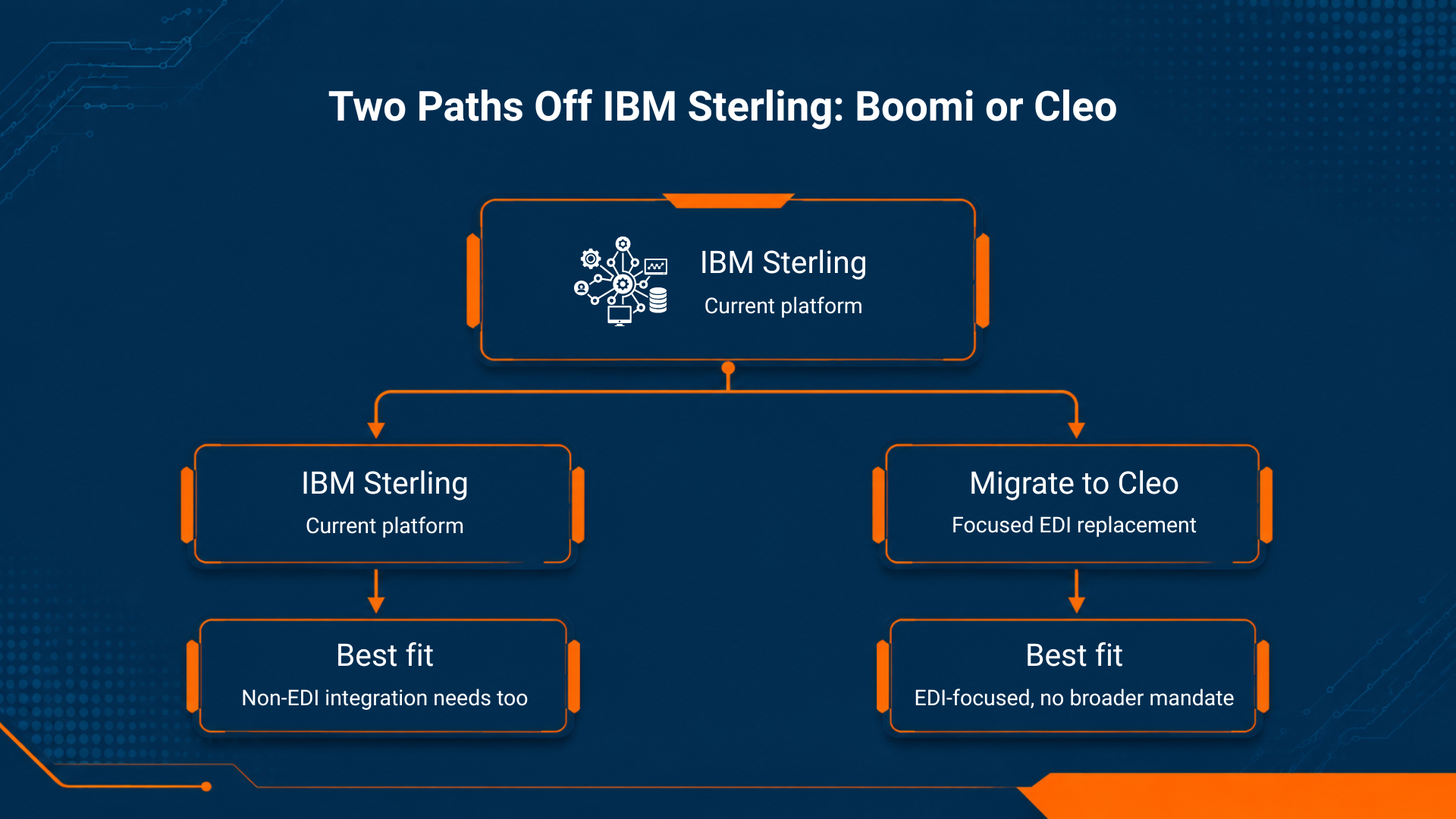
The decision ultimately comes down to how much of the organization's integration need sits inside EDI specifically versus spanning a broader set of applications and connections. An organization with a clean, EDI-focused need is generally better served by Cleo's narrower, purpose-built approach. An organization with substantial non-EDI integration requirements gets more consolidated value from Boomi, even if the EDI-specific migration work is comparably sized either way.
A few final checks are worth running before committing to either path:
- Resource the migration as a real project. Teams should plan and resource the migration with dedicated attention, not squeeze it into existing staff's spare capacity. Migrations resourced as genuine projects run with fewer delays and cleaner validation than ones treated as a background task.
- Model against the next three to five years, not just today. A migration is disruptive enough that repeating it sooner than necessary is worth avoiding, so weigh each platform's fit against where the organization expects to be, not only its current trading partner list.
- Involve the team that will operate the platform day to day. Bringing that team into the evaluation, not just the eventual migration execution, tends to produce a better long-term fit than a decision leadership or procurement makes alone.
What This Means for Suppliers Going Forward
Boomi and Cleo both replace Sterling capably; the real decision point is how much of the organization's integration footprint lives inside EDI versus stretching across other applications and connections. Getting that scoping question right up front, before comparing feature lists or list prices, is what determines whether the migration itself goes smoothly and whether the destination platform still fits three to five years from now.
A structured, vendor-neutral EDI platform evaluation gives organizations a clear, objective way to answer that scoping question before committing to either path.
Also Read: IBM Sterling, Boomi, or Cleo: A Vendor-Neutral Comparison for 2026