
Every tap, swipe, and login creates another opportunity for attackers to exploit a mobile application. Although secure code is crucial, it does not ensure that undiscovered vulnerabilities won't find their way into production. Mobile app penetration testing is essential in this situation because it helps businesses find exploitable flaws before attackers do.
In this blog, we'll explore the OWASP MASVS framework, walk through a practical mobile app penetration testing checklist, and explain the key security controls every organization should verify to strengthen its mobile application security.
What Is OWASP MASVS?
OWASP MASVS (Mobile Application Security Verification Standard) is a structure that outlines the security requirements a mobile application should implement. Created by the Open Worldwide Application Security Project (OWASP), MASVS provides a uniform standard for evaluating the security of iOS and Android applications and helps development and security teams establish consistent mobile application security requirements.
MASVS defines what security controls an application should implement across areas such as storage, cryptography, authentication and authorization, network communication, platform interaction, code quality, resilience, and privacy. It does not prescribe the testing methods or tools used to verify those controls.
OWASP's current mobile security model connects MASVS controls to MASWE weaknesses and MASWE weaknesses to MASTG tests, creating a traceable path from a security requirement to a specific weakness and the technical testing guidance used to assess it.
OWASP MASVS vs. OWASP MASTG vs. OWASP MASWE: What's the Difference?
MASVS, MASWE, and MASTG work together as complementary components of OWASP's mobile application security approach. MASVS defines what the application should implement, MASWE identifies the weaknesses that can prevent those controls from being achieved, and MASTG provides the technical testing guidance used to assess those weaknesses.
| Criteria | OWASP MASVS | OWASP MASWE | OWASP MASTG |
|---|---|---|---|
| Primary Purpose | Defines the security requirements and controls that a mobile application should implement to achieve a secure baseline. | Defines the weaknesses that can cause a mobile application to fail its MASVS security requirements. | Provides technical testing guidance for assessing MASWE weaknesses and validating mobile application security. |
| Focus | Focuses on what needs to be secured, including authentication, cryptography, data storage, network communication, platform interaction, code quality, resilience, and privacy. | Focuses on what can go wrong when a MASVS control is not properly implemented or when a security weakness is present. | Focuses on how to test weaknesses associated with MASVS controls using practical testing methodologies and techniques. |
| Primary Users | Security architects, developers, DevSecOps teams, product owners, compliance teams, and organizations establishing mobile security requirements. | Security architects, developers, penetration testers, application security engineers, and security teams analyzing mobile application weaknesses. | Penetration testers, application security engineers, red teams, and security consultants conducting mobile application security assessments. |
| Role in the SDLC | Helps define security requirements during application design, development, security reviews, and release preparation. | Helps teams understand and classify weaknesses that can prevent the application from meeting defined security requirements. | Supports technical verification during security testing, validation, and post-development assessments before release. |
| Key Deliverable | A standardized set of security requirements and controls that organizations can use to assess the security posture of a mobile application. | A structured catalog of mobile application weaknesses mapped to relevant MASVS controls and connected to technical testing guidance. | A comprehensive technical testing guide containing procedures, techniques, and tools for assessing mobile application security. |
| Business Value | Establishes a consistent security baseline, strengthens secure development practices, and helps organizations align mobile applications with recognized security requirements. | Creates traceability between security requirements and specific weaknesses, helping teams understand where and why an application may fail a security control. | Enables organizations to identify and validate exploitable weaknesses, verify implemented security controls, and strengthen overall mobile application security through effective testing. |
| How It Connects | Defines the security requirement. | Identifies the weakness associated with the requirement. | Provides the technical testing approach for weaknesses. |
Common Mobile App Vulnerabilities Found During Penetration Testing
Insecure Authentication - Attackers can more easily obtain unwanted access when authentication systems are weak, such as inadequate session management, weak password rules, or the lack of multi-factor authentication (MFA). Penetration testing verifies if user profiles and sensitive app functionality are adequately protected by authentication controls.
Broken Authorization - Inadequate permission checks can enable users to view data or carry out actions outside their granted privileges, even in cases when authentication is properly performed. Testers evaluate how uniformly role-based access controls are applied throughout the application and its backend APIs.
Insecure Data Storage - Sensitive data should never be kept on a device in an unsafe manner. This includes encryption keys, credentials, authentication tokens, and personally identifiable information (PII). Penetration testing for mobile apps assesses how data is kept and whether it can be retrieved from iOS or Android devices.
Weak Cryptographic Implementation - Sensitive data may be exposed by using antiquated encryption methods, shoddy key management procedures, or poorly executed cryptography. Security testing confirms the use of robust encryption techniques to safeguard data while it is in transit and at rest.
Insecure Network Communication - Man-in-the-middle (MITM) attacks can occur in applications that do not properly check TLS certificates or enforce encrypted communication channels. In order to find vulnerabilities in certificate validation and insecure data transmission, penetration testers examine network traffic.
API Security Weaknesses - For data sharing and business operations, the majority of mobile applications rely on backend APIs. Every mobile app penetration test must include API security because insecure APIs can create risks including failed authentication, high data exposure, insufficient authorization, and poor input validation.
Hardcoded Secrets - The risk of unwanted access is greatly increased when credentials, encryption keys, access tokens, or API keys are directly embedded in application code. To find accessible secrets before hackers can take advantage of them, testers use static testing and reverse engineering.
Insufficient Runtime Protection - It is simpler to alter and reverse engineer applications that do not have runtime integrity checks, root detection, jailbreak detection, or anti-tampering methods. Penetration testing assesses how well these defenses fend off typical attack methods.
Mobile App Penetration Testing Methodology
While the exact approach may vary depending on the application's architecture and business requirements, the following methodology aligns with OWASP's mobile security testing guidance. MASTG provides technical testing guidance for assessing weaknesses mapped to MASVS controls.
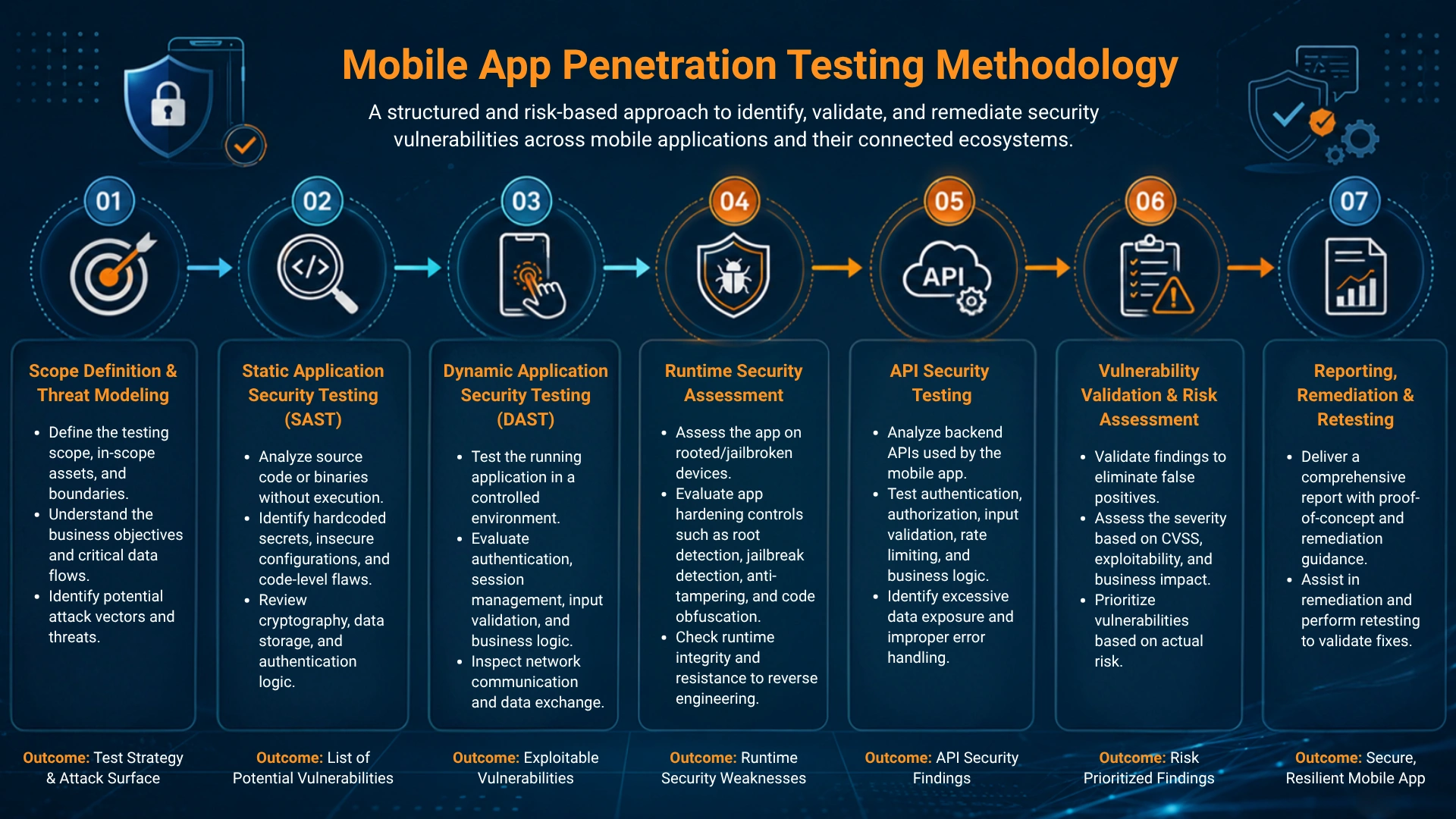
Tools To Use During Mobile App Penetration Testing in 2026
Static evaluation, dynamic testing, real-time instrumentation, reverse engineering, and API security testing are all used in modern mobile app penetration testing. The tools below support security professionals in assessing mobile applications against OWASP MASVS requirements and the weaknesses and testing guidance associated with MASWE and MASTG.
| Tool | Primary Purpose | Platform | Typical Use Cases |
|---|---|---|---|
| Burp Suite Professional | Intercepting and modifying application traffic | Android & iOS | API security testing, authentication and authorization validation, session management, request manipulation, fuzzing, and identifying insecure network communication. |
| MobSF (Mobile Security Framework) | Automated static and dynamic mobile application analysis | Android & iOS | Detecting hardcoded secrets, insecure configurations, weak cryptography, manifest issues, exported components, and mapping findings to OWASP MASVS controls. |
| Frida | Dynamic runtime instrumentation | Android & iOS | Hooking application functions, bypassing SSL/TLS certificate pinning, analyzing sensitive methods, monitoring runtime behavior, and validating security controls. |
| Objection | Interactive runtime security assessment | Android & iOS | Simplifying Frida-based testing, inspecting application memory, bypassing runtime protections, evaluating local storage, and testing authentication workflows. |
| JADX | APK decompilation and source code review | Android | Reverse engineering Android applications, reviewing business logic, identifying exposed credentials, and analyzing application structure. |
| APKTool | APK decoding and rebuilding | Android | Examining AndroidManifest.xml, modifying application resources, assessing exported components, and validating application hardening controls. |
| Ghidra | Reverse engineering native binaries | Android & iOS | Analyzing compiled native libraries, identifying insecure implementations, and evaluating vulnerabilities within native code components. |
| NowSecure | Enterprise mobile application security testing platform | Android & iOS | Automated security testing, cloud-based device testing, SBOM generation, compliance reporting, and OWASP MASVS-aligned assessments for enterprise environments. |
| AppKnox | Continuous mobile application security testing | Android & iOS | Automated vulnerability scanning, CI/CD integration, real-device testing, and compliance validation for enterprise mobile applications. |
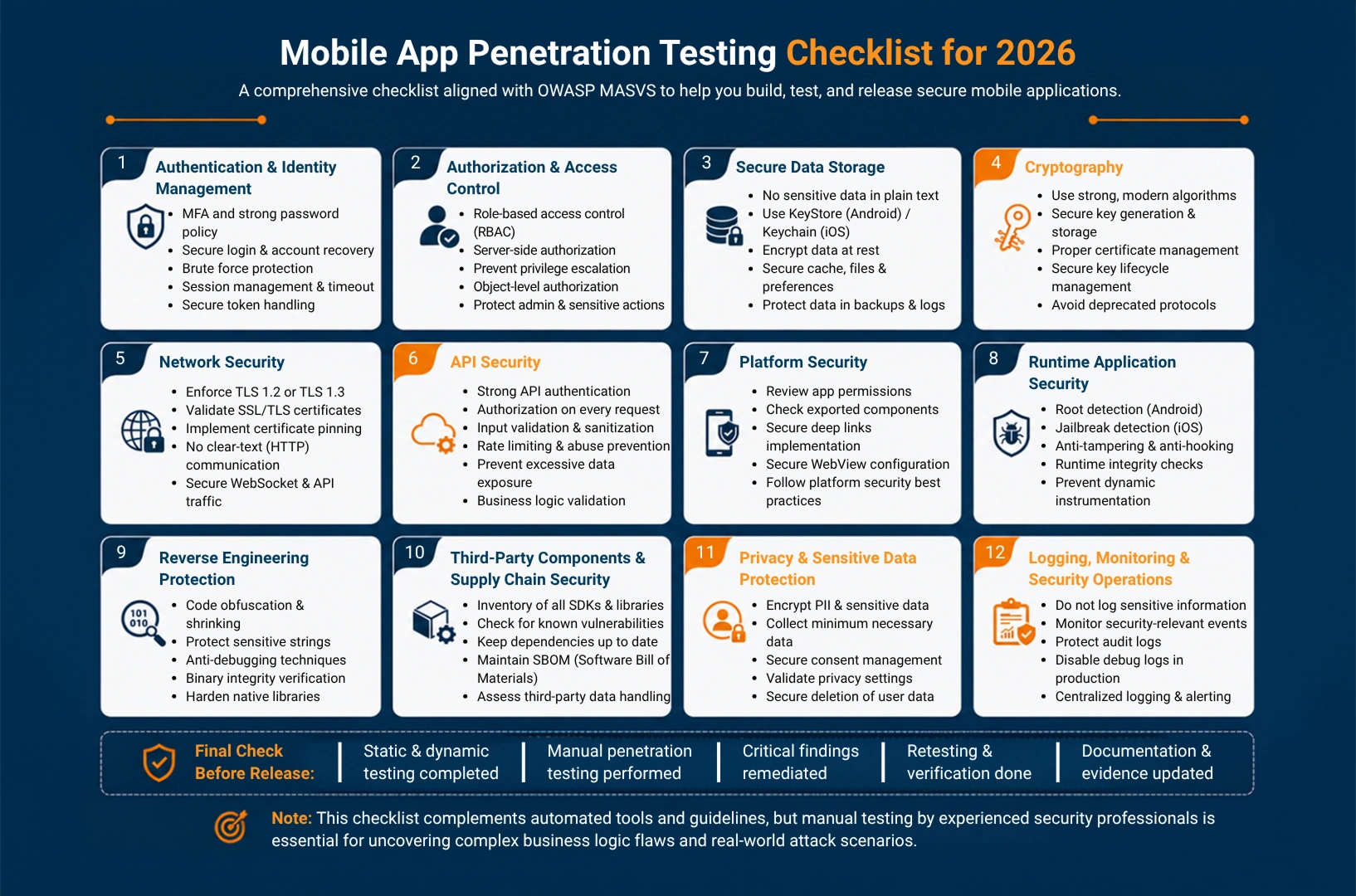
Mobile App Penetration Testing Checklist
Vulnerability scanning is only one aspect of a comprehensive mobile application security assessment. The checklist below organizes the assessment around OWASP MASVS controls and connects each control to its associated MASWE weaknesses and MASTG testing guidance. This structure helps teams understand exactly which security requirements are being assessed, what weaknesses may affect them, and where technical testing should provide supporting evidence.
Compliance Frameworks That Reference Mobile Security
Mobile application security is now a crucial part of fulfilling industry and regulatory compliance requirements, not just a development best practice. Most compliance frameworks require enterprises to install suitable security controls, conduct frequent security assessments, and safeguard sensitive data throughout the application lifetime, even though they do not specify testing tools or processes.
| Compliance Framework | Mobile Security Focus | How Mobile App Penetration Testing Helps |
|---|---|---|
| OWASP MASVS | Defines security requirements for Android and iOS applications. | Validates security controls across authentication, storage, cryptography, networking, platform interaction, resilience, and privacy. |
| PCI DSS v4.0.1 | Protects payment card data processed by mobile applications and APIs. | Identifies vulnerabilities that could expose cardholder data, insecure APIs, authentication weaknesses, and misconfigured payment workflows. |
| HIPAA | Safeguards electronic Protected Health Information (ePHI) within healthcare applications. | Verifies secure storage, encrypted communications, access controls, and protection of sensitive patient data. |
| GDPR | Protects personal data of individuals within the European Union. | Assesses data protection controls, encryption, secure consent handling, and secure deletion of personal information. |
| SOC 2 | Requires organizations to implement controls supporting security, confidentiality, and privacy. | Demonstrates that mobile applications undergo regular security assessments and vulnerability validation. |
| ISO/IEC 27001:2022 | Encourages risk-based information security management across organizational assets, including mobile applications. | Supports risk identification, vulnerability management, and continuous security improvement. |
| NIST Cybersecurity Framework (CSF) 2.0 | Provides a risk management framework covering governance, protection, detection, response, and recovery. | Helps validate technical safeguards protecting mobile applications and supporting secure software development. |
Moving Ahead
Penetration testing for mobile apps is now more than simply a security best practice; it's an essential step in safeguarding private information, preserving user confidence, and lowering corporate risk. Organizations should routinely assess their apps against reputable security requirements such as OWASP MASVS and use the associated MASWE weaknesses and MASTG testing guidance to support technical validation. A structured evaluation approach can help find security flaws before attackers do, whether you're analyzing an existing application or getting ready for a new release.