
Penetration testing shows organizations how attackers could exploit weaknesses in their applications, networks, and infrastructure. Each assessment captures one point in time, while technology environments keep growing and changing. New deployments, infrastructure updates, and emerging vulnerabilities can introduce risks between scheduled tests.
So, how often should you pen test? Most organizations should run penetration tests at least annually and after significant system changes. Compliance requirements, asset criticality, and risk exposure also shape the right frequency.
Also Read: How Much Does Pen Testing Cost?
The Short Answer: Annual Testing and Beyond
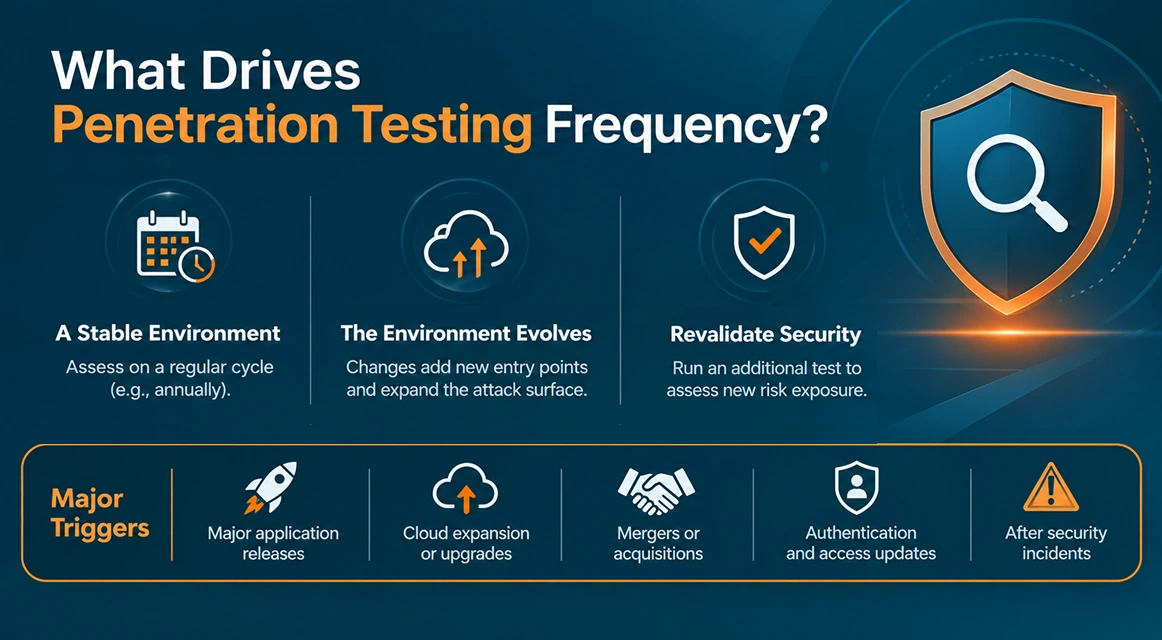
Organizations should run penetration tests at least once a year. They should also test after significant changes to applications, infrastructure, or networks. Systems that process sensitive information, support critical operations, or change often may need more frequent assessments.
An annual penetration test sets out a baseline for evaluating security controls and finding exploitable weaknesses. Many organizations treat it as a minimum planning interval. Testing requirements, however, vary across compliance frameworks.
For example, a financial services company may assess its customer-facing applications and internal networks every year. A new payment gateway or cloud migration of critical workloads may justify an extra test before the next annual cycle.
Organizations should also test when they are:
- Advancing major application releases or architectural changes.
- Extending workloads to the cloud or upgrading infrastructure.
- Building network integrations through mergers or acquisitions.
- Updating authentication and access controls in significant ways.
- Securing systems after incidents that reveal potential weaknesses.
The goal is to align testing frequency with changing risk exposure. An annual assessment sets up a regular testing cycle. Additional assessments evaluate changes that could affect security.
What Compliance Frameworks Require: Minimum Penetration Testing Frequency
Compliance frameworks set different expectations for security testing. Some specify penetration testing intervals. Others ask organizations to assess risks and evaluate controls to fit their operating environment.
Understanding these differences helps organizations plan annual pen tests and additional assessments. It also helps them meet each framework's specific requirements.
PCI DSS: Annual Testing and Significant Changes
PCI DSS 4.0.1 Requirements 11.4.2 and 11.4.3 call for internal and external penetration testing at least once every 12 months. Organizations must also test after significant infrastructure or application upgrades or changes.
Organizations that use network segmentation must also test their segmentation controls. These tests confirm that the controls isolate the cardholder data environment. Requirement 11.4.5 calls for this testing at least every 12 months and after changes to segmentation controls. Requirement 11.4.6 asks service providers to run these tests at least every six months and after relevant changes.
These requirements make testing frequency especially important for organizations that process, store, or transmit payment card information.
SOC 2: Evaluating Security Controls
The SOC 2 Trust Services Criteria leaves the penetration testing interval to each organization. Penetration testing still supports control evaluations under CC4.1, which covers ongoing and separate evaluations of internal controls.
Organizations should weigh their documented security commitments, auditor expectations, customer contracts, and risk profile when setting up a testing schedule. An organization that commits to annual testing in its control documentation should keep evidence of each test within the stated period.
HIPAA: Risk-Based Security Evaluation
The current HIPAA Security Rule HIPAA Pen Testing Requirements requires covered entities and business associates to conduct an accurate and thorough risk analysis. It also requires them to evaluate their security measures periodically. The current rule leaves the penetration testing interval open.
HHS proposed changes to the Security Rule in January 2025. The proposal calls for penetration testing at least once every 12 months, or more often when the risk analysis indicates. As of November 2026, these changes remain proposed. Organizations should separate current requirements from the proposed testing interval when planning compliance activities.
ISO 27001: Risk-Based Security Testing
ISO/IEC 27001:2022 takes a risk-based approach to penetration testing schedules. Its Annex A controls address technical vulnerability management and security testing during development and acceptance.
Organizations set their testing activities through risk assessment, control selection, and information security management processes. Penetration testing provides evidence that security controls work as intended. It also helps evaluate exposure to technical vulnerabilities.
CMMC: Assessment Requirements for Defense Contractors
CMMC requirements vary by certification level. Level 2 requires periodic security control assessments under CA.L2-3.12.1. It leaves the penetration testing interval to the organization.
Level 3 includes a specific penetration testing requirement, CA.L3-3.12.1e. It calls for testing at least annually or when significant security changes occur. The requirement also references automated scanning and ad hoc testing by subject matter experts.
Defense contractors should identify the requirements for their certification level and assessment scope before setting up a testing schedule.
FFIEC: Testing Based on Institutional Risk
The FFIEC Information Security booklet lets each financial institution set its own penetration testing frequency. Testing frequency and scope should reflect the level of assurance the institution needs and its risk assessment.
Financial institutions should weigh their technology environment, critical systems, threat exposure, and testing objectives when setting assessment intervals.
| Framework | Relevant Requirement or Control | Testing frequency |
|---|---|---|
| PCI DSS 4.0.1 | Requirements 11.4.2 and 11.4.3 | At least once every 12 months and after significant infrastructure or application changes |
| SOC 2 | CC4.1: Ongoing and separate evaluations | Organization-defined intervals |
| HIPAA | 45 CFR §164.308(a)(8): Evaluation | Periodic evaluation driven by environmental or operational changes. Annual penetration testing appears in the 2025 proposed rule, not the current Security Rule |
| ISO/IEC 27001:2022 | Annex A.8.8 and A.8.29 | Risk-based interval set by the organization |
| CMMC Level 3 | CA. L3-3.12.1e: Penetration Testing | At least annually or when significant security changes occur |
| FFIEC | Information Security Examination Handbook | Set by institutional risk and required assurance |
Note: Framework version, certification level, contractual commitments, and assessment scope all shape testing frequency.
When to Test Beyond the Annual Cycle: Significant Changes and Release Events
An annual penetration test offers a regular opportunity to assess security. Significant changes, however, can introduce new vulnerabilities between scheduled assessments. Organizations should consider additional testing when application functionality, infrastructure, or access arrangements change substantially.
New Applications and Major Releases
A new application or major new functionality can create additional entry points. For example, a company adding a customer payment portal may introduce new APIs, authentication workflows, and third-party integrations. A penetration test examines these components and finds weaknesses before they affect production systems.
Cloud Migrations and Infrastructure Changes
Cloud migrations can change network configurations, identity permissions, storage settings, and workload connections. Consider an organization moving its internal applications to a cloud platform. Post-migration testing helps verify access restrictions, examine exposed services, and assess connected resources.
Mergers, Acquisitions, and Network Integrations
Mergers and acquisitions often bring together different applications, networks, and user directories. These integrations can create new access paths. For instance, connecting two corporate networks may open unintended access between business units. A penetration test examines these connections and validates network segmentation.
Security Incidents and Significant Vulnerability Disclosures
A security incident or a newly disclosed vulnerability in a critical component may also justify additional testing. Organizations can check whether affected systems remain exposed and whether existing controls block exploitation. They can also confirm that remediation resolves the issue.

A Risk-Based Approach: Setting a Cadence by Risk
Systems carry different levels of risk. Organizations should set penetration testing frequency by asset criticality, exposure, and potential business impact. This approach helps security teams prioritize critical systems while keeping appropriate coverage across the wider environment.
Prioritize Critical Assets and Crown Jewels
Crown jewels are the systems, information, and services that hold the greatest value for an organization. These may include payment platforms, customer databases, intellectual property repositories, and production infrastructure.
For example, a financial institution may prioritize its payment processing application and customer authentication systems. Vulnerabilities in these systems could expose financial information or disrupt transactions. These assets may need additional assessments when significant changes occur or risk exposure increases.
Organize Systems into Risk-Based Asset Tiers
Asset tiers help security teams group systems by business importance, sensitivity, and exposure.
- Tier 1, critical assets: Payment systems, sensitive databases, and production environments. Prioritize annual penetration testing and additional assessments after significant changes.
- Tier 2, important assets: Internal business applications, employee portals, and supporting infrastructure. Include these systems in the annual testing cycle and reassess them after relevant updates.
- Tier 3, lower-risk assets: Isolated applications and systems with limited access to sensitive information. Schedule testing by exposure, business importance, and applicable compliance requirements.
Account for Exposure and Business Impact
Internet-facing applications, remote access services, and systems with third-party integrations may need closer attention. These systems introduce additional access paths.
A manufacturing company, for instance, may prioritize production control systems and engineering workstations. Vulnerabilities in these systems could disrupt operations. Organizations should adjust their testing schedules as asset exposure, business dependencies, and risk levels of change.
Also Read: How to Choose a Pen Testing Company
Choosing the Right Schedule: Annual vs. Continuous Testing
Annual and continuous testing serve different purposes within a security program. Annual penetration testing delivers an in-depth assessment at a defined point in time. Continuous testing helps organizations track security changes between formal assessments.
When Annual Testing Fits
An annual penetration test delivers meaningful coverage when the technology environment stays relatively stable. The testing scope should also reflect current business risks.
Consider a company with established applications, controlled release cycles, and regular vulnerability management. It may use an annual assessment as its primary penetration testing exercise. Additional testing can address significant changes or newly identified risks.
When Continuous Testing Adds Value
Organizations with frequent deployments, dynamic cloud environments, and large application portfolios may benefit from continuous security testing.
Continuous penetration testing programs can combine automated vulnerability checks, recurring application assessments, attack surface monitoring, and periodic human-led testing. Penetration Testing as a Service (PTaaS) supports this approach with centralized findings, remediation tracking, and ongoing visibility.
| Testing approach | Primary purpose | Best suited for |
|---|---|---|
| Annual penetration testing | In-depth security assessment | Formal security reviews and compliance evidence |
| Continuous vulnerability testing | Recurring identification of known weaknesses | Frequent deployments and changing environments |
| PTaaS and continuous pen testing | Ongoing testing coordination and visibility | Dynamic environments requiring regular assessment |
Combining scheduled penetration tests with continuous security checks helps organizations maintain visibility as their environments evolve.
Moving Ahead
Effective penetration testing starts with a schedule that reflects how an organization operates and where its greatest risks lie. Annual assessments, change-driven testing, and continuous security checks each play a role. Together, these approaches keep testing priorities aligned with evolving infrastructure, compliance expectations, and business requirements.