
Automated penetration testing uses tools and predefined workflows to find security weaknesses. It covers applications, networks, and infrastructure. Security teams use it to run repeatable checks, examine large environments, and detect known vulnerabilities. Some testing calls for an understanding of application behavior, business logic, or complex attack paths. In those areas, human expertise takes the lead.
This blog explores where automated pen testing delivers the most value and where manual expertise remains essential. It compares automated, manual, and hybrid testing approaches. It also examines how AI, continuous testing, and PTaaS are shaping modern security assessment programs.
Also Read: Pen Testing Tools: What Testers Actually Use and How They Work
What Automated Pen Testing Is and How It Differs from Scanning
Automated penetration testing is a security assessment approach. It uses software tools, scripts, and predefined workflows to find and validate potential vulnerabilities. It covers applications, networks, APIs, and other systems.
These tools automate activities such as asset discovery, vulnerability checks, and controlled exploitation. For example, a platform may find an exposed service and inspect its configuration. It can then test a known vulnerability and record the results. Some platforms also support authenticated testing. With supplied credentials, they can examine application functions and system components.
Automated Pen Testing vs. Vulnerability Scanning
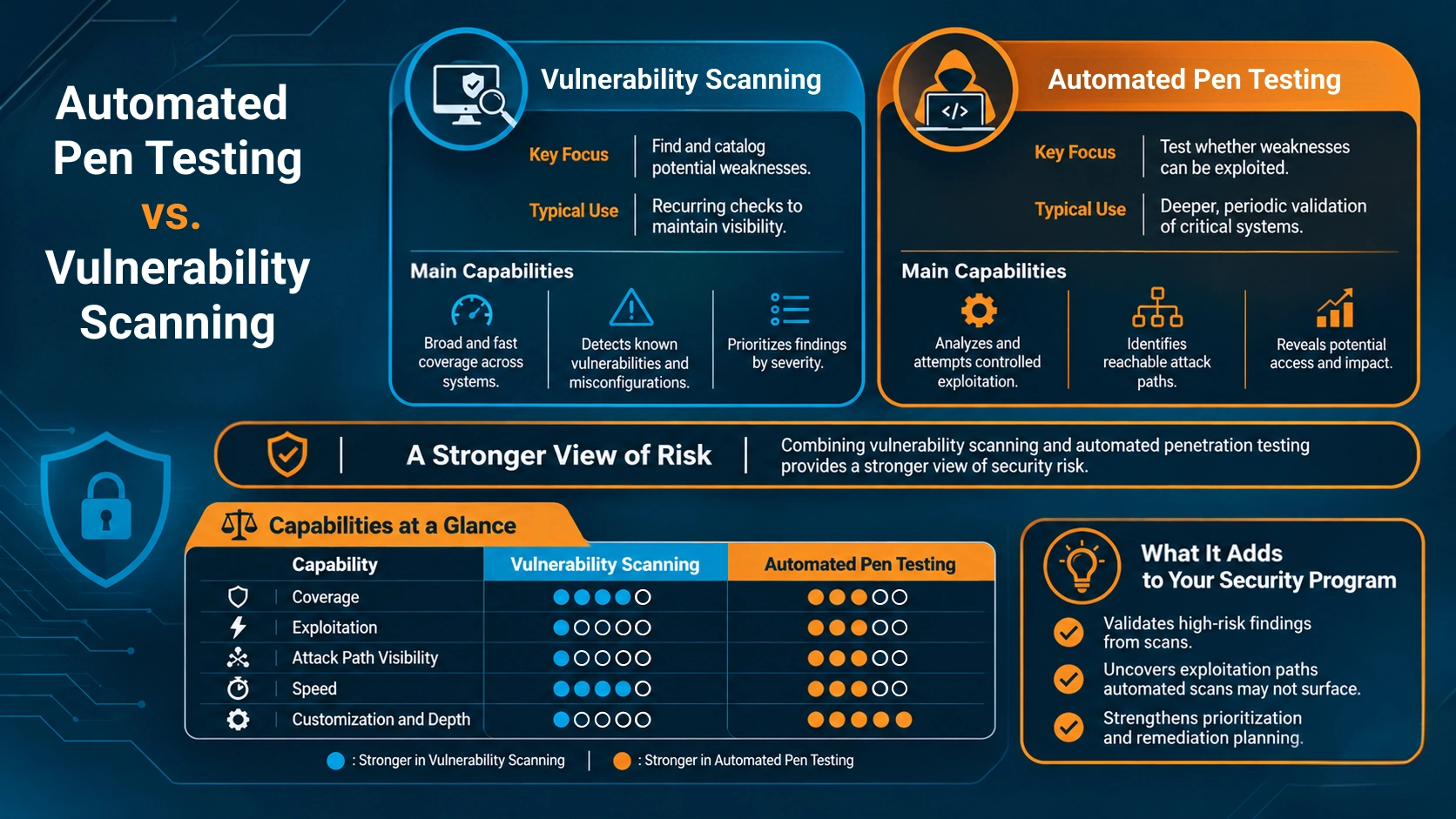
Automated penetration testing and vulnerability scanning serve different purposes. A vulnerability scanner finds and reports potential weaknesses. These include outdated components, exposed services, and insecure configurations. Penetration testing goes further. It examines whether attackers can exploit a weakness and what access or impact that could create.
For instance, a scanner may flag an application endpoint as open to an injection attack. Further testing shows whether the application processes the input unsafely. It also shows whether exploitation could expose sensitive information or open further access.
Automated platforms can perform parts of this validation. Their testing depth depends on their capabilities, configuration, permissions, and the target environment. Organizations can evaluate these capabilities to see exactly what an automated pen test covers.
What Automation Does Well: Speed, Scale, and Consistency
Penetration testing automation helps security teams run routine checks faster and more consistently. Automated pen testing tools examine multiple assets, repeat predefined tests, and collect findings across assessment cycles. This proves especially useful for organizations that manage several applications, frequent releases, or changing infrastructure.
Faster Testing Across Large Environments
Consider a company preparing to launch an updated customer portal. The release includes changes to its login system, payment pages, and account management features. Testers can use automated tools to check every accessible endpoint at once. The tools look for common vulnerabilities, exposed services, and configuration weaknesses.
The tools run predefined tests across multiple endpoints and generate findings for review. Teams complete routine checks within tight release schedules. Testers gain more time to investigate complex issues.
Broader Coverage Through Automated Testing
Organizations often run several connected applications, APIs, cloud services, and network components. Testing each asset one by one takes significant effort.
For example, a business may deploy a new cloud-based application. Automated discovery tools then find accessible hosts, services, and endpoints within the authorized scope. Automated pen testing tools examine supported assets for known vulnerabilities and common security weaknesses.
This keeps teams' visibility current as their environments evolve. Actual coverage depends on the tool's capabilities, configured scope, and available access.
Consistent Testing and Repeatable Results
Automation also helps teams keep testing procedures consistent across development cycles.
For instance, a development team may run automated security tests against a staging environment before every major release. Testers may spot an outdated component or an exposed endpoint. Developers fix the issue and run the same tests again to confirm the results.
This approach supports regression testing and helps teams track remediation across releases. Automated tools also collect evidence such as affected URLs, request and response data, and vulnerability indicators.
Testers review these records, validate findings, and assess their potential impact. Automation simplifies recurring checks. Human analysis turns technical results into meaningful security insights.
Also Read: Penetration Testing for Cyber Insurance: A CISO’s Playbook
Where Automation Falls Short: Business Logic, False Positives, and Attack Chains
Automated penetration testing finds known vulnerabilities and validates predefined attack scenarios. Some security weaknesses emerge through unexpected application behavior or links between multiple systems. Three scenarios show where human investigation takes over.
Business Logic Flaws Call for an Understanding of Application Workflows
Consider an e-commerce platform that lets customers apply discounts at checkout. A user discovers that modifying a request lets them apply multiple discount codes to one purchase. The platform permits only one. A scanner may test input validation and flag unusual responses. Recognizing that the transaction breaks the platform's pricing rules takes an understanding of its business logic.
OWASP documents similar testing scenarios. These include manipulating product prices during checkout and claiming loyalty points before completing a transaction. Testers uncover these issues by examining how the application handles its intended workflows.
Manual Validation Confirms Real Findings
Imagine an automated tool flags a web application for using an outdated software component. The finding appears to point to a known vulnerability. Further investigation reveals that the team has disabled the affected functionality. The vulnerable component sits out of reach.
This is a false positive. Automated pen testing tools spot indicators linked to known weaknesses. Testers then examine the affected component, reproduce the finding, and confirm whether exploitation is possible. This validation helps security teams prioritize genuine risks.
Attack Chains Call for Investigation Across Systems
The 2019 Capital One data breach shows how multiple security weaknesses can combine into a larger attack. The attacker exploited a server-side request forgery (SSRF) vulnerability in a web application firewall. This gave access to AWS instance metadata and temporary credentials. The attacker then used an overprivileged IAM role to reach sensitive S3 data. (Source: Technical Analysis of the Breach)
This incident shows why individual findings need broader investigation. Testers examine how application weaknesses, cloud configurations, identity permissions, and connected resources interact. Together, these can form an attack path.
Security Context Determines the Actual Impact
Business impact depends on more than a technical finding. Testers weigh the affected asset, available privileges, exposed information, and potential consequences. Automated tools provide useful findings and evidence. Human analysis connects those findings to realistic attack scenarios and organizational risk.
Also Read: Black Box vs. White Box vs. Gray Box Penetration Testing
Choosing the Right Approach: Automated vs. Manual vs. Hybrid Testing
Automated, manual, and hybrid penetration testing each serve different security assessment needs. The right choice depends on testing scope, application complexity, available resources, and the level of validation required.
Automated Testing for Repeatable Security Checks
Automated testing works well for recurring checks across multiple applications, endpoints, and infrastructure components. Organizations can use an automated pen testing service to find known vulnerabilities, examine common configurations, and run scheduled assessments.
For example, a development team may release application updates every two weeks. The team can schedule automated security checks before each deployment. This surfaces recurring weaknesses and tracks changes across releases.
Manual Testing for Complex Security Scenarios
Manual penetration testing suits assessments that call for contextual analysis and investigative reasoning. Testers examine business logic, manipulate application workflows, and investigate access controls. They also explore how vulnerabilities relate to one another.
For instance, a tester may examine an employee portal. The tester checks whether a standard user can reach restricted records by modifying application requests. Human expertise validates the permissions involved and assesses the potential impact.
Hybrid Testing for Broader Assessment Coverage
Hybrid testing combines automated tools with manual investigation. Automated workflows handle repeatable checks. Testers validate findings and explore scenarios that need deeper analysis. This supports a human-in-the-loop model, where security professionals review automated results and guide testing decisions.
| Testing approach | Best suited for | Key advantage |
|---|---|---|
| Automated | Recurring checks and large environments | Speed and consistency |
| Manual | Business logic and complex attack scenarios | Contextual analysis |
| Hybrid | Broad assessments that need deeper validation | Combines automation with human expertise |
For many organizations, hybrid testing strikes a practical balance. It pairs the consistency of automation with the investigative depth that real-world security risks demand.
Also Read: External vs. Internal Penetration Testing: Methods, Risks, and Assessment Scope
The Next Phase of Security Testing: AI and Continuous Testing
Artificial intelligence and continuous testing are expanding how organizations approach penetration testing. AI-assisted tools support security analysis, generate test cases, and help interpret findings. Continuous testing brings recurring security checks into development and operational workflows. Together, these capabilities are reshaping how teams plan, run, and manage security assessments.
AI-Assisted Testing and LLMs
Large language models (LLMs) support several penetration testing activities. These include reconnaissance analysis, script generation, test planning, and vulnerability research. LLM pen testing also examines the security of applications that use these models. It covers prompt injection, sensitive information disclosure, and insecure output handling.
For example, a tester may assess an AI-powered customer support application. The tester checks whether crafted prompts can expose internal instructions. The tester also checks whether prompts can retrieve information beyond the user's permitted access. AI-assisted tools generate test variations, while testers validate the results and assess their impact.
Agentic AI marks another advance. AI agents interact with testing tools, process results, and execute multiple steps toward a defined objective. Their actions call for controlled permissions, clear testing boundaries, and human oversight.
Continuous Pen Testing Across Development Cycles
Continuous pen testing builds recurring security assessments into development and operational workflows. Teams can trigger automated checks after code changes, application releases, or infrastructure updates.
For instance, a development team may set security tests to run whenever a new build enters the staging environment. This surfaces potential weaknesses earlier in the release cycle and supports ongoing remediation.
Continuous testing can also include scheduled assessments of external assets and applications. Continuous penetration testing goes beyond recurring vulnerability scans. Deeper validation investigates exploitability and potential impact.
PTaaS and the Human-in-the-Loop Model
Penetration Testing as a Service (PTaaS) pairs a platform-based approach with penetration testing activities. Depending on the provider, PTaaS may include automated checks, tester-led assessments, centralized findings, and remediation tracking.
A human-in-the-loop model keeps security professionals involved throughout. They review results, validate vulnerabilities, and investigate complex attack scenarios. This model combines the efficiency of automation with the expertise that meaningful security assessments demand.