
A penetration test reveals more than vulnerabilities. It shows a CISO how well the organization’s defenses hold up. That insight carries extra weight when cyber insurance is on the table. Penetration testing measures security controls against real attack scenarios. It pinpoints exploitable vulnerabilities, likely attack paths, and opportunities to strengthen defenses. These results can also offer helpful technical proof for talks about insurance and cyber risk.
This playbook shows CISOs how to align penetration testing with cyber insurance requirements. It covers scoping, results of assessment, remediation, and retesting. It also explains which documents support underwriting and renewal.
Also Read: Prompt Injection Attacks Threaten Banking AI Chatbots: A Pentester's Guide
What Cyber Insurers Look for in Your Security Posture
Cyber insurers consider more than just the existence of security safeguards on paper. They evaluate the implementation, upkeep, and evidence-based support of controls. Underwriters often review multi-factor authentication (MFA), vulnerability and patch management, and privileged access. They also weigh endpoint security, backups, incident response, and security awareness. Demonstrable cybersecurity controls are becoming increasingly important; however, requirements differ by insurer and risk profile.
31 percent of breaches now start with software vulnerabilities, beating stolen passwords as the top way attackers get in. For CISOs, this reinforces the importance of understanding which vulnerabilities can actually be exploited and how they could affect the organization.
The table below highlights key security areas insurers commonly consider and what CISOs should be prepared to demonstrate when assessing their organization’s cyber risk:
| Security Area | What CISOs Should Be Able to Demonstrate |
|---|---|
| MFA & Access | Strong authentication and authorization boundaries |
| Vulnerability Management | The team identifies, prioritizes, and remediates vulnerabilities |
| Network Security | Segmentation and resistance to lateral movement |
| Endpoint Security | Security controls can detect or limit malicious activity |
| Cloud Security | Controls protect critical cloud resources and identities |
| Incident Response | The organization can detect, contain, and respond to security incidents |
| Security Awareness | Employees understand cybersecurity responsibilities and know how to identify and report potential security threats. |
How Penetration Testing Supports Cyber Insurance Underwriting
A penetration test can give CISOs technical evidence that complements the information collected during cyber insurance underwriting. Testing confirms whether controls and security boundaries hold up under real attacks. This evidence adds depth to questionnaire answers and documented policies. According to NIST SP 800-115, Technical Guide to Information Security Testing and Assessment, penetration testing can assist organizations in identifying vulnerabilities, evaluating results, and developing mitigation plans.
Connecting technical discoveries with cybersecurity risk is important for cyber insurance. A well-scoped test identifies exploitable vulnerabilities and verifies authentication and permission rules. It also evaluates network segmentation and exposes attack paths to critical systems. The findings can assist CISOs in setting remediation priorities and preserving proof of security enhancements for insurance-related conversations. In a similar vein, Marsh's 2025 study highlights that insurers are becoming more concerned about the efficacy of cybersecurity controls rather than just their existence.
Source: Marsh McLennan’s 2025 Cybersecurity Signals report
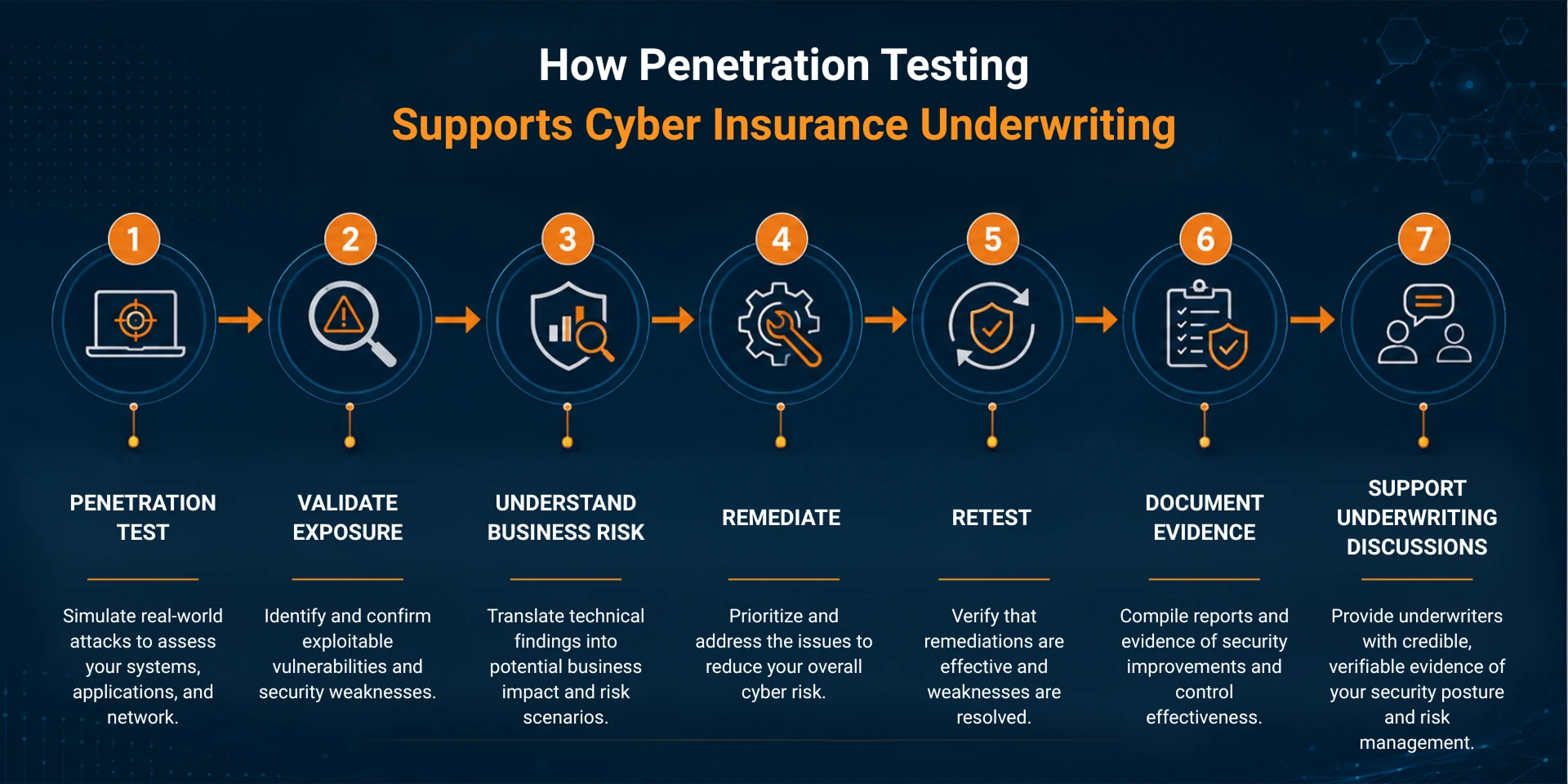
Here's how penetration testing can turn technical findings into actionable evidence for cyber insurance discussions:
- Penetration Test: Simulate realistic attack scenarios across systems, applications, networks, and other defined assets.
- Validate Exposure: Confirm which vulnerabilities are genuinely exploitable and determine how weaknesses could be leveraged
- Understand Business Risk: Connect technical findings and attack paths to potential impacts on critical systems, data, and operations
- Remediate: Prioritize and address vulnerabilities and security-control weaknesses based on their severity, exploitability, and business relevance
- Retest: Verify that remediation has effectively addressed identified vulnerabilities and reduced the associated exposure
- Document Evidence: Record testing scope, findings, remediation actions, and retesting results to demonstrate measurable security improvements
Support Underwriting Discussions: Use documented results to give insurers additional, evidence-based context about cybersecurity controls and risk management
Defining the Right Penetration Testing Scope for Cyber Insurance
Penetration testing's usefulness for cyber insurance is largely dependent on its contents. A narrow penetration test can identify weaknesses in the systems it covers while leaving other relevant attack paths unexamined. Therefore, rather than using a conventional checklist, CISOs should match the penetration testing scope with their organization's existing cyber risk, important assets, external exposure, and security limits.
A cyber insurance-focused scope can include internet-facing infrastructure, online applications, APIs, cloud environments, internal networks, remote access, authentication and authorization controls, and critical business processes. CISOs should also add major changes such as cloud migrations, new applications, acquisitions, and infrastructure upgrades. This ensures that the penetration test generates pertinent proof of the organization's present security posture and facilitates talks about cyber insurance and remediation.
Also Read: Penetration Testing Modern SaaS Integrations: Where Does Your Security Boundary End?
Security Controls a Penetration Test Can Put to the Test
Penetration testing can validate how security mechanisms function under actual attack scenarios. It shows whether controls work together to block unauthorized access and limit attacker movement. It also confirms they protect sensitive systems and data as one unified defense.
Key security controls that penetration testing can put to the test include:
- Authentication Controls: Test whether authentication mechanisms can resist credential attacks, bypass attempts, and other methods of unauthorized access.
- Authorization & Access Controls: Determine whether users can access only the applications, functions, and data permitted by their assigned roles.
- Network Segmentation: Assess whether segmentation effectively restricts lateral movement between networks, systems, and critical assets.
- Application & API Security: Test applications and APIs for weaknesses that could enable unauthorized access, data exposure, or manipulation of business functionality.
- Remote Access Controls: Evaluate VPNs, remote access services, and other externally accessible entry points for weaknesses that could provide unauthorized access.
- Cloud Security Controls: Assess externally accessible cloud resources, identity permissions, configurations, and exposed services within the agreed testing scope.
- Security Boundaries Around Critical Systems: Determine whether controls protecting sensitive data and business-critical systems can withstand realistic attack paths.
Also Read: How to Scope IT-OT Penetration Testing Safely
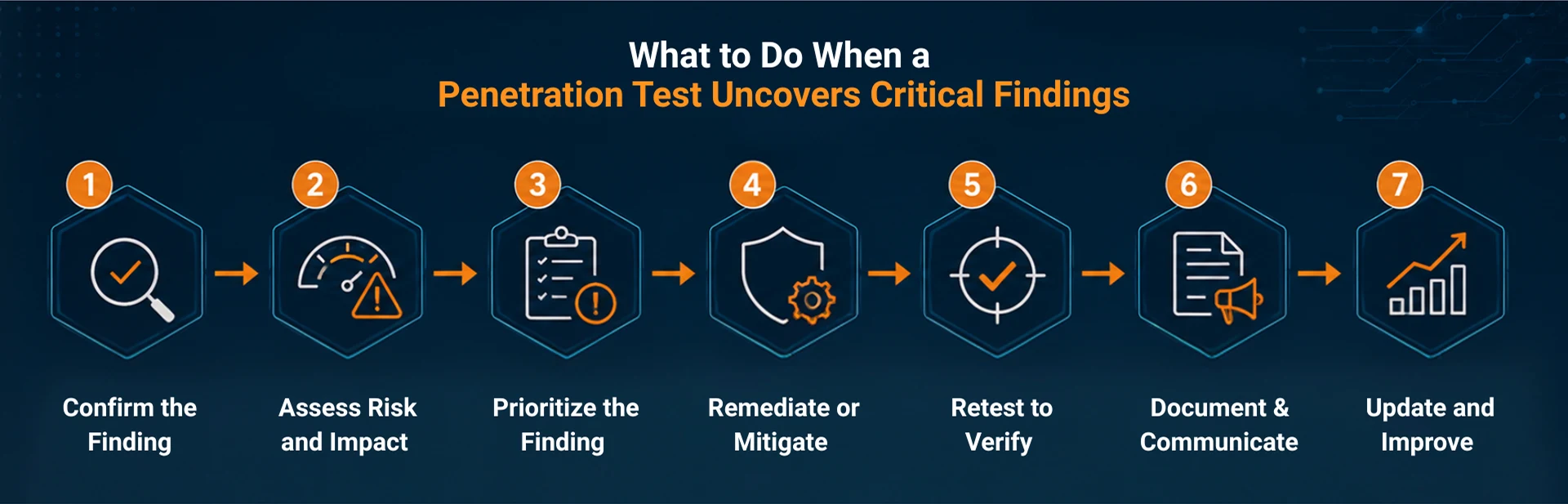
What to Do When a Penetration Test Uncovers Critical Findings
A serious penetration testing finding should prompt an organized, risk-based response rather than simply closing a vulnerability ticket. CISOs should prioritize repair, verify the finding, evaluate its exploitability and business effect, and make sure that corrective activities are appropriately validated. While CISA stresses taking into account elements like asset criticality, exploitation, and business impact when prioritizing vulnerabilities, NIST advises using risk and possible impact to guide cybersecurity decisions.
The recommended response includes:
- Confirm the Finding: Review the testing evidence and validate the vulnerability before taking corrective action.
- Assess Risk and Impact: Evaluate exploitability, affected assets, data sensitivity, and potential business impact.
- Prioritize the Finding: Use a risk-based approach that considers severity, asset criticality, and organizational risk tolerance.
- Remediate or Mitigate: Apply a permanent fix where possible or implement appropriate compensating controls when immediate remediation is not feasible.
- Retest to Verify: Retest the affected area to confirm the fix resolves the vulnerability, and the control works as intended.
- Document and Communicate: Record the finding, risk assessment, remediation, and retest results, and communicate relevant outcomes to stakeholders.
- Update and Improve: Use the findings to strengthen security controls, policies, processes, and future penetration testing scope.
What a Cyber Insurance Penetration Test Report Should Include
There should be more to a penetration testing report than just a list of vulnerabilities. It gives CISOs a clear record of the scope, the findings, their significance, and the actions taken. The report should give executives and risk stakeholders a clear picture of the organization's security posture while presenting technical results in a format that security teams can use for cyber insurance talks.
| Report Component | What It Should Show |
|---|---|
| Executive Summary | Testing objectives, overall risk themes, significant findings, and key recommendations |
| Scope & Methodology | Systems tested, testing period, testing firm, lead tester and certifications, assessment approach, techniques used, and scope limitations |
| Detailed Findings | Affected assets, vulnerability details, technical evidence, potential impact, and attack paths |
| Risk Ratings | Severity, exploitability, business impact, and prioritization of identified findings |
| Remediation Recommendations | Practical actions to address vulnerabilities and reduce associated risk |
| Retest Results | Whether remediation was effective and which findings remain open or have been resolved |
| Supporting Evidence | Screenshots, test results, and other evidence supporting reported findings |
Building a Stronger Cyber Insurance Risk Strategy with Penetration Testing
Instead of being a one-time activity carried out solely before an insurance renewal, penetration testing is most beneficial when it is integrated into an organization's larger cyber risk management strategy. While the Cybersecurity Framework (CSF) 2.0 stresses incorporating cybersecurity risk information into more comprehensive corporate risk management.
Vulnerability remediation, security control enhancements, risk prioritization, security investments, and future testing scopes can all be influenced by penetration testing outcomes for CISOs. Retesting can then assist in confirming whether the detected exposure has decreased as a result of corrective efforts. The significance of comprehending an organization's larger cyber risk and control environment when evaluating cyber insurability is also highlighted in Aon's 2025 Cyber Risk Report.
A more robust approach integrates cyber insurance evidence, remediation, retesting, and penetration testing into a continuous cycle. This cycle keeps their view of exploitable risk current. It also shows insurers' steady remediation progress backed by fresh data.
Cyber Insurance Penetration Testing Checklist for CISOs in 2026
A cyber insurance penetration testing checklist in 2026 must include more than just conventional vulnerability identification. Cloud environments, APIs, supply chain and third-party connections, identity and access controls, ransomware exposure, and, if relevant, AI-enabled systems should all be included in the testing scope.
According to Marsh's Cyber Catalyst report, published December 9, 2025, companies are preparing to invest more in cybersecurity in response to growing third-party risks and ongoing ransomware threats. Additionally, in March 2026, NIST released an updated Guidelines for API Protection for Cloud-Native Systems, highlighting the significance of API security in contemporary settings.
Before signing off on a penetration testing engagement, CISOs should verify:
- Testing Objectives: Define what the assessment needs to validate based on current cyber risk, critical assets, and insurance requirements.
- Attack Surface: Include relevant internet-facing infrastructure, applications, APIs, remote-access services, and externally exposed assets.
- Cloud Security: Include cloud-hosted systems, identities, permissions, configurations, and exposed services within the agreed scope.
- Identity & Access: Test authentication, authorization, privileged access, MFA, and other access-control boundaries.
- Critical Attack Paths: Assess whether vulnerabilities can be chained to reach sensitive data or business-critical systems.
- Third-Party Exposure: Include vendor connections, integrations, and supply-chain dependencies in the testing scope when they can reach systems on the organization's critical-asset list.
- AI-Enabled Systems: Identify which systems an AI application, agent, or connected tool can reach, what it can do without human intervention, and what is logged when it acts.
- Ransomware Resilience: Assess where backups are stored, whether they are isolated from production systems, and when a restoration from backup was last tested.
- Rules of Engagement: Document authorized targets, testing boundaries, timing, escalation procedures, and responsible contacts before testing begins. NIST SP 800-115 recommends planning and documenting technical security testing activities.
- Actionable Reporting: Require findings to include affected assets, technical evidence, severity, potential impact, attack paths, and remediation recommendations.
- Remediation & Retesting: Track critical findings through remediation and perform retesting where appropriate to verify corrective actions.
- Evidence Management: Maintain the scope, methodology, findings, remediation records, and retest results as part of the organization's cybersecurity risk documentation.