
Organizations use penetration testing and red team engagements to evaluate cybersecurity from an attacker's perspective. In both, authorized security professionals simulate attacks to uncover weaknesses and assess how systems respond. Each one serves a distinct assessment objective.
Knowing how red teaming and pen testing differ helps organizations choose the right assessment. The best fit aligns with their security priorities, technical maturity, and business objectives.
Also Read: Pen Test vs. Vulnerability Assessment: What's the Difference?
Pen Testing vs. Red Teaming: Understanding the Difference
The key difference between penetration testing and red teaming lies in their objectives. Penetration testing identifies and validates as many exploitable weaknesses as possible within a defined scope. Red teaming pursues a specific objective and measures how well an organization's defenses detect and respond to simulated adversarial activity.
| Aspect | Penetration Testing | Red Teaming |
|---|---|---|
| Primary goal | Identify and validate vulnerabilities | Achieve a defined adversarial objective |
| Focus | Security weaknesses across the agreed scope | Detection, response, and defensive effectiveness |
| Approach | Systematic testing of specified assets | Targeted attack simulation using adversarial techniques |
| Success measure | Vulnerabilities identified and validated | Objective achieved, detected, or stopped, with an evaluation of the defensive response |
| Key outcome | Findings and remediation guidance | Insights into defensive capabilities and opportunities to strengthen response |
What a Pen Test Does: Scope, Goals, and Output
A penetration test evaluates the security of defined systems, applications, or networks. It identifies and validates exploitable vulnerabilities. The assessment follows an agreed scope and testing methodology. It shows organizations where weaknesses exist and how they could affect business operations.
A typical penetration testing engagement includes:
- Scope: Defining the assets, applications, networks, environments, and testing boundaries for the assessment.
- Goals: Setting the assessment objectives, such as finding vulnerabilities, validating security controls, evaluating exposure, or supporting compliance requirements.
- Testing: Combining reconnaissance, automated scanning, manual investigation, controlled exploitation, and vulnerability validation.
- Findings: Documenting confirmed vulnerabilities, affected assets, supporting evidence, severity, and potential impact.
- Output: Delivering a technical report, executive summary, and remediation recommendations, plus retesting results when the engagement includes them.
For example, a web application penetration test may examine authentication, access controls, APIs, input validation, and business logic. The final report helps technical teams prioritize vulnerabilities, implement fixes, and validate remediation.
The organization's objectives, environment, and risk profile shape the scope and depth of each penetration test.
Also Read: Black Box vs. White Box vs. Gray Box Penetration Testing: Key Differences and Use Cases
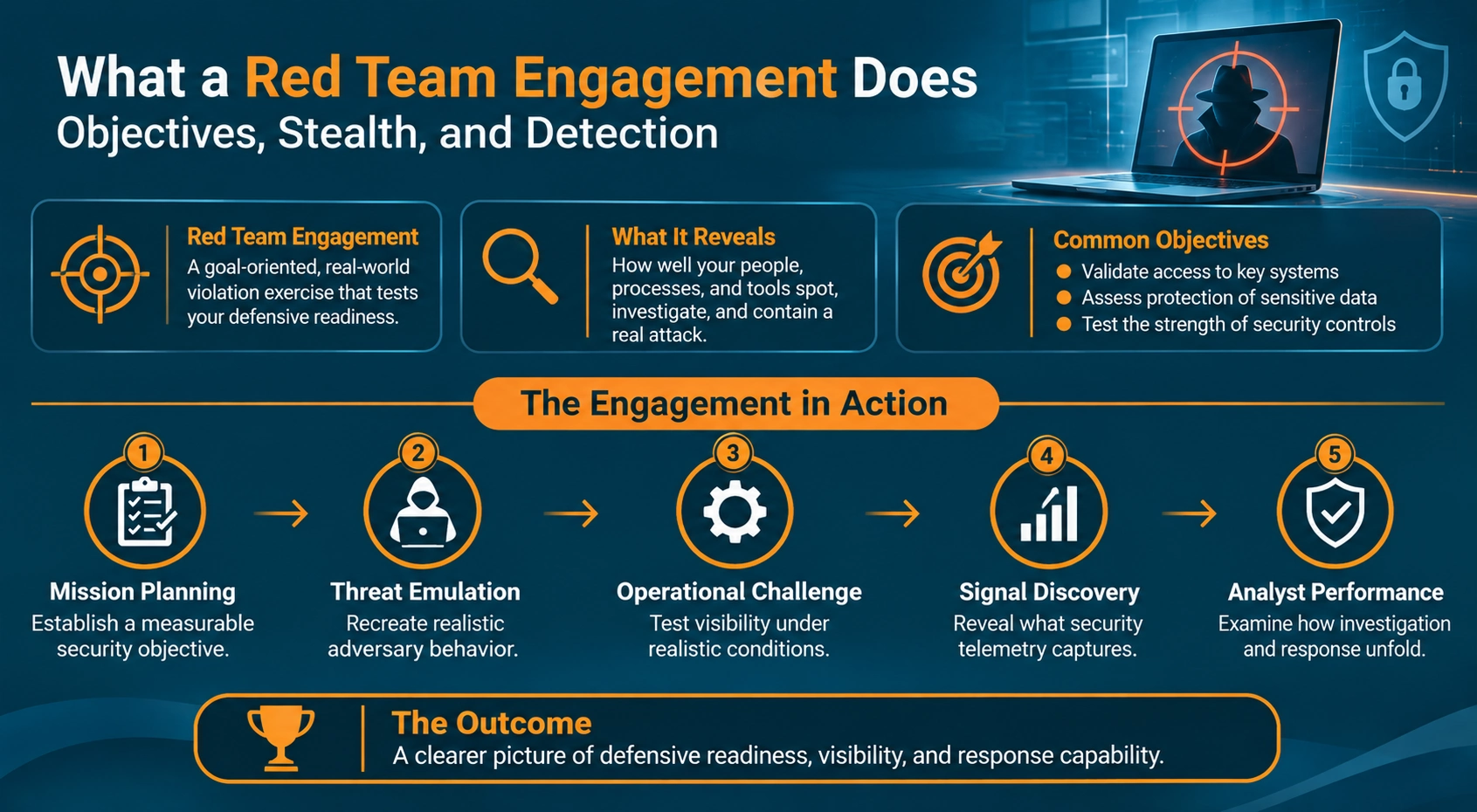
What a Red Team Engagement Does: Objectives, Stealth, and Detection
Red team engagement simulates realistic adversarial activity. It evaluates how effectively an organization detects, investigates, and responds to security threats. Instead of a broad vulnerability to sweep, the engagement pursues a defined objective that mirrors a potential attacker's goal. Examples include reaching a critical system, accessing sensitive information, or testing defensive controls.
A red team engagement typically involves:
- Defined objectives: Establishing a mission, target assets, success criteria, and boundaries for the exercise. Objectives may include demonstrating access to critical systems or evaluating security monitoring capabilities.
- Adversarial techniques: Simulating attacker behavior with tactics, techniques, and procedures (TTPs) relevant to the organization's threat landscape. MITRE ATT&CK provides a framework to map these activities to recognize adversary behaviors.
- Stealth and controlled testing: Conducting authorized activities with limited defender awareness when the goal is to evaluate detection capabilities. All testing follows agreed safeguards, escalation procedures, and safety controls.
- Detection evaluation: Examining whether security monitoring tools and analysts recognize suspicious activity, generate relevant alerts, and identify potential attack patterns.
- Response assessment: Evaluating how security teams investigate alerts, coordinate incident responses, contain threats, and communicate during simulated activity.
For example, a red team may aim to demonstrate access to a sensitive business system while the security operations team monitors activity. The exercise evaluates both the simulated attack path and the defenders' ability to detect and respond.
The final deliverable typically documents the exercise objectives, activities, and achieved outcomes. It also captures areas to strengthen detection, response observations, and recommendations to advance defensive capabilities.
Pen Testing vs. Red Teaming: Side-by-Side Comparison
Penetration testing and red teaming use similar security testing techniques. Their objectives, however, shape how teams plan, execute, and evaluate each engagement. The differences become clearer when you compare scope, duration, team awareness, approach, and expected outcomes.
| Aspect | Penetration Testing | Red Teaming |
|---|---|---|
| Goal | Identify and validate vulnerabilities | Evaluate detection, response, and defensive effectiveness |
| Scope | Defined assets, applications, networks, or systems | Objective-driven, potentially spanning multiple security layers |
| Duration | Typically days to weeks, depending on scope | Often several weeks or longer, depending on objectives and complexity |
| Team awareness | Coordinated with relevant stakeholders | Limited to designated personnel when needed |
| Approach | Systematic vulnerability assessment and controlled exploitation | Adversarial simulation using realistic TTPs |
| Output | Vulnerability report, severity ratings, and remediation guidance | Attack narrative, detection improvement areas, response observations, and recommendations |
| Cost | Depends on scope, complexity, testing depth, and resources | Depends on objectives, duration, complexity, specialist expertise, and coordination |
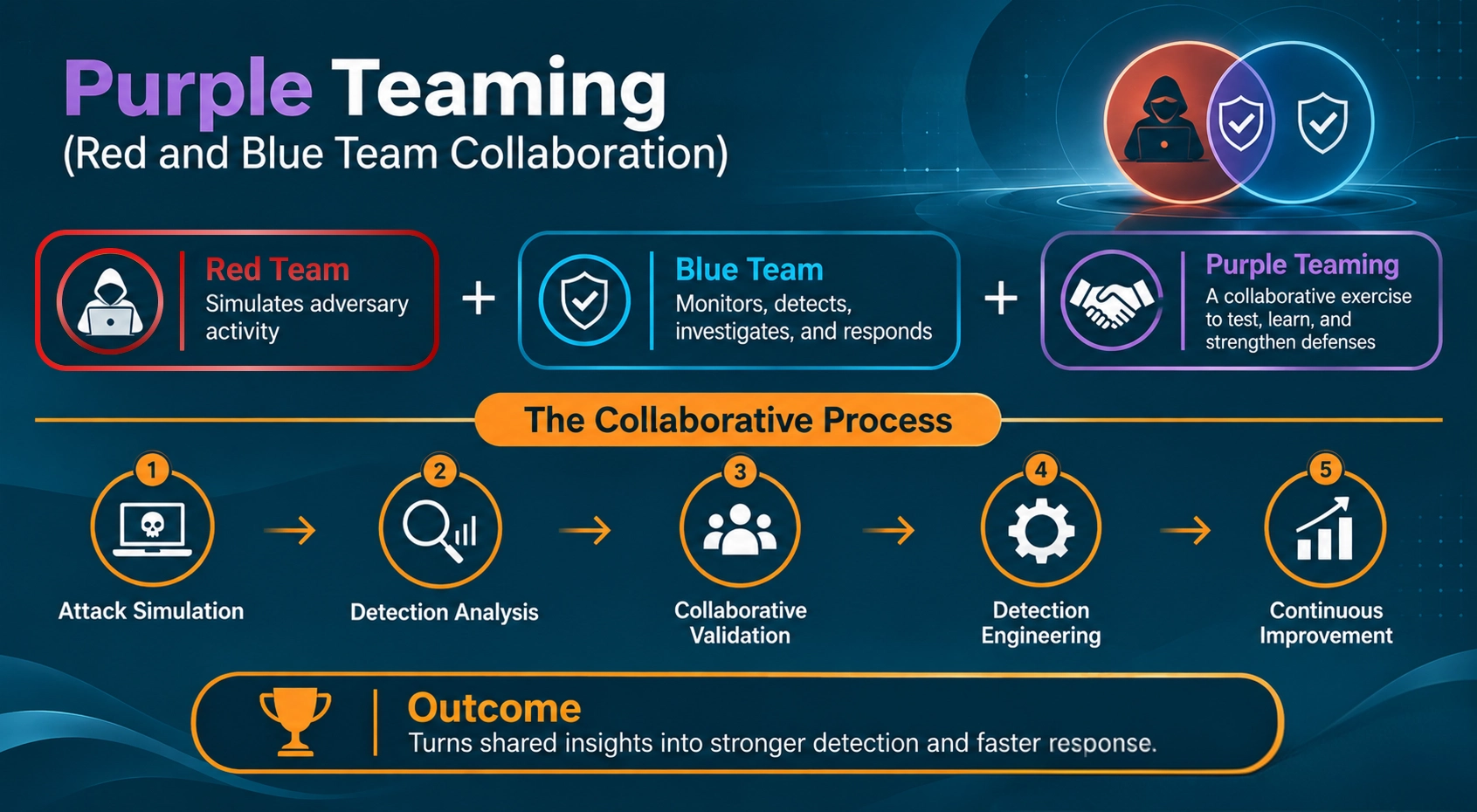
Purple Teaming: Red and Blue Team Collaboration
Purple teaming brings red and blue teams together to strengthen an organization's security capabilities. The red team simulates adversarial activity. The blue team monitors, detects, investigates, and responds to it. Both teams share insights and validate defensive capabilities throughout the exercise.
A purple team exercise typically involves:
- Attack simulation: Demonstrating specific adversarial tactics, techniques, and procedures (TTPs) through the red team.
- Detection analysis: Enabling the blue team to evaluate how monitoring tools and detection rules identify those activities.
- Collaborative validation: Reviewing findings together, identifying detection improvement areas, and validating security controls.
- Detection engineering: Strengthening monitoring coverage by refining detection rules and improving alert logic.
- Continuous improvement: Advancing future testing, defensive improvements, and incident response with insights from the exercise.
Purple teaming builds a feedback loop between offensive testing and defensive security. This loop helps organizations strengthen detection capabilities and respond better to realistic attack scenarios.
Which One Do You Need: Assessing Your Security Priorities
The right security assessment depends on your organization's security maturity, objectives, and current priorities. Penetration testing and red teaming serve different purposes. Your choice comes down to what you want to evaluate and improve.
Choose penetration testing to identify and validate vulnerabilities across defined systems, applications, networks, or infrastructure. It supports security assessments, compliance requirements, remediation planning, and technical control validation.
Choose red teaming to evaluate how effectively your security teams detect, investigate, and respond to realistic adversarial activity. It delivers the most value once your security controls, monitoring capabilities, and incident response processes are ready for evaluation.
Consider purple teaming to bring offensive and defensive teams together. It helps validate detection capabilities, refine detection engineering, and strengthen response workflows.
Organizations can use these assessments at different stages of their security journey. Penetration testing builds visibility into technical vulnerabilities. Red teaming evaluates defensive effectiveness against defined objectives. Purple teaming turns those insights into measurable improvements.