What happens when a security scan flags a critical vulnerability? Can an attacker exploit it, or does it only signal a potential weakness? The answer depends on how deeply an organization examines the finding. This is where vulnerability assessments and penetration testing take different approaches. One identifies and prioritizes security weaknesses, while the other attempts to exploit them and uncover potential attack paths.
Both approaches strengthen cybersecurity, but their objectives, methodologies, testing depth, and outcomes differ. This pen test vs vulnerability assessment guide examines how each approach works. It compares their scope, frequency, and cost. It also explains when to use one or combine both.
Pen Testing and Vulnerability Assessment: The Key Difference
The primary difference between pen testing and vulnerability assessment lies in their objectives. A vulnerability assessment identifies security weaknesses and evaluates their potential severity. A penetration test examines whether attackers can exploit those weaknesses and what they can access.
A vulnerability assessment provides a broad view of an organization's security posture. It identifies exposed services, outdated software, configuration errors, missing patches, and other weaknesses. Security teams use these findings to evaluate exposure and prioritize remediation.
Penetration testing takes an attacker-focused approach. Ethical hackers simulate real-world attack techniques against authorized systems. They investigate potential entry points, attempt-controlled exploitation and examine how weaknesses create broader attack paths.
For example, a vulnerability assessment might identify an outdated application component with a known security flaw. A penetration tester then checks whether attackers can use that flaw. The tester probes for unauthorized access, data exposure, and deeper movement within the environment.
The distinction becomes clearer through two questions:
- Vulnerability Assessment: What security weaknesses exist, and how serious are they?
- Penetration Testing: Can an attacker exploit those weaknesses, and what could they achieve?
Both approaches contribute to security risk management. Vulnerability assessments establish visibility into potential exposure, while penetration tests provide deeper insight into exploitability and potential business impact.
What a Vulnerability Assessment Does: Scope, Methodology, and Output
A vulnerability assessment identifies, evaluates, and prioritizes security weaknesses across an organization's IT environment. It examines networks, applications, endpoints, cloud resources, and other technology assets to identify potential exposure.
Vulnerability assessments combine automated scanning with manual validation. Tools examine assets and configurations against known records, including the Common Vulnerabilities and Exposures (CVE) catalog. In FY 2025, CISA added 238 vulnerabilities to its Known Exploited Vulnerabilities (KEV) catalog. It also assessed more than 43,000 vulnerabilities using its Stakeholder-Specific Vulnerability Categorization (SSVC) method. These figures show why teams prioritize findings by exploitability, asset importance, and business context. (Source: CISA 2025 Year in Review)
Scope and Methodology
The assessment scope depends on the organization's security objectives. It may cover an entire enterprise network, selected applications, cloud infrastructure, endpoints, or business-critical systems.
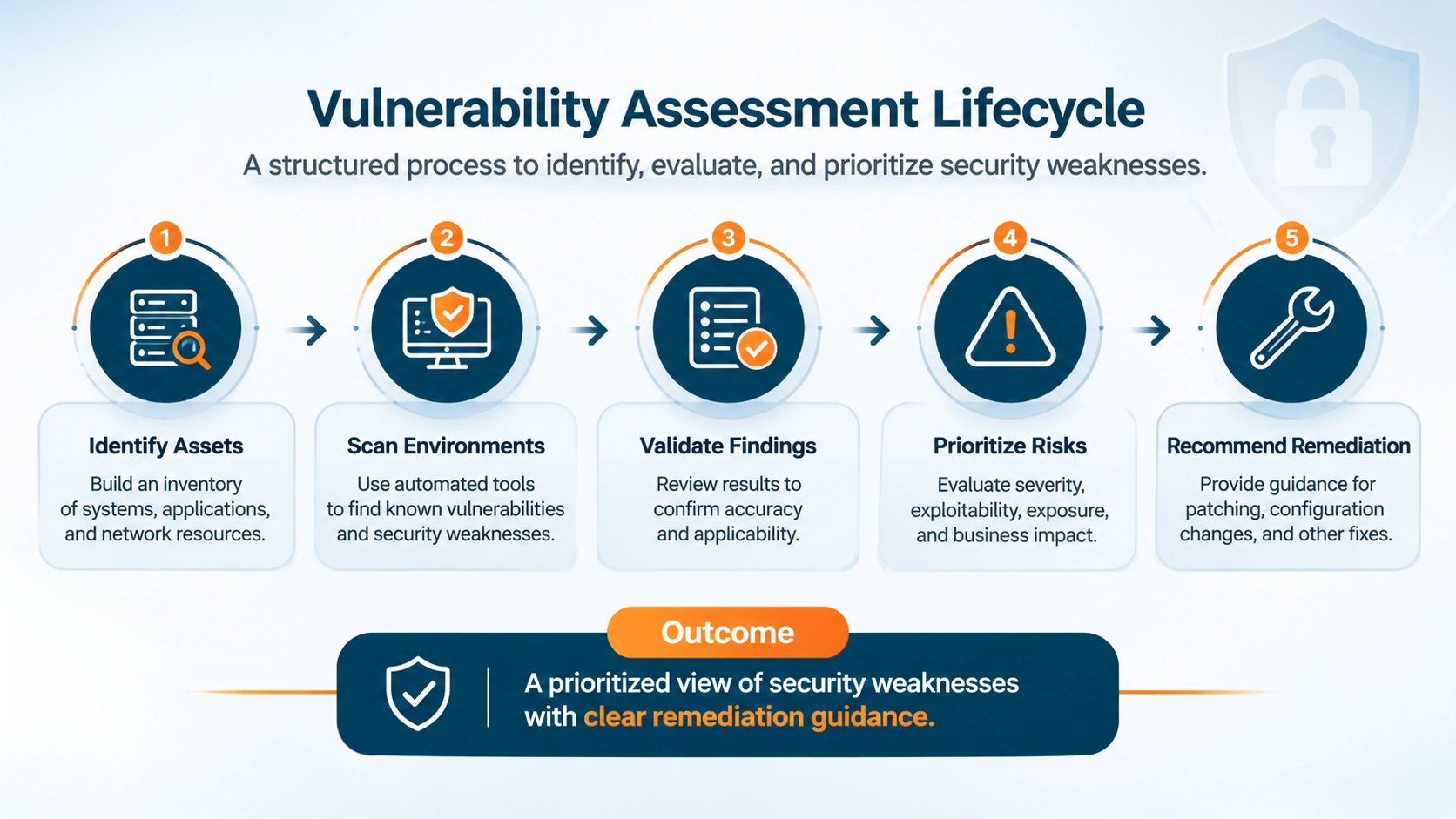
The process generally includes:
- Identifying Assets: Build an inventory of systems, applications, and network resources
- Scanning Environments: Use automated tools to identify known vulnerabilities and security weaknesses
- Validating Findings: Examine relevant results to confirm their accuracy and applicability
- Prioritizing Risks: Evaluate severity, exploitability, asset exposure, and business impact
- Supporting Remediation: Provide guidance for patching, configuration changes, and other fixes
False Positives and Limitations
Automated scanners sometimes flag findings that fall outside an environment’s actual exposure. Inaccurate software identification, configuration differences, and incomplete service detection can produce false positives. Manual validation helps security teams distinguish genuine vulnerabilities from inaccurate findings. Security professionals also examine the surrounding environment to understand the relevance of each finding. A vulnerability assessment identifies and evaluates weaknesses. Penetration testing then confirms which findings create viable attack paths.
Expected Output
A vulnerability assessment report provides a structured view of an organization's security weaknesses. It typically includes:
- Identified vulnerabilities and affected assets
- Severity ratings and risk classifications
- Supporting technical evidence
- Prioritized remediation recommendations
These findings support patch management, configuration improvements, asset management, and recurring vulnerability management activities.
What a Pen Test Does: Manual Testing, Exploitation, and Attack Paths
A penetration test evaluates an organization's security from an attacker's perspective. Authorized security professionals simulate real-world attacks against applications, networks, systems, and infrastructure. They examine potential entry points, test security controls, and determine how far an attacker could progress within the approved scope.
Penetration testing combines manual techniques, automated tools, custom scripts, and established attack methodologies. The process begins with defined objectives, authorization, and testing boundaries. Testers then conduct reconnaissance, identify attack surfaces, analyze vulnerabilities, and investigate potential exploitation scenarios.
Manual Testing
Manual testing allows security professionals to examine application behavior, business logic, authentication mechanisms, and access controls. Testers apply technical expertise to scenarios that call for human judgment and context.
For example, a tester might examine whether an application enforces appropriate access restrictions across different user roles. This analysis can reveal authorization weaknesses or business logic flaws that require contextual investigation.
Exploitation
Exploitation involves testing whether identified vulnerabilities provide opportunities for unauthorized access or other security compromises. Testers use controlled techniques to validate weaknesses and document their potential impact.
For example, a tester might exploit an authentication weakness to gain access to a user account. The tester then evaluates the level of access and the resources available through that account.
Attack Paths
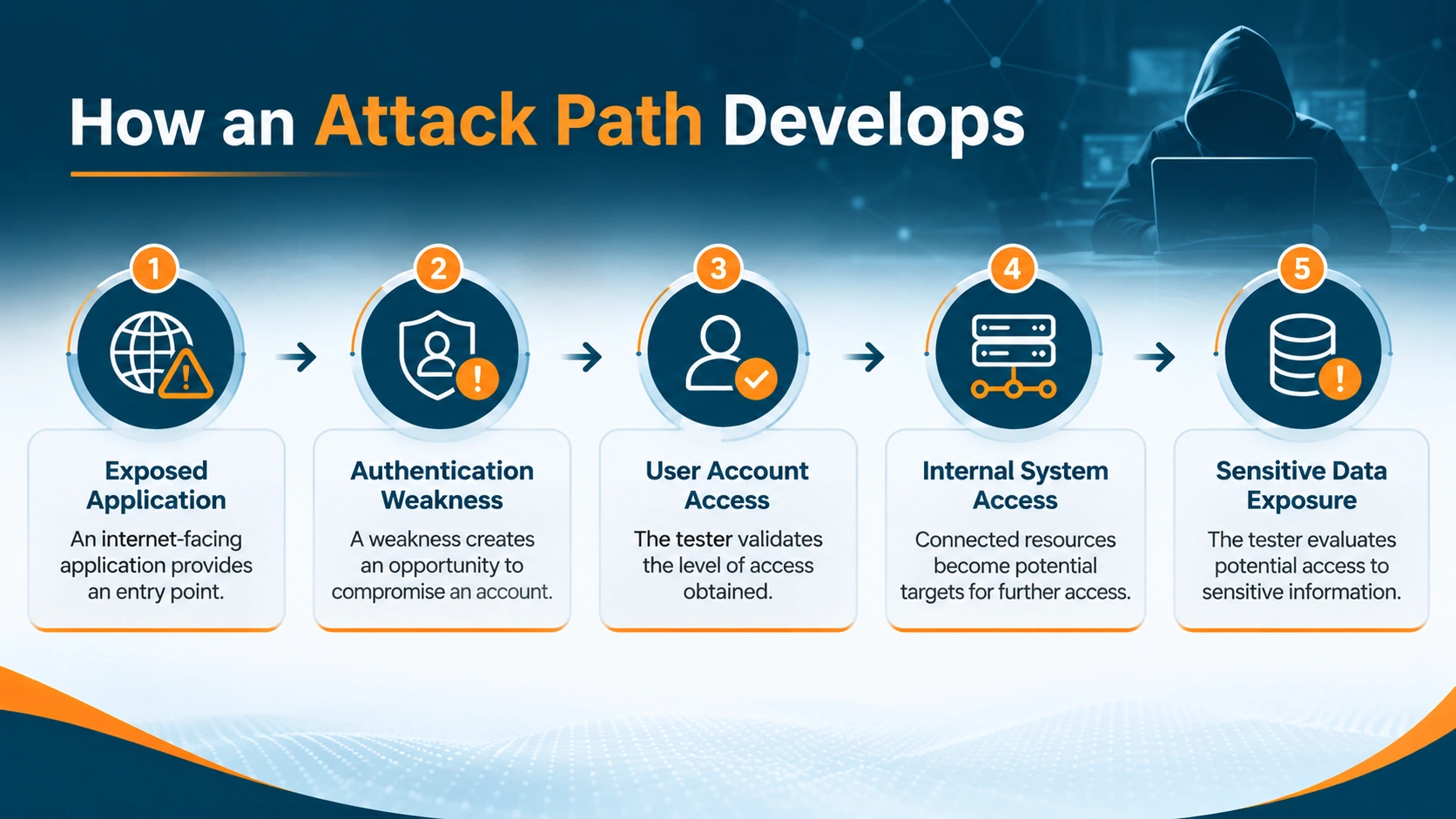
Attack path analysis examines how individual vulnerabilities and security weaknesses can connect to create opportunities for further access. Testers investigate privilege escalation, lateral movement, and access to sensitive resources within the approved scope.
For example, an exposed application might provide an initial entry point. A compromised user account could then create an opportunity to access internal systems or sensitive information. Mapping this sequence helps security teams understand how an attack could progress across connected environments.
Side-by-Side Comparison: Pen Test vs. Vulnerability Assessment
Penetration testing and vulnerability assessments differ in their objectives, execution methods, resource requirements, and outcomes. The following comparison highlights the factors that influence an organization's testing decisions.
| Comparison factor | Vulnerability Assessment | Penetration Testing |
|---|---|---|
| Primary objective | Identify and prioritize security weaknesses | Validate exploitability and demonstrate potential impact |
| Testing approach | Automated scanning supported by manual analysis | Manual testing supported by automated tools |
| Testing depth | Broad identification and evaluation of weaknesses | In-depth examination of selected targets and attack paths |
| Human involvement | Depends on scope and validation requirements | Requires extensive security expertise and manual investigation |
| Exploitation | Focuses on identifying and evaluating vulnerabilities | Uses controlled exploitation within authorized boundaries |
| Attack paths | Identifies individual weaknesses and potential exposure | Examines how weaknesses can combine to enable attacks |
| False positives | Requires validation to confirm findings | Uses manual verification and exploitation evidence |
| Expected output | Vulnerability inventory, severity ratings, and remediation priorities | Validated vulnerabilities, attack paths, evidence, and impact analysis |
| Testing frequency | Supports regular and recurring assessments | Typically conducted periodically or after significant changes |
| Cost | Generally lower due to repeatable assessment processes | Generally higher due to specialized expertise and testing effort |
Testing Depth and Frequency
Vulnerability assessments support recurring security checks across large environments. Organizations can schedule assessments monthly, quarterly, or more frequently based on risk and operational requirements.
Penetration tests usually require more planning and manual investigation. Organizations often schedule them annually or after major infrastructure changes. Teams also commission them when critical systems need deeper validation.
Cost Considerations
Vulnerability assessment costs depend on asset volume, infrastructure complexity, scanning requirements, and manual validation effort.
Penetration testing costs also reflect tester expertise, exploitation complexity, engagement duration, and reporting requirements. Larger environments and specialized testing scopes can increase the overall effort. Each budget reflects a distinct testing objective and depth of investigation.
The pen testing vs vulnerability scanning discussion often centers on automated versus manual work. The real distinction runs deeper. Both approaches can use automated tools and human expertise. Their primary difference lies in the outcome: identifying security weaknesses versus validating what an attacker could achieve through exploitation.
Which One Do You Need? Choosing the Right Security Testing Approach
The right choice starts with your security objectives and infrastructure. Risk exposure, compliance requirements, and security maturity also shape it. Each approach serves a distinct security need.
When a Vulnerability Assessment Makes Sense
A vulnerability assessment provides broad visibility into an organization's security weaknesses. It helps security teams understand their exposure and establish remediation priorities.
Consider this approach when:
- Building an initial view of infrastructure security
- Securing systems by identifying outdated software, missing patches, and configuration weaknesses
- Strengthening visibility into exposure across large IT environments
- Enabling recurring vulnerability management cycles
- Simplifying remediation with priorities based on severity and business risk
- Preparing for security reviews and compliance assessments
Organizations with extensive infrastructure can use recurring assessments to monitor changes in their security exposure. These assessments also support consistent patch management and remediation planning.
When Penetration Testing Makes Sense
Penetration testing helps organizations evaluate how effectively their security controls withstand simulated attacks. It provides technical evidence of exploitability and potential attack impact.
Consider this approach when:
- Extending vulnerability findings with proof of exploitability
- Securing internet-facing applications and infrastructure through attack simulation
- Enhancing visibility into attack paths between connected systems
- Strengthening authentication, authorization, and access controls
- Advancing security validation after major infrastructure or application changes
- Supporting compliance and security requirements through technical testing evidence
Penetration testing delivers strong value in high-stakes environments. These include systems that handle sensitive data, run critical operations, or serve external users.
Why Organizations Need Both
A comprehensive security program combines vulnerability assessments with penetration testing. Each approach provides a different perspective on security exposure.
Vulnerability assessments help organizations maintain visibility into security weaknesses and prioritize remediation. Penetration testing adds a validation layer. It shows whether attackers can exploit those weaknesses and how far an attack can progress.
Pen testing and vulnerability scanning work best together. An organization can run recurring scans to catch new weaknesses across its infrastructure. It could then commission penetration testing to examine critical applications, exposed network segments, or high-value systems in greater depth.
This combination supports a continuous cycle of identification, validation, remediation, and security improvement.
Compliance requirements and security maturity also influence testing decisions. Certain frameworks and regulations specify particular security testing activities. Aligning testing programs with control requirements and business objectives keeps every security investment focused.
Ultimately, vulnerability assessments help answer where security weaknesses exist. Penetration testing establishes how those weaknesses could affect an organization through exploitation. Together, they provide complementary insights that support informed risk management and stronger cybersecurity decisions.