
Choosing a pen testing company starts before you contact a single vendor. Start by defining your goal: a compliance test for PCI DSS, SOC 2, or ISO 27001, assurance before a launch, or proactive risk reduction. Then list your in-scope systems and the safety rules for production. With that in hand, you can compare boutique firms, large consultancies, and PTaaS platforms on equal terms.
This guide shows what a strong engagement delivers, the questions to ask, how to tell manual testing from a scan, which credentials matter, and how to compare proposals side by side.
What a Good Pen Testing Company Delivers
A good pen testing company delivers proof, not just a list of issues. You get tested evidence of how an attacker could reach your most valuable data, ranked by business impact, with fixes your team can apply and a retest that confirms they worked.
Here’s what surprises most buyers: the real product is the tester’s judgment, captured in a report you keep long after the engagement ends. That’s why strong pen testing companies all deliver the same six things.
- Scope That Matches Your Risk: A tester can only report on what sits inside scope. A strong penetration testing company maps the scope to where your sensitive data actually lives, even when that makes the test bigger than you first planned.
- Manual Testing That Connects the Dots: Three Low findings, chained together, can open a path to full domain control. Scanners grade each issue on its own. Skilled testers show you the path.
- Severity Ranked by Your Context: CVSS includes Environmental metrics so severity can reflect your own environment.¹ A Medium finding on an internet-facing customer portal can outrank a Critical on an isolated test server. Strong testers score for your business, not the textbook.
- Evidence You Can Reproduce: Every finding comes with requests, screenshots, and step-by-step reproduction notes. Your team can confirm each issue on its own, then prove the fix.
- A Coverage Statement: A clear record of what got tested, how deeply, and what sat outside scope. A clean report only means something when leadership knows exactly what “clean” covers.
- A Readout and a Retest: A walkthrough call so your team knows what to fix first, then a retest that confirms every Critical and High finding stays closed.
Pro Tip: Ask every vendor for a redacted sample pen test report before you sign. Check three things: whether findings show attack chains, whether severity reflects business context, and whether the report includes a coverage statement. Those three details separate a real pen testing service from a rebranded scan.
Questions to Ask Before You Hire Pen Testing Company
The best questions to ask a pen testing provider cover five areas: methodology, testers, reporting, retest policy, and data handling. Vague answers in any of them tell you more than a polished sales deck. Here’s what to ask, and what a strong answer sounds like.
Methodology
“Walk me through how you’d test our main application on day three.”
A provider with a real methodology can describe it in concrete steps: what they map first, which business logic they target, and when they switch from tools to hands-on testing. Generic answers about “industry-leading frameworks” usually point to a template process.
“Which findings in your sample report came from manual testing?”
This one question shows the real balance between human work and automated scanning. Strong providers can point to specific findings, like a broken approval workflow or a chained privilege escalation, that no scanner could find.
Testers
The person on the sales call is rarely the person who tests your systems. So ask: “Who exactly will run our test, and can we see their background before we sign?” Ask for named testers in the statement of work, plus a commitment to tell you before anyone gets swapped out.
Then ask: “Will the same tester run the retest?” The tester who found an issue understands its root cause best. Continuity makes retests faster and more accurate.
Reporting
| Ask This | Why It Matters |
|---|---|
| “Can I see a sample report from an environment like ours?” | A healthcare portal report tells you more than a generic network sample. |
| “How do you adjust severity for our business context?” | The same flaw carries different risk on a customer portal than on a test server. |
| “Does the report include a coverage statement?” | It shows leadership exactly what “clean” covers. |
| “Who joins the readout call?” | You want the tester on the call, not only an account manager. |
Retest Policy
Get the retest policy in writing before you sign: “How many retests are included, within what time window, and do you issue a letter confirming the fixes?” That letter often becomes the document your auditor, customer, or insurer actually asks for. Strong providers include at least one retest of Critical and High findings in the base price.
Data Handling
Your pen test report is a step-by-step map to your weakest points. In the wrong hands, it’s an attack plan. Ask:
- “Where do our findings and test data live, and who can access them?” Listen for encryption, named access, and a set deletion date.
- “What happens if you find signs of a real attacker during the test?” A strong provider stops, calls your named contact right away, and preserves the evidence.
- “What’s your emergency stop if a production system slows down?” You want a named contact, a phone number, and a clear pause procedure in the rules of engagement.
Send these questions in writing and compare the replies side by side. Strong providers answer specifically and fast, because they field these questions every week. Slow, vague replies before you sign usually mean slow, vague reports after.
How to Spot a Scan Sold as a Pen Test
The fastest way to tell a real pen test from an automated scan is to look at the findings. A scan answers “what might be wrong?” A manual pen test answers “what can an attacker actually do?” Both have value, but they’re different products at different prices.
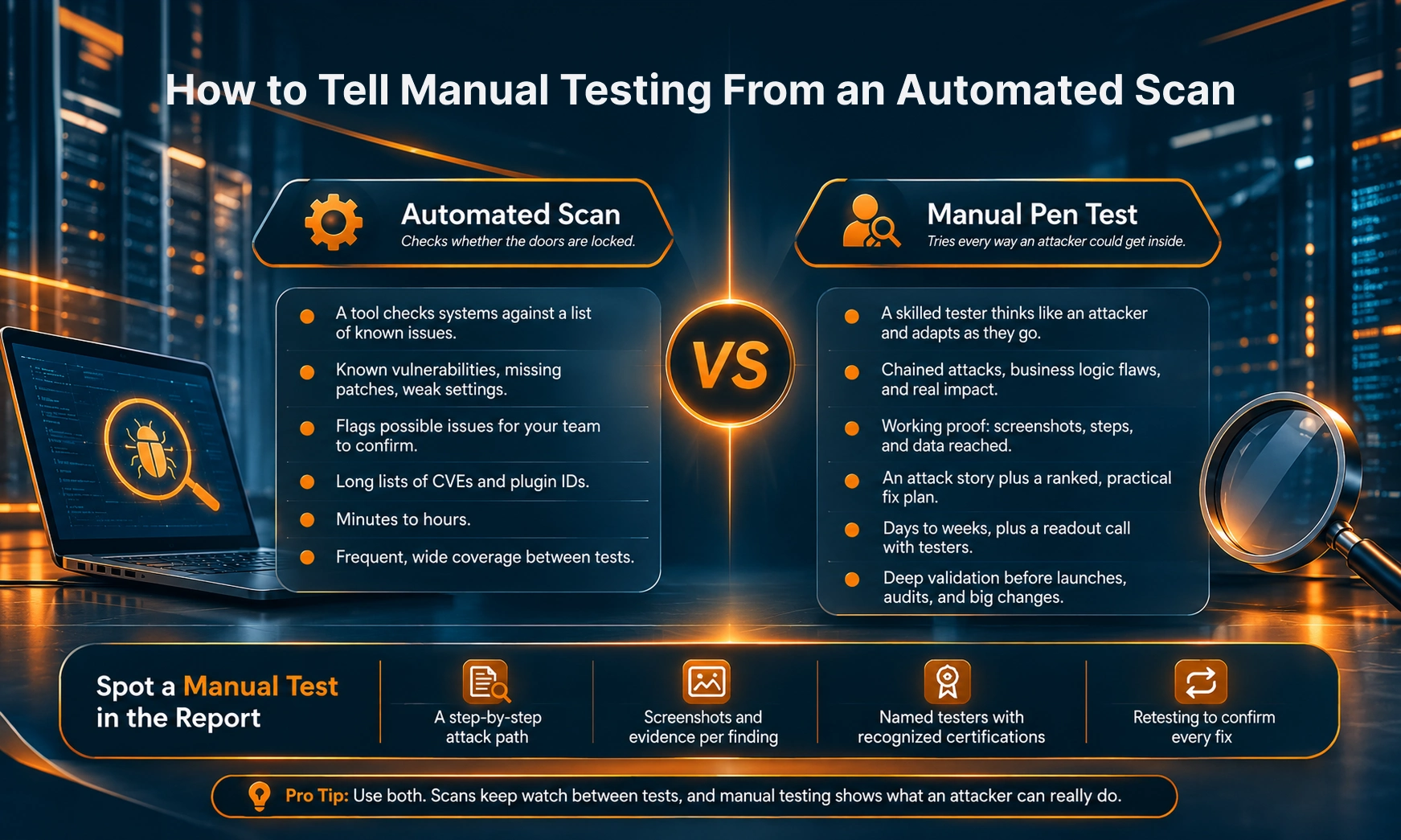
Here’s the logic most buyers miss. Broken access control is the #1 web application risk.² It depends on business rules, like who should approve a refund or which patient records a nurse should see. Only a human who understands those rules can test them. So the most common serious flaw is exactly the one an automated scan tends to miss.
Use these signals to compare any report or proposal:
| Signal | Automated Scan | Manual Pen Test |
|---|---|---|
| Timeline | Finishes overnight, no matter the size | Takes days per application, scaled to scope |
| Finding names | CVE numbers, missing headers, outdated versions | Business impact, like “Standard user can approve their own payments” |
| Proof | “Potential” or “possible” vulnerabilities | Screenshots, requests, and steps showing the exploit worked |
| Attack chains | Each issue listed on its own | Low findings linked into a path to sensitive data |
| Severity | Copied from the tool’s default score | Adjusted for your environment and business context |
| Report wording | Matches the scanner’s own output | Written for your systems, with a clear attack narrative |
The one-question test
Pick any High finding in a vendor’s sample report and ask, “Show me the exploitation evidence for this one.” A manual tester can walk you through exactly what they did and what they reached. A scan-based report can only point back to the tool’s output.
Strong pen testing companies run automated scans too, as their starting point. Look for a report that shows both: scan coverage for breadth, then manual testing for depth on the systems that matter most.
Pen Testing Certifications and Experience That Matter
Certifications prove a tester passed a demanding exam. Experience proves they can test an environment like yours. The strongest pen testing companies show both, and smart buyers check each one separately.
The Core Pen Testing Credentials
| Credential | Who Holds It | What It Proves |
|---|---|---|
| OSCP / OSCP+ | Individual tester | Passed a proctored, hands-on exam: almost 24 hours of breaking into live machines, including an Active Directory set, plus 24 more hours to write the report.³ |
| GPEN | Individual tester | Passed GIAC’s proctored exam on penetration testing methodology, which includes hands-on CyberLive questions run in virtual machines.⁴ |
| CREST | Company and individual | Company accreditation means CREST reviewed the firm’s policies, processes, and procedures. Individual certifications like CRT and CCT test the people.⁵ |
Specialist Credentials by Testing Type
A general credential shows strong fundamentals. A specialist credential shows depth in the exact systems you’re testing. Match the credential to your scope:
| Testing Type | Credentials to Look For | What They Signal |
|---|---|---|
| Web applications | OSWA, OSWE | OSWE is OffSec’s expert web credential, built around advanced web attacks and exploitation.⁷ |
| Hardened networks and Active Directory | OSEP, OSCE³ | OSEP covers advanced evasion and breaching defenses. OSCE³ goes to testers who earn OSEP, OSWE, and OSED.⁷ |
| Cloud | GCPN | GIAC’s cloud penetration testing credential, covering AWS and Azure attacks, containers, and CI/CD pipelines.⁸ |
| AI and LLM applications | OSAI, GAIPT | New AI red teaming and AI penetration testing credentials for LLM apps, RAG pipelines, and agentic systems.⁷ ⁹ |
| OT and ICS | GICSP, GRID | GIAC credentials for industrial control system security and ICS active defense.¹¹ |
| Mobile | GMOB | GIAC’s mobile device security credential.¹² |
What Changed in 2026
OSCP+ moves to scaled scoring. Starting December 1, 2026, OffSec scores OSCP+ exams on a scaled basis instead of a fixed passing score. OffSec states the competency required to pass stays the same.⁶
AI pen testing credentials arrived. OffSec added OSAI, its AI red teamer certification.⁷ GIAC’s AI Penetration Tester (GAIPT) is in presale, with general availability on February 9, 2027.⁹ SANS and GIAC plan four AI-focused certifications by the end of 2026.¹⁰
These credentials are brand new, so few testers hold them yet. For AI testing, ask for proof of real engagements: a redacted AI finding, a prompt injection test plan, or a scope document for an LLM application.
Two Details Most Buyers Miss
OSCP is a lifetime credential, while OSCP+ expires after three years.³ A current OSCP+ shows the tester passed a recent version of the exam.
Company accreditation and tester certification are separate. CREST states that a member company can be accredited without employing CREST-qualified individuals.⁵ So ask which certified people will work on your project, and get their names in the statement of work.
Where Credentials Stop, Experience Takes Over
An exam lab can’t recreate your hospital’s EHR integrations, your plant’s PLCs, or your bank’s payment APIs. Before you sign, ask each pen testing company for:
- Two or three recent engagements in your industry, with the systems they tested
- A redacted report from one of those engagements, so you can judge depth and clarity
- The named testers’ backgrounds, including the specialist credentials that match your scope
- How they handle fragile systems, like production databases, medical devices, or live controllers
Map each part of your scope to a credential before you compare vendors. A web application test calls for OSWE or OSWA depth. A cloud test calls for GCPN, and an OT test calls for GICSP or GRID. A team with one strong general credential and no specialist match is a sign to ask more questions.
Comparing Proposals and Pricing
The best way to compare pen testing vendors is to line up three things side by side: scope, deliverables, and retest terms. Once those match, price becomes a fair comparison. Until they match, you’re comparing different products.
Here’s the surprising part: the cheapest proposal often covers the smallest scope. Two quotes for a “web application pen test” can mean three testing days or ten, one role tested or five. The price gap usually reflects the scope gap.
Use This Side-by-Side Worksheet
| What to Compare | Vendor A | Vendor B | What to Check |
|---|---|---|---|
| Scope | Exact systems, URLs, IP ranges, user roles, and environments in scope | ||
| Tester-days | Total hands-on testing days, separate from reporting time | ||
| Testing approach | Share of manual testing, and which systems get the deepest work | ||
| Deliverables | Executive summary, technical findings, attack narrative, coverage statement, readout call | ||
| Retest | Number of retests, time window, and confirmation letter | ||
| Named testers | Credentials that match your scope | ||
| Extra fees | Out-of-hours testing, added retests, report revisions, travel | ||
| Total price |
Three Ways to Make the Numbers Comparable
- Divide price by tester-days. This turns every quote into a day rate you can compare directly. A higher total with more tester-days often delivers better value per dollar.
- Price the full year, not one test. Add retests, a mid-year test after major changes, and any compliance-driven scans. The vendor with the lowest one-time quote can end up costing more over 12 months.
- Ask what sits outside scope. Every proposal has edges. Knowing exactly where they fall keeps surprise change orders off your budget.
For typical price ranges by test type, see our guide to pen testing cost.
Send every pen testing vendor the same written scope before you ask for pricing. When all bids start from one scope document, the differences that remain show you real gaps in approach, depth, and value.

Warning Signs to Watch For in Proposals
The clearest warning signs show up before you sign: a price set before anyone asks about your systems, a sample report the vendor can’t share, and promises no honest tester can make. Each one points to the same risk, which is paying for a pen test and receiving a scan.
| Warning Sign | What It Usually Means | Ask This Instead |
|---|---|---|
| Fixed-price scans sold as pen tests, at one flat price whatever your scope | The price reflects tool runtime, not tester time | “How many tester-days does this price include?” |
| No sample report available, even redacted | The report quality may surprise you after delivery | “Can I see a redacted report from a similar engagement?” |
| A quote before a scoping call | The vendor priced a template, not your environment | “What do you need to know about our systems to scope this?” |
| Guaranteed outcomes, like a promised “pass” | The test may be shaped to the promise | “How do you report findings that affect our compliance status?” |
| Unnamed testers | Anyone could run your test | “Who will test, and what credentials match our scope?” |
| Retest terms missing from the proposal | Fixes may cost extra to confirm | “How many retests are included, and within what window?” |
| A fast turnaround for a large scope | Depth gives way to speed | “How do you split time between automated and manual testing?” |
Every warning sign has a simple fix. Ask the question, and get the answer in writing. Strong vendors welcome the questions, because the answers show off their work.
Choose the Pen Testing Company That Shows Its Work
The right pen testing company makes its value easy to see before you sign. It scopes your environment before it quotes. It names its testers and matches their credentials to your systems. It shares a sample report that shows attack chains, context-based severity, and a clear coverage statement. And it puts retest terms in writing.
Start with one written scope, send every vendor the same questions, and line up the answers side by side. The vendor that answers specifically and shows real proof is the one that will deliver a report your team can act on, and your auditors can trust.
Sources
- FIRST, “Common Vulnerability Scoring System Version 4.0: Specification Document.” https://www.first.org/cvss/v4.0/specification-document
- OWASP, “A01:2025 Broken Access Control,” OWASP Top 10:2025. https://top10.owasp.org/2025/A01_2025-Broken_Access_Control/index.html
- OffSec, “OSCP Exam Guide.” https://www.offsec.com/offsec/oscp-exam-guide/
- GIAC, “GIAC Penetration Tester Certification (GPEN).” https://www.giac.org/certifications/penetration-tester-gpen/
- CREST, “Membership” and “What We Do.” https://www.crest-approved.org/about-us/what-we-do/
- OffSec, “OSCP+ Scoring Update,” October 6, 2026. https://www.offsec.com/blog/oscp-scoring-update/
- OffSec, “Certifications” and “What Is Your Course Code System?” https://www.offsec.com/certifications/
- GIAC, “GIAC Cloud Penetration Tester (GCPN).” https://www.giac.org/certifications/cloud-penetration-tester-gcpn/
- GIAC, “GIAC AI Penetration Tester (GAIPT).” https://www.giac.org/certifications/offensive-ai-penetration-tester-gaipt/
- GIAC, “SANS and GIAC Launch AI-Focused Cybersecurity Certifications.” https://www.giac.org/about/press/announcements/sans-giac-launch-ai-focused-cybersecurity-certifications/
- GIAC, “GIAC Response and Industrial Defense (GRID).” https://www.giac.org/certifications/response-industrial-defense-grid/
- SANS, “Explore the Value of GIAC Cloud Security and Penetration Testing Certifications.” https://sans.org/blog/explore-the-value-of-giac-cloud-security-and-penetration-testing-certifications
- Forbes, Janakiram MSV, “AWS Deploys AI Agents To Do The Work Of DevOps And Security Teams,” April 1, 2026. https://www.forbes.com/sites/janakirammsv/2026/04/01/aws-deploys-ai-agents-to-do-the-work-of-devops-and-security-teams/
- Anthropic, “Project Glasswing: Initial Update.” https://www.anthropic.com/research/glasswing-initial-update