
HIPAA pen testing requirements come from two places. Today, the Security Rule requires a periodic technical evaluation of your safeguards, and a pen test is the most direct way to meet it. HHS’s proposed update would require pen testing at least once every 12 months and vulnerability scanning every six months.
This guide covers what each rule asks for, what to test across your healthcare environment, how to map findings to HIPAA safeguards, and what OCR expects to see.
Does HIPAA Require Pen Testing?
HIPAA already requires a periodic technical evaluation of your security safeguards, and a pen test is the most direct way to meet that requirement. HHS’s proposed Security Rule update would go a step further and require HIPAA pen testing at least once every 12 months.
Under the current Security Rule, 164.308(a)(8) requires every covered entity and business associate to “perform a periodic technical and nontechnical evaluation” of its security policies and procedures.¹ The rule leaves the method up to each organization. A pen test covers the technical side of that evaluation with hard evidence, because it shows whether your safeguards hold up against real attack techniques. Its findings also feed your Security Risk Analysis.
The proposed rule turns that into a clear schedule. HHS published the proposal in January 2025. It would require vulnerability scanning at least every six months and penetration testing at least once every 12 months.² HHS now targets final action for July 2027. While the rulemaking continues, the current Security Rule remains in effect.² ³
Here’s how the HIPAA penetration testing requirements compare under each version:
| Current Security Rule | Proposed Security Rule | |
|---|---|---|
| Pen testing | Supports the periodic technical evaluation under 164.308(a)(8) | Required at least once every 12 months |
| Vulnerability scanning | Supports the Security Risk Analysis and evaluation | Required at least every six months |
| Status | In effect today | Proposed, with final action targeted for July 2027 |
What the Proposed Security Rule Would Change
HHS’s proposed rule would make pen testing and vulnerability scanning required, scheduled activities under a new vulnerability management standard at 164.312(h).⁴ Pen testing would happen at least once every 12 months, and scanning at least every six months.²
That’s a big shift from today’s flexible “periodic evaluation.” Here’s what the proposed rule spells out.
The Testing Requirements
- Annual Pen Testing: A qualified person tests your relevant electronic information systems at least once every 12 months, or more often if your risk analysis calls for it.⁴
- Qualified Testers: The proposal defines a qualified person by their knowledge of and experience with generally accepted cybersecurity principles and methods.⁴
- Six-Month Scanning: Run automated vulnerability scans at least every six months,² and monitor authoritative sources for known vulnerabilities.⁴
- Patching: Apply patches and updates within a reasonable and appropriate period, based on your risk analysis and the results of your scans and pen tests.⁴
The Related Requirements That Shape Your Test
Several other proposed changes feed straight into how you scope and report a pen test:
- Asset Inventory and Network Map: Keep a technology asset inventory and a network map showing how ePHI moves. Update both on an ongoing basis, at least once every 12 months, and whenever a change in your environment or operations may affect ePHI.² Together, they give your tester a clear scope.
- Annual Compliance Audit: Audit your compliance with the Security Rule at least once every 12 months.² Your pen test report becomes a core piece of that evidence.
- Annual Control Testing: Review and test the effectiveness of certain security measures at least once every 12 months.²
- Network Segmentation: The proposal requires network segmentation.² A pen test shows how well it holds.
- Business Associate Verification: Each business associate verifies its technical safeguards at least once every 12 months. That verification includes a written analysis by a subject matter expert and a written certification.²
The Timing
If HHS finalizes the rule as proposed, it takes effect 60 days after publication, and compliance comes due 180 days after that.⁴ That’s about eight months from publication to have annual testing and six-month scanning in place. Existing business associate agreements get up to one year of extra transition time.⁴ HHS currently targets final action for July 2027.³
Eight months goes by fast for a hospital system with EHR modules, vendor connections, and connected medical devices to cover. Teams that run a full-scope test now set their baseline early and have time to fix findings before the compliance date.
What to Test in a Healthcare Environment
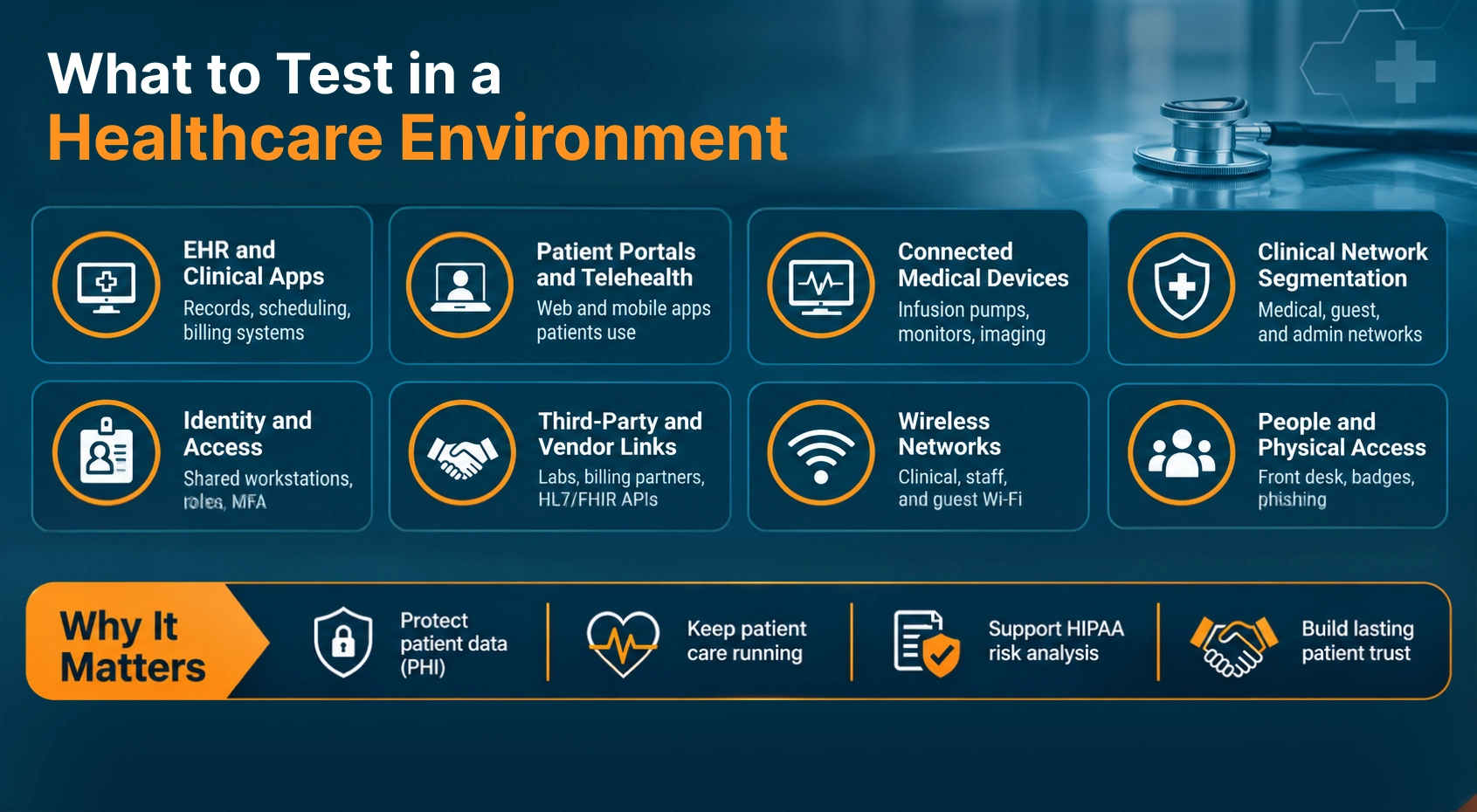
Healthcare pen testing covers every system that creates, receives, maintains, or transmits ePHI. Four areas matter most: EHR systems, patient portals and health APIs, connected medical devices, and business associate access. The technology asset inventory and network map in the proposed rule show how ePHI moves between these systems,² so they make a strong starting point for scope.
EHR Systems
The EHR is where clinicians read and write patient records every day, so testers look at who can reach what:
- Role-Based Access: Check whether a front-desk or billing account can open clinical notes it has no reason to see.
- Integration Interfaces: Test the HL7 and FHIR interfaces that connect the EHR to labs, pharmacy, imaging, and billing.
- Remote Access: Confirm MFA covers every remote path into the EHR, including VPN and virtual desktop access.
- Data Stores: Test the database, reporting, and backup servers that hold ePHI outside the main application.
Patient Portals and Health APIs
Portals and APIs face the internet, which makes them a top target. Health plans have more API surface coming. CMS requires impacted payers to have Patient Access, Provider Access, Payer-to-Payer, and Prior Authorization APIs in place by January 1, 2027.⁵ Testers check whether one patient can view another patient’s records by changing an ID, whether password reset flows allow account takeover, how sessions expire, and what data third-party app connections can pull.
Connected Medical Devices (IoMT)
IoMT devices like infusion pumps, patient monitors, and imaging systems connect to hospital networks. Testers check the segmentation between IoMT and corporate networks, default credentials, unencrypted device traffic, and vendor remote support connections. For devices in clinical use, testers use passive methods and coordinate every step with biomedical engineering.
Device makers carry part of this work too. Under the FDA’s premarket cybersecurity guidance, manufacturers should submit pen test reports that cover tester independence, scope, duration, testing methods, and findings.⁶ Ask vendors for that report during procurement, and use it to focus your own testing.
Business Associate Access
Third parties played a role in 32% of healthcare breaches.⁷ Every business associate agreement must require the business associate to comply with the Security Rule,⁸ and the proposed rule would add an annual written verification of each business associate’s technical safeguards.² Testers check vendor VPN and remote support tools, shared or stale vendor accounts, API keys held by billing and cloud vendors, file transfer connections, and how far a compromised vendor account can reach into ePHI systems.
Mapping Findings to HIPAA Safeguards
Every pen test finding maps to a specific HIPAA safeguard, whether administrative under 164.308, physical under 164.310, or technical under 164.312. That mapping turns a list of technical findings into evidence your compliance team, auditors, and OCR can follow.
Start with the Security Risk Analysis. HIPAA requires an “accurate and thorough assessment” of risks and vulnerabilities to ePHI, plus security measures that reduce those risks “to a reasonable and appropriate level.”¹ Each confirmed finding gives that analysis a real, tested data point, and each fix becomes a documented risk management step. Here's how common pen test findings map to each safeguard:
Administrative Safeguards
| Pen Test Finding | HIPAA Safeguard | Citation |
|---|---|---|
| Weak or reused passwords | Password management | 164.308(a)(5)(ii)(D)¹ |
| Active accounts for former staff | Termination procedures | 164.308(a)(3)(ii)(C)¹ |
| Users with more access than their role needs | Access authorizatio006E | 164.308(a)(4)(ii)(B)¹ |
| Staff who click phishing links | Security awareness and training | 164.308(a)(5)(i)¹ |
| Over-permissive vendor access | Business associate contracts | 164.308(b)(1)¹ |
Physical Safeguards
| Pen Test Finding | HIPAA Safeguard | Citation |
|---|---|---|
| Tailgating into server rooms or records areas | Facility access controls | 164.310(a)(1)⁹ |
| Unlocked workstations in patient areas | Workstation security | 164.310(c)⁹ |
| Unencrypted laptops or drives holding ePHI | Device and media controls | 164.310(d)(1)⁹ |
Technical Safeguards
| Pen Test Finding | HIPAA Safeguard | Citation |
|---|---|---|
| Patients viewing other patients’ records in a portal | Access control | 164.312(a)(1)¹⁰ |
| Shared logins on clinical systems | Unique user identification | 164.312(a)(2)(i)¹⁰ |
| Gaps in activity logging | Audit controls | 164.312(b)¹⁰ |
| Single-factor logins to ePHI systems | Person or entity authentication | 164.312(d)¹⁰ |
| Unencrypted stored ePHI | Encryption and decryption | 164.312(a)(2)(iv)¹⁰ |
| ePHI sent over unencrypted connections | Transmission security | 164.312(e)(1)¹⁰ |
What OCR and Auditors Expect to See
OCR and auditors expect documented proof that you test, fix, and verify. That proof includes the pen test report, evidence of remediation, retest results, and an updated Security Risk Analysis, all kept on file for six years.
OCR’s audit protocol shows where that proof gets checked. For the evaluation standard, auditors review documentation showing that periodic technical and nontechnical evaluations took place.¹¹ They also review how the organization documents findings, remediation options and recommendations, and remediation decisions.¹¹ Enforcement follows the same pattern. OCR announced the 12th enforcement action in its Risk Analysis Initiative in March 2026.¹³ In a February 2026 settlement, the corrective action plan required an accurate and thorough risk analysis, a plan to reduce the risks it found, and two years of OCR monitoring.¹²

What to Keep in Your Evidence File
- The Pen Test Report: Scope, methods, dates, tester qualifications, findings, severity ratings, and the HIPAA safeguard tied to each finding.
- Remediation Records: Each finding with an owner, a fix date, and notes on what changed. These records become your risk management evidence under 164.308(a)(1)(ii)(B).¹
- Retest Results: Proof that each Critical and High finding stays closed, signed off by the tester with dates.
- Updated Security Risk Analysis: Confirmed findings added as tested risks, plus any accepted risks with the business reason behind each one.
- Retention: Keep all of it for six years from the date you create it or the date it was last in effect, whichever is later.¹⁴
Build Your HIPAA Pen Testing Program Before the Final Rule
HIPAA pen testing already does real work today. It gives your periodic evaluation hard evidence, feeds your Security Risk Analysis, and shows auditors your safeguards hold up. The proposed rule would make that work a fixed annual requirement, with final action targeted for July 2027.
The teams in the best position start now. They scope every system that touches ePHI, including EHRs, patient portals, IoMT devices, and business associate access. They map each finding to a HIPAA safeguard, then fix, retest, and keep the full record on file.
Run that cycle once, and your next audit becomes a review of work you’ve already finished.
Sources
- eCFR, “45 CFR 164.308 Administrative Safeguards.” https://www.ecfr.gov/current/title-45/subtitle-A/subchapter-C/part-164/subpart-C/section-164.308
- HHS, “HIPAA Security Rule Notice of Proposed Rulemaking to Strengthen Cybersecurity for Electronic Protected Health Information,” Fact Sheet. https://www.hhs.gov/hipaa/for-professionals/security/hipaa-security-rule-nprm/factsheet/index.html
- Fierce Healthcare, “Feds Push Back HIPAA Security Rule Overhaul to July 2027.” https://www.fiercehealthcare.com/health-tech/feds-push-back-hipaa-security-rule-overhaul-july-2027
- Federal Register, “HIPAA Security Rule To Strengthen the Cybersecurity of Electronic Protected Health Information,” Proposed Rule, January 6, 2025. https://www.federalregister.gov/documents/2025/01/06/2024-30983/hipaa-security-rule-to-strengthen-the-cybersecurity-of-electronic-protected-health-information
- CMS, “CMS Interoperability and Prior Authorization Final Rule (CMS-0057-F),” Fact Sheet. https://www.cms.gov/files/document/fact-sheet-cms-interoperability-and-prior-authorization-final-rule-cms-0057-f.pdf
- FDA, “Cybersecurity in Medical Devices: Quality Management System Considerations and Content of Premarket Submissions,” February 3, 2026. https://www.fda.gov/media/119933/download
- Becker’s Hospital Review, “Staff Mistakes Plague Healthcare Cybersecurity: Verizon Report” (Verizon 2026 DBIR). https://www.beckershospitalreview.com/healthcare-information-technology/cybersecurity/staff-mistakes-plague-healthcare-cybersecurity-verizon-report/
- eCFR, “45 CFR 164.314 Organizational Requirements.” https://www.ecfr.gov/current/title-45/subtitle-A/subchapter-C/part-164/subpart-C/section-164.314
- eCFR, “45 CFR 164.310 Physical Safeguards.” https://www.ecfr.gov/current/title-45/subtitle-A/subchapter-C/part-164/subpart-C/section-164.310
- eCFR, “45 CFR 164.312 Technical Safeguards.” https://www.ecfr.gov/current/title-45/subtitle-A/subchapter-C/part-164/subpart-C/section-164.312
- HHS, “HIPAA Audit Protocol.” https://www.hhs.gov/hipaa/for-professionals/compliance-enforcement/audit/protocol/index.html
- HHS, “HHS’ Office for Civil Rights Settles HIPAA Security Rule Investigation with Top of the World Ranch Treatment Center,” February 19, 2026. https://www.hhs.gov/press-room/ocr-settles-hipaa-security-rule-investigation-twrtc.html
- HHS, “HHS’ Office for Civil Rights Settles HIPAA Investigation of MMG Fusion, LLC Breach Affecting 15 Million Individuals,” March 5, 2026. https://www.hhs.gov/press-room/ocr-mmg-fusion-hipaa-agreement.html
- eCFR, “45 CFR 164.316 Policies and Procedures and Documentation Requirements.” https://www.ecfr.gov/current/title-45/subtitle-A/subchapter-C/part-164/subpart-C/section-164.316
- HHS, “HHS Office for Civil Rights Settles HIPAA Security Rule Investigation with Northeast Radiology,” April 10, 2025. https://www.hhs.gov/press-room/hhs-ocr-hipaa-settlement-nerad.html
- Military Health System (Health.mil), “Info Paper: Technical Safeguards.” https://health.mil/Reference-Center/Fact-Sheets/2015/01/20/Info-Paper-Technical-Safeguards