
On November 13, 2026, the FBI issued a FLASH advisory about ARTEX, an AI-driven penetration testing framework that threat actors now use to run attacks at machine speed. Some intrusions reached privileged access in under three hours. The tool started life as a security testing platform. That twist holds the real lesson. Here is what the FBI found, how these attacks unfold, and how a modern pen testing program keeps pace.
What Did the FBI Warn About?
The FBI warned that cybercriminals and state-aligned hackers use ARTEX, an open-source agentic AI framework, to automate cyber intrusions from the first scan to data theft. The advisory, FLASH-20261113-001, carries a TLP:CLEAR marking, so anyone can share it.
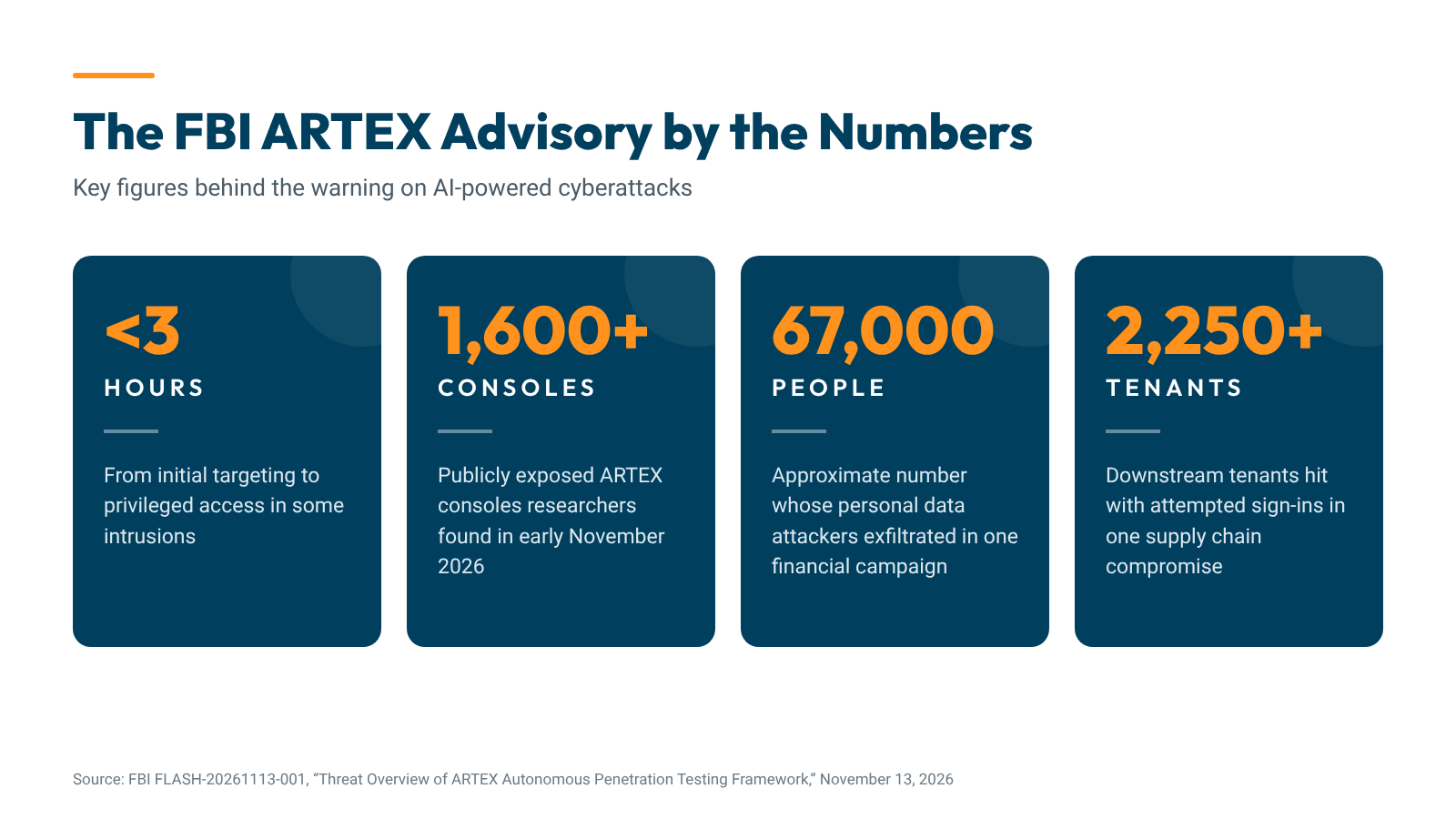
According to the FBI, malicious campaigns began by August 2026 and reached organizations worldwide. Targets span ten industries: financial services, government, technology, defense, semiconductors, energy, healthcare, manufacturing, telecommunications, and legal. Two campaigns stand out in the advisory:
- Financial Data Theft: A financially motivated campaign against financial institutions in South Korea exfiltrated personal information belonging to about 67,000 people.
- Supply Chain Reach: A compromise at a cloud backup provider let attackers attempt sign-ins across more than 2,250 downstream customer tenants.
The original developer pulled the code from its public repository in October 2026. The framework lives on through community forks, archived copies, and a commercial edition called ARTEX PRO. Researchers counted more than 1,600 publicly exposed ARTEX consoles in early November, and the FBI expects the true number runs higher.
How ARTEX Works
Think of ARTEX as a project manager for hacking. An operator types a goal in everyday language, and the framework handles the rest.
The FBI describes ARTEX as a multi-agent platform written in Go. It breaks a high-level goal into tasks and hands each one to a specialized AI agent. Those agents scan, exploit, escalate, and collect data with minimal human input after the first instruction.
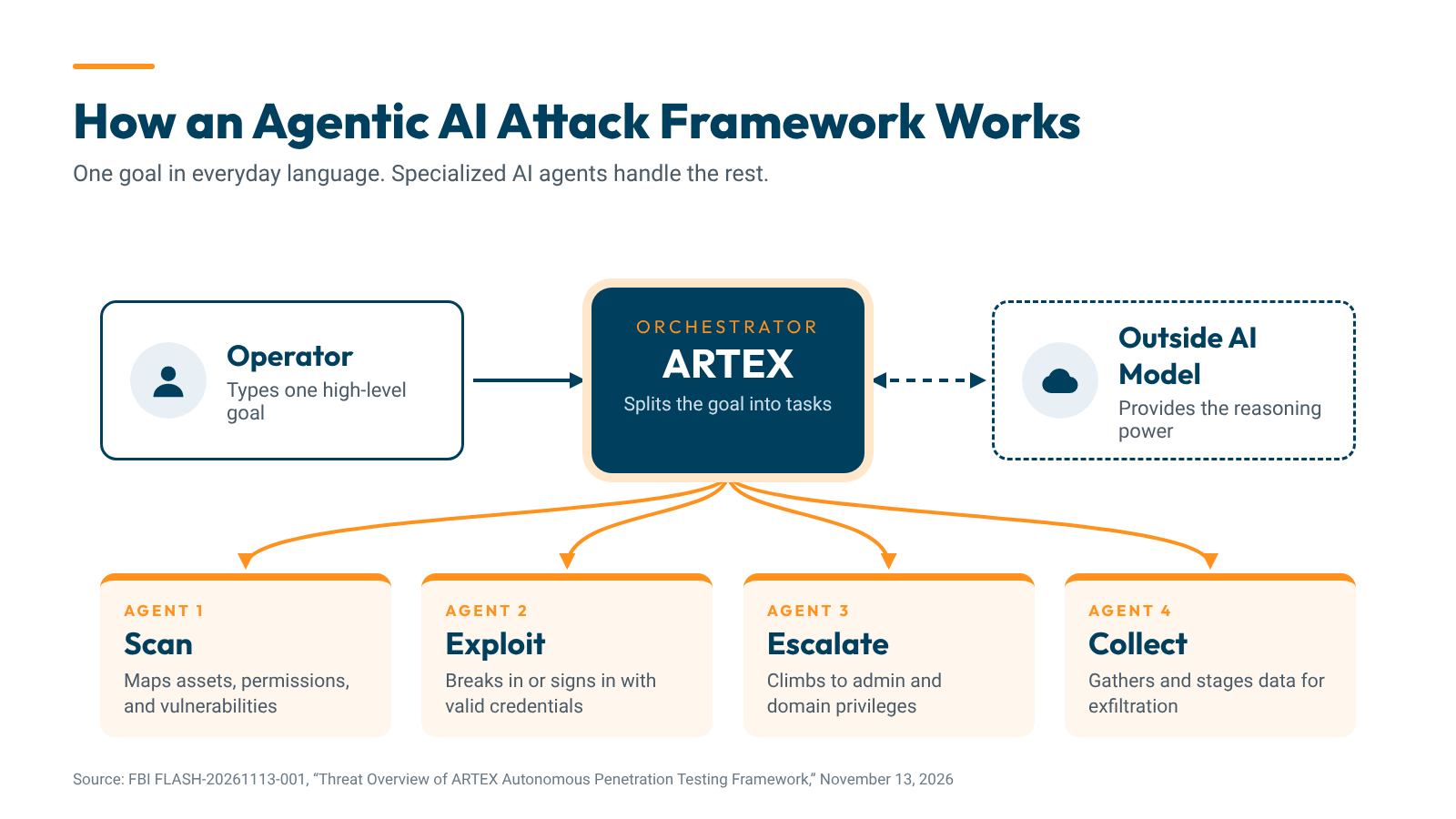
ARTEX borrows its reasoning power from outside large language models (LLMs). Attackers mostly choose low-cost models that show few observable guardrails once a prompt frames the work as penetration testing. Adoption moved fast, too. The project earned an estimated 1,500 to 2,000 stars on its public repository within 10 weeks of its July 2026 release.
Why a Pen Testing Tool Turned Into an Attack Tool
Every capability a defender wants in a testing tool, an attacker wants too. Penetration testing works because ethical hackers think and act like adversaries. Automated frameworks package that adversary mindset into software.
The ARTEX developer built it for authorized security testing within defined scopes. Threat actors simply dropped the scope. This dual-use reality carries three practical lessons for security leaders:
- Attack Speed Now Matches Software Speed: Agents chain reconnaissance, exploitation, and escalation in minutes, so testing cadence works best when it tracks the pace of change in your environment.
- Skill Barriers Have Dropped: The FBI notes that ARTEX lets actors with minimal technical expertise run complex, multi-target campaigns at the same time.
- Authorization Defines the Difference: The same techniques that strengthen an organization inside a scoped engagement cause harm outside one. Rules of engagement, human oversight, and clear reporting set professional pen testing apart.
Inside the Three-Hour Attack Timeline
The FBI mapped observed ARTEX activity to MITRE ATT&CK, and the pattern reads like a pen test report on fast-forward.
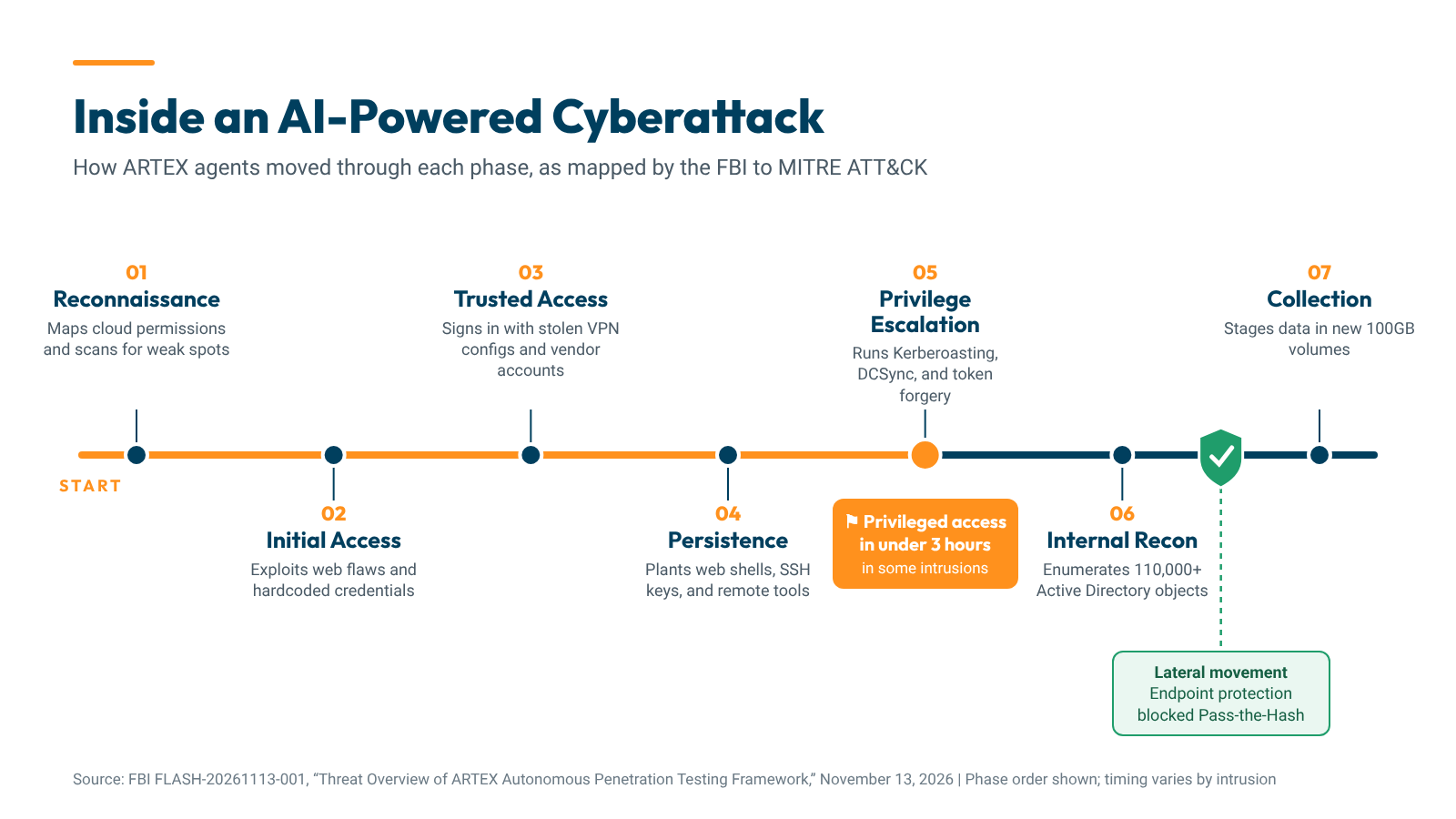
Here is how the agents moved through each phase:
- Reconnaissance: Agents mapped the effective permissions of cloud credentials with sub-second checks, fuzzed web directories across 500+ requests, and scanned for known vulnerabilities.
- Initial Access: Agents exploited SQL injection, SSRF, XXE, and command injection flaws, plus authentication bypasses, unsigned SAML assertions, and administrator passwords hardcoded in JavaScript bundles.
- Trusted Access: Agents also signed in through the front door with stolen VPN configurations, leaked credentials, compromised vendor accounts, and cross-tenant trust relationships.
- Persistence: Agents deployed web shells, installed open-source remote access tools, created SSH keys, and added credentials to existing OAuth applications.
- Privilege Escalation: Agents ran Kerberoasting and DCSync, queried cloud metadata services, and forged administrator tokens with unrotated authentication keys.
- Internal Reconnaissance: Agents enumerated more than 110,000 Active Directory objects, read LAPS passwords, and inventoried endpoint sensor coverage to locate exposed Windows hosts.
- Collection: Agents read mailboxes, interrogated backend databases, and created new 100GB storage volumes to stage data for exfiltration.
Two details deserve a closer look. First, many steps relied on valid credentials and trusted connections rather than exploits. These attackers often logged in instead of breaking in. Second, when agents tried Pass-the-Hash against domain controllers, endpoint protection blocked them. Well-deployed fundamentals still hold strong against machine-speed attackers.
The Noise Paradox: Loud Attacks That Still Outrun Response
Here is the counterintuitive part of the advisory: ARTEX attacks are loud.
The FBI notes that ARTEX generates high volumes of forensically noisy traffic that may trigger alerts. Yet attack speed compresses the window for a coordinated response.
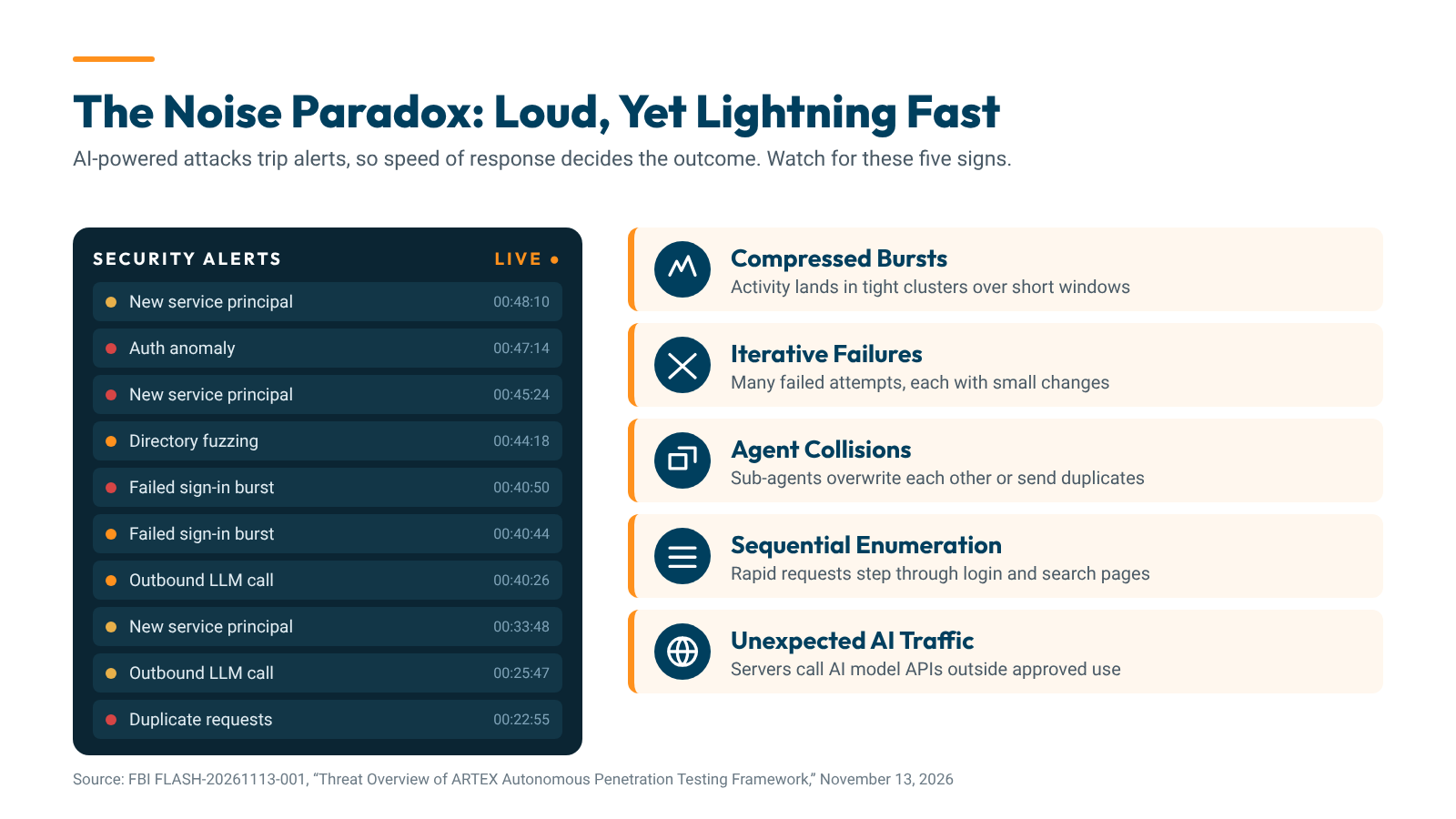
That shifts the goal from spotting an attack to acting on it within minutes. The FBI lists telltale signs that defenders can tune their tools to catch:
- Compressed Bursts: Activity arrives in tight clusters across very short time windows.
- Iterative Failures: Logs show high volumes of failed attempts with small, incremental changes between each try.
- Agent Collisions: Multiple sub-agents overwrite each other or send duplicate requests.
- Sequential Enumeration: Automated, high-frequency requests step through login and search endpoints one record at a time.
- Unexpected LLM Traffic: Servers reach out to AI model API endpoints outside your approved AI use cases.
Where Agentic Attackers Look First
Agentic attackers gravitate toward the edges of an organization. The FBI found that ARTEX excels at finding peripheral systems that receive less security attention than flagship applications.
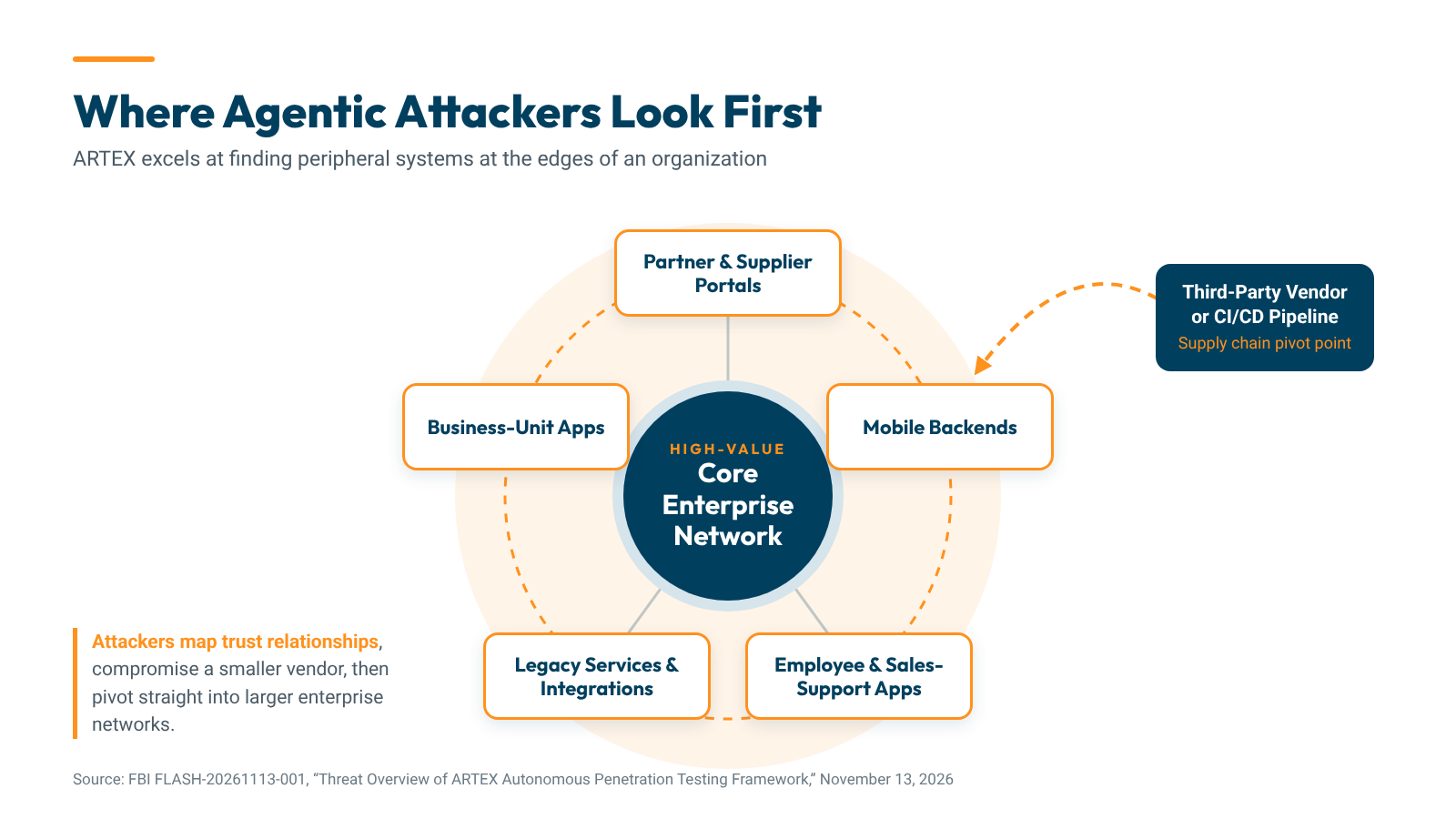
These include:
- Partner and Supplier Portals: External systems connect straight into trusted business relationships.
- Mobile Backends: APIs power mobile apps and carry rich customer data.
- Employee and Sales-Support Apps: Tools built for internal teams often live on the internet for convenience.
- Legacy Services and Third-Party Integrations: Older systems and connectors link many environments together.
- Business-Unit Applications: Individual departments build and launch apps on their own timelines.
Supply chains add another layer. The FBI describes agents that systematically map trust relationships between organizations, compromise a smaller vendor or CI/CD pipeline, and pivot straight into a larger enterprise network.
What the ARTEX Alert Means for Your Pen Testing Program
The smartest response to an AI-powered attacker is a testing program that sees your environment the way that attacker does. These seven moves put the FBI findings to work:
- Test the Edges: Expand scope to cover partner portals, mobile backends, legacy services, and business-unit apps alongside flagship applications.
- Prioritize Identity and Cloud: Include cloud permissions, service principals, OAuth consent grants, SAML configurations, and Active Directory attack paths in every engagement.
- Test Supply Chain Connections: Validate how vendor access, B2B federation, and CI/CD pipelines reach core systems, and confirm each trust relationship follows least privilege.
- Hunt for Exposed Secrets: Bring source code, JavaScript bundles, infrastructure-as-code, and container images into scope to find hardcoded credentials before an agent does.
- Validate Detection and Response Speed: Pair pen testing with purple team exercises that measure how fast your team spots and contains a compressed, high-volume attack.
- Increase Testing Cadence: Move toward continuous or more frequent testing so results keep pace with changes across your cloud and application footprint.
- Combine AI Speed With Human Judgment: Use AI-assisted testing for breadth, and rely on experienced testers to chain findings, weigh business context, and confirm real-world risk.
FBI Recommendations and How Pen Testing Validates Them
The FBI paired its warning with a clear set of defensive actions. A pen test turns each recommendation from a policy into proof:
| FBI Recommendation | How Pen Testing Validates It |
|---|---|
| Inventory every internet-facing application, including peripheral systems. | External attack surface testing discovers and tests every reachable asset, including the ones business units launch on their own. |
| Restrict cloud admin, publishing, hypervisor, and backup interfaces to trusted paths. | Network and cloud testing confirms these interfaces respond only on approved networks and management paths. |
| Apply least privilege to multi-tenant app permissions and consent grants. | Cloud and identity testing maps effective permissions and traces each route to privilege escalation. |
| Rate-limit high-impact APIs and alert on sequential lookups. | API testing simulates automated enumeration and confirms that limits and alerts fire on time. |
| Enforce server-side authorization on partner and employee portals. | Web application testing probes for IDOR flaws and authorization bypass across every record type. |
| Keep stack traces and internal details away from unauthenticated users. | Application testing walks each error path and confirms responses share only what users need. |
| Scan code, pipelines, and container images for secrets and rotate them fast. | Secrets review and CI/CD testing confirm that credentials stay out of reach of attackers and agents. |
| Preserve sign-in, audit, and SIEM records during response. | Purple team exercises verify that logs capture the evidence responders and investigators rely on. |
Moving at Machine Speed, Together
AI changed the clock speed of cyberattacks, and the FBI's ARTEX advisory puts a number on it: under three hours from first contact to privileged access. Organizations that test the way modern attackers operate gain the clearest view of their real exposure.
Broad scope, identity-first testing, supply chain coverage, and frequent validation turn the FBI's guidance into measurable resilience. DivIHN's penetration testing team pairs AI-assisted speed with human expertise to help you stay a step ahead.
SOURCES
- Federal Bureau of Investigation. “Threat Overview of ARTEX Autonomous Penetration Testing Framework,” FLASH-20261113-001, November 13, 2026. https://www.ic3.gov/csa/2026/261113.pdf