Internal and external penetration testing examine an organization's security from two different starting points. External testing evaluates internet-facing assets and potential entry points, while internal testing examines what an attacker could access from an assumed foothold within the network.
This blog compares the scope, testing methods, typical findings, duration, and cost of both approaches. It also examines compliance requirements, risk priorities, and the factors organizations can consider when deciding which assessment to conduct first.
Also Read: 2027 Pen Testing Guide: AI, Methods, Tools, and Costs
Internal vs. External Penetration Testing: The Key Difference
The primary difference between internal and external pen testing lies in the attacker's starting position. An external pen test examines an organization's security from outside its network. An internal pen test evaluates defenses from inside the network. It often simulates an attacker who already has access to the internet.
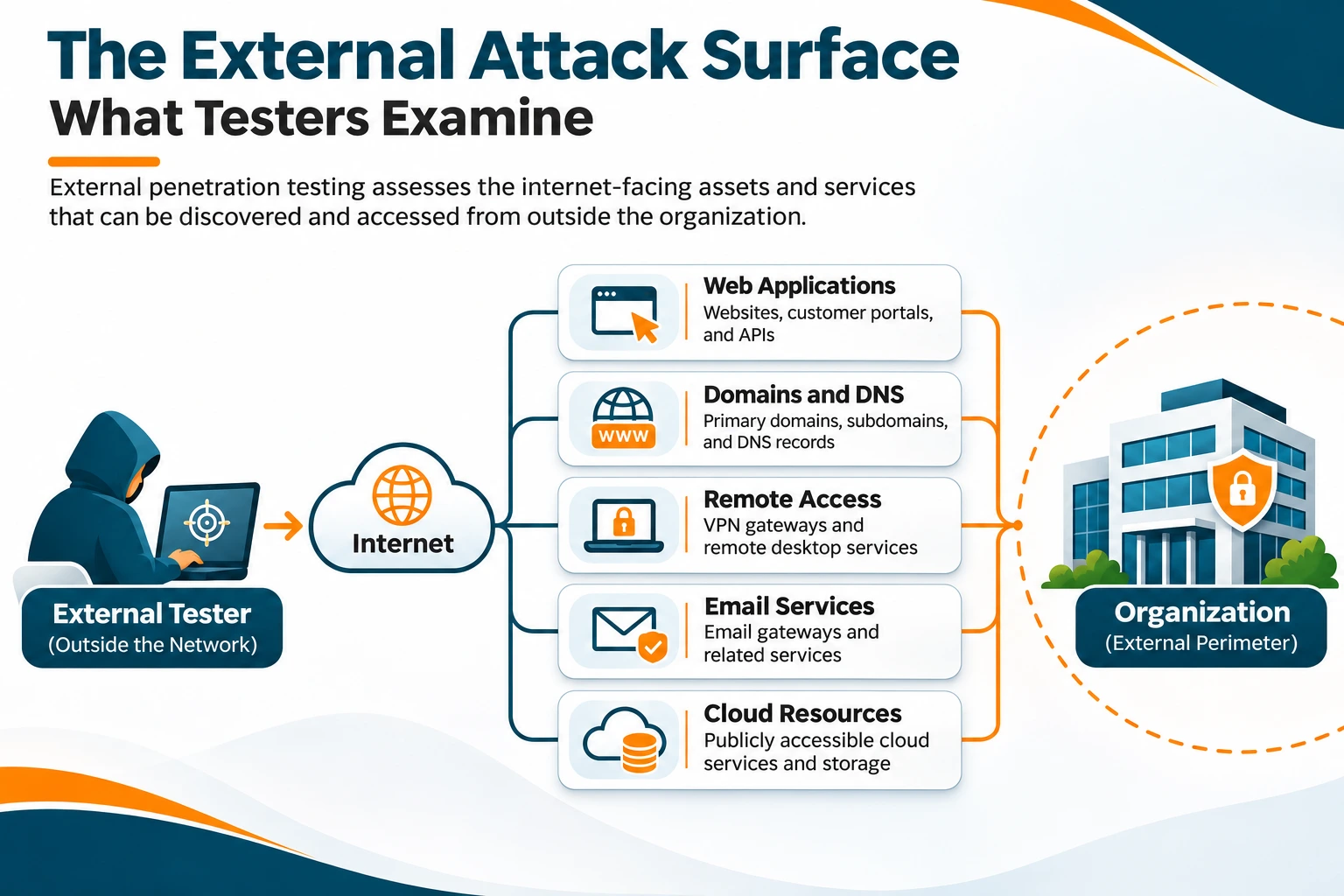
External penetration testing focuses on internet-facing assets, such as public applications, web servers, VPN gateways, email services, and exposed network infrastructure. Testers examine these assets to identify potential entry points and determine whether an attacker could gain unauthorized access.
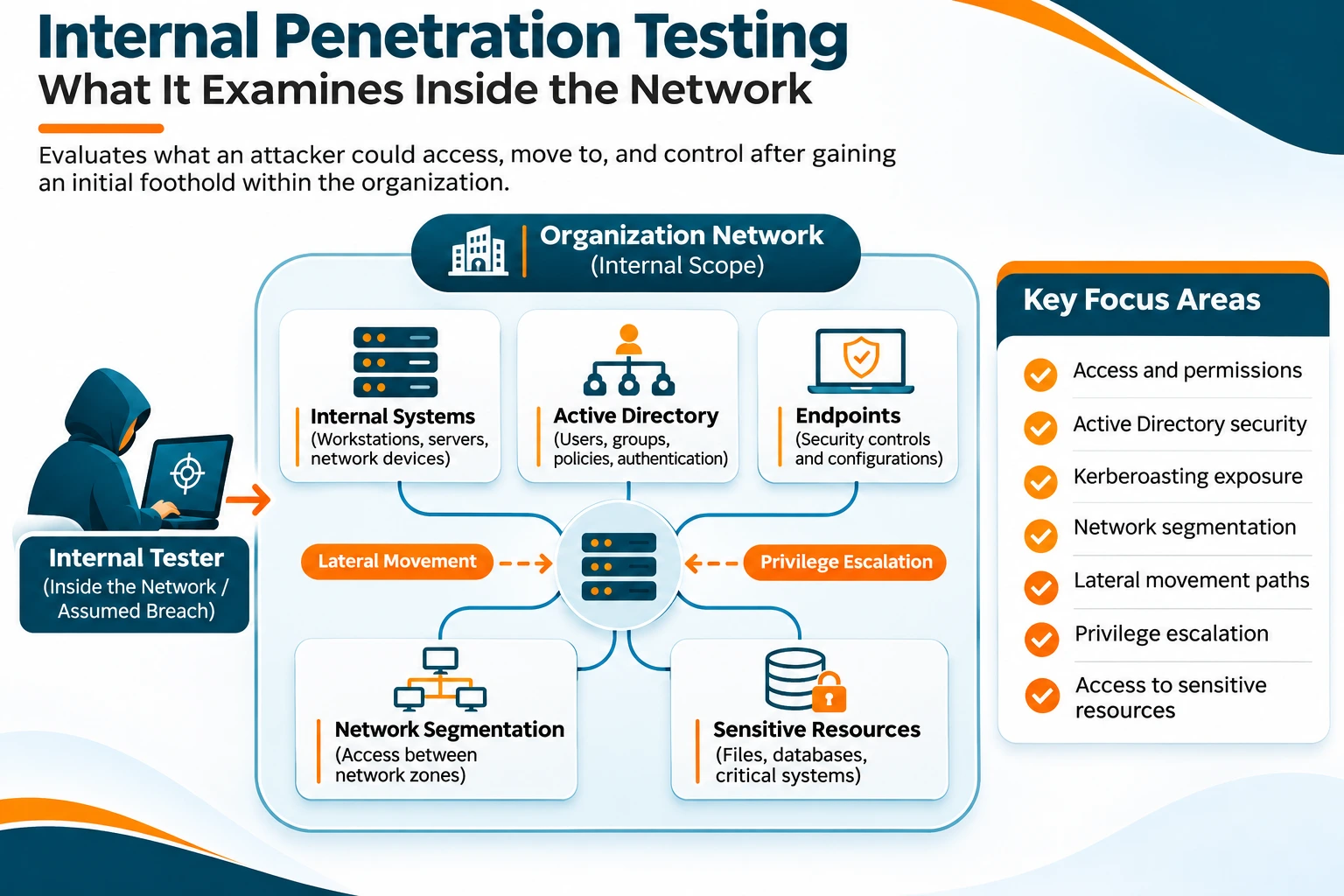
Internal penetration testing examines systems and resources within the organization's network. Testers assess network access controls, user privileges, Active Directory configurations, and opportunities for lateral movement. The exercise helps establish how an attacker could progress after gaining an initial foothold.
Consider an organization with a public-facing VPN gateway and an internal Active Directory environment. An external tester might examine the VPN gateway for vulnerabilities that could provide unauthorized access. An internal tester might assess whether a compromised employee account could access additional systems or escalate privileges.
The two approaches answer different security questions:
- External Pen Testing: How could an attacker enter the organization's environment?
- Internal Pen Testing: What could an attacker access after gaining a foothold inside?
Together, these perspectives help organizations evaluate perimeter defenses and internal security controls as part of a broader penetration testing program.
What an External Pen Test Covers
An external pen test evaluates the security of assets that attackers can reach through public networks. Testers approach the environment from outside the organization's network and examine its internet-facing attack surface.
The scope covers public IP addresses, web applications, and VPN services. It also covers email gateways, DNS, remote access portals, and exposed servers. Testers use reconnaissance, scanning, manual validation, and controlled exploitation to evaluate these assets.
Attack Surface and Scope
External penetration testing begins with asset discovery and reconnaissance. Testers identify publicly accessible systems and examine the technologies, services, and configurations they expose.
The methodology may include:
- Mapping Exposed Assets: Identify public IP addresses, domains, subdomains, and internet-facing services
- Gathering OSINT: Collect public information on domains, technologies, employees, and exposed resources
- Scanning External Services: Examine open ports, service versions, and configurations for potential weaknesses
- Testing Remote Access: Assess VPN gateways, remote desktop services, and authentication mechanisms within the approved scope
- Validating Vulnerabilities: Investigate whether identified weaknesses could provide unauthorized access or expose sensitive information
For example, a tester discovers a public VPN gateway running outdated software. Further testing could establish whether the version contains an exploitable vulnerability and whether it provides a path to the organization's internal network.
Typical Findings
External pen testing can uncover weaknesses across internet-facing infrastructure and applications. Common findings include:
- Exposed services with vulnerable software versions
- Weak authentication and password policies
- Misconfigured web servers and network devices
- Insecure remote access configurations
- Exposed administrative interfaces
- Vulnerabilities in public-facing applications
- Information disclosure through DNS records, metadata, or public resources
These findings help security teams evaluate perimeter controls, strengthen remote access security, and prioritize remediation across exposed assets.
What an Internal Pen Test Covers
An internal pen test evaluates security from within an organization's network. Testers start from either an internal network connection or an assumed-breach scenario. This approach helps organizations understand what an attacker could access after compromising an account, endpoint, or other internal assets.
Internal testing examines segmentation, user permissions, and Active Directory. It also reviews authentication, endpoint security, and access to sensitive resources. Testers investigate how an attacker could move between systems, escalate privileges, or reach critical infrastructure.
Assumed Breach and Internal Scope
An assumed-breach assessment starts with a defined level of access. For example, testers may receive access to a standard employee workstation or a user account with limited privileges. They then examine how that access could extend across the network.
The methodology may include:
- Mapping Internal Systems: Identify workstations, servers, network devices, and critical infrastructure
- Assessing Active Directory: Examine domain configurations, group policies, user privileges, and authentication controls
- Testing Kerberoasting Exposure: Evaluate whether service account configurations and password practices create opportunities for credential attacks
- Examining Network Segmentation: Test whether network boundaries restrict access between business units, servers, and sensitive environments
- Validating Lateral Movement: Assess whether an attacker could move between systems using compromised credentials or existing access
- Testing Privilege Escalation: Examine whether users or compromised systems could gain higher-level permissions
- Assessing Sensitive Resource Access: Determine whether an account could reach confidential files, databases, or administrative systems
For example, an internal tester might begin with a standard domain user account. The assessment could examine whether weak service account configurations expose credentials through Kerberoasting. The tester could then evaluate whether those credentials provide access to additional systems or higher privileges.
Typical Findings
Internal pen testing often identifies weaknesses in identity management, network access, and system configurations. Common findings include:
- Excessive user or service account privileges
- Weak Active Directory configurations
- Kerberoasting opportunities
- Inadequate network segmentation
- Unrestricted lateral movement paths
- Insecure file shares and access permissions
- Weak endpoint security controls
- Privilege escalation opportunities
These findings help security teams strengthen identity controls, improve network segmentation, and protect critical systems from threats that originate within the environment.
Internal and External Pen Testing: Side-by-Side Comparison
Internal and external penetration testing use different starting points, testing methods, and objectives. The following comparison highlights how each approach contributes to security testing.
| Comparison Factor | External Pen Testing | Internal Pen Testing |
|---|---|---|
| Starting Point | Outside the organization's network | Inside the organization's network |
| Primary Objective | Evaluate perimeter security and external entry points | Evaluate internal access, privileges, and network defenses |
| Testing Scope | Public IPs, web applications, VPNs, DNS, and exposed services | Active Directory, endpoints, servers, internal networks, and segmentation |
| Testing Approach | Reconnaissance, OSINT, scanning, and exploitation | Assumed breach, privilege analysis, and lateral movement testing |
| Typical Findings | Exposed services, weak authentication, and vulnerable applications | Excessive privileges, AD weaknesses, and unrestricted access |
| Attack Scenarios | External attacker targeting public-facing assets | Insider threat or attacker with an initial foothold |
| Key Outcome | Understanding potential external entry points | Understanding potential internal attack paths |
| Testing Duration | Depends on asset count, exposure, and testing depth | Depends on network size, access levels, and testing depth |
| Cost Factors | Number of public assets, applications, and services | Number of internal systems, domains, segments, and access scenarios |
Testing Duration and Cost
The duration of each engagement depends on its scope and complexity. External testing may require additional time when an organization operates multiple public-facing applications, domains, and remote access services. Internal testing may require more effort when the environment includes several network segments, active directory domains, and interconnected systems.
Cost also depends on testing depth, specialist expertise, authorization requirements, and reporting needs. Organizations can define the scope around critical assets and business priorities to align testing effort with security objectives.
Also Read: Black Box vs. White Box Pen Testing
Internal or External Pen Testing: Which One Do You Need?
Choosing between internal and external penetration testing depends on an organization's infrastructure, risk exposure, and compliance requirements. Each approach addresses a different part of the security environment.
External testing helps evaluate internet-facing assets and perimeter defenses. Consider it when:
- Securing public-facing applications, servers, VPNs, and remote access services
- Identifying potential entry points across internet-accessible assets
- Preparing for external security assessments and infrastructure changes
Internal testing examines access controls and potential attack paths within the network. Consider it when:
- Strengthening active directory and identity management
- Evaluating network segmentation, lateral movement, and privilege escalation
- Securing sensitive databases, servers, and critical systems
Which One Should You Run First?
The testing approach to prioritize depends on the organization's immediate risk exposure. External penetration testing is a practical starting point when internet-facing applications, servers, or remote access services represent the primary concern. Internal penetration testing takes priority when the assessment needs to examine identity controls, network segmentation, privilege escalation, or lateral movement.
For PCI DSS compliance organizations must conduct both internal and external penetration tests at least annually and after significant infrastructure or application changes, as outlined in Requirements 11.4.2 and 11.4.3. The testing sequence should therefore reflect the organization's risk priorities while meeting applicable compliance requirements.