
Penetration testing approaches differ in how much information testers receive about the target environment. Black box testing starts with minimal prior knowledge. White box testing provides extensive internal visibility. Gray box testing uses limited information or access. Each approach offers a different perspective on an organization's security posture.
Knowing how black box, white box, and gray box testing differ helps security teams choose the right method. The chosen method should match their testing objectives, resources, and risk priorities. This guide explains how each approach works, compares them pair by pair, and shows when each one fits.
Also Read: Attack-Path Validation: Why Low-Severity Findings Can Become Critical
The Key Differences Between Black Box, White Box, and Gray Box Pen Testing
The primary difference between the three approaches is the level of information and access available to the penetration tester.
- Black Box Pen Testing: Testers begin with little or no internal information about the target. They investigate the environment from an external perspective and identify potential entry points through reconnaissance and testing.
- White Box Pen Testing: Testers receive extensive information about the target environment. This may include source code, architecture diagrams, system configurations, documentation, and user credentials.
- Gray Box Pen Testing: Testers receive limited information or access, such as standard user credentials, selected documentation, or details about specific system components.
The appropriate method depends on what the organization wants to learn from the assessment.
Black Box Pen Testing: Simulating an External Attacker's Perspective
Black box penetration testing evaluates an environment from the perspective of someone with little or no prior knowledge of its internal systems. Testers receive a defined target scope. They use public information and technical testing methods Pen Testing Tools: What Testers Actually Use to identify potential entry points.
How Black Box Pen Testing Works
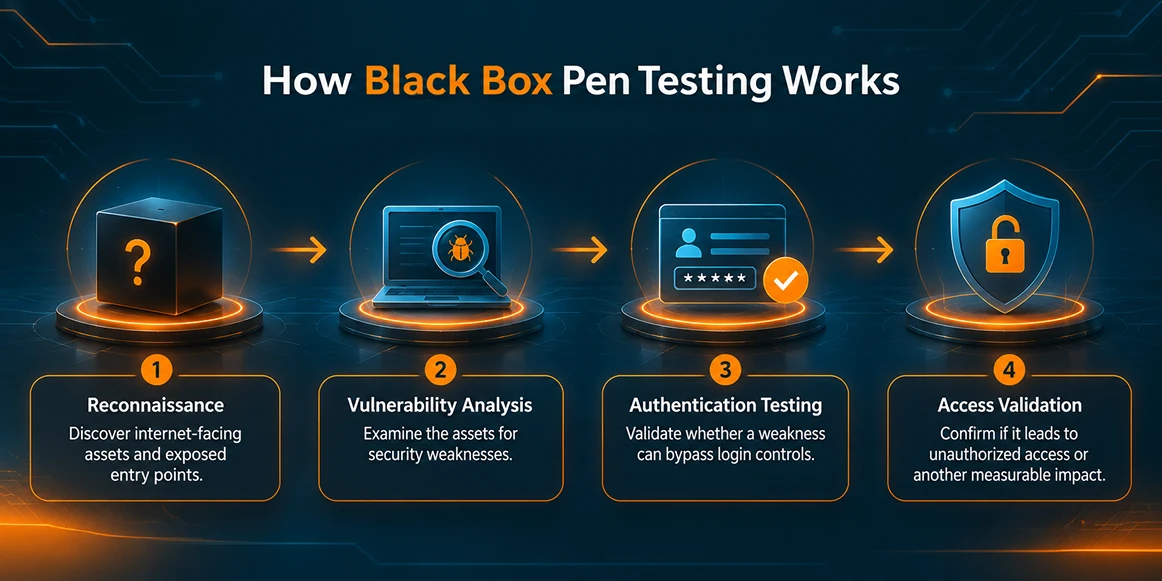
The assessment typically begins with reconnaissance. Testers identify internet-facing assets, domains, exposed services, and publicly accessible applications. Next, they examine these assets for vulnerabilities. They then check whether each weakness can lead to unauthorized access or another measurable security impact.
For example, a tester might find an exposed login portal on a public-facing web application. The tester then identifies an authentication weakness and checks whether it opens access to protected functions.
Strengths of Black Box Testing
- Simulating External Threats: Evaluates how an environment appears to an attacker without internal knowledge.
- Examining Exposed Assets: Identifies potential weaknesses in internet-facing applications, services, and infrastructure.
- Testing Discovery and Detection: Measures how well security controls identify and respond to external activity.
Limitations of Black Box Testing
Minimal internal information can extend the time testers need to discover assets and understand system behavior. Testers may also have limited visibility into internal components, source code, and vulnerabilities that require authenticated access.
White Box Pen Testing: Examining the Internal Environment
White box penetration testing provides testers with extensive information about the target environment. This approach supports deeper investigation of applications, infrastructure, configurations, and internal security controls.
How White Box Pen Testing Works
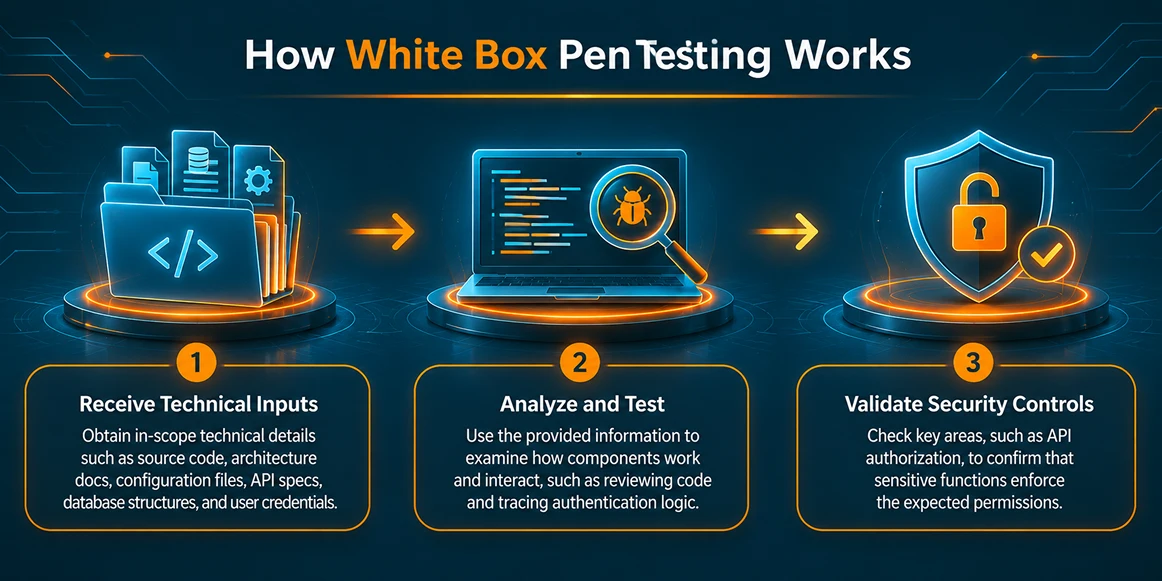
Before testing begins, the organization provides relevant technical information. Depending on the scope, this may include source code, architecture documentation, configuration files, API specifications, database structures, and credentials for different user roles.
Testers use this information to examine how individual components operate and interact. For example, a tester might inspect a web application’s source code and trace its authentication logic. The tester can also examine API authorization checks and confirm that sensitive functions enforce the expected permissions.
Strengths of White Box Testing
- Enabling Deeper Code Analysis: Examines application logic, input handling, authentication, and access control implementation.
- Improving Internal Visibility: Lets testers investigate components and configurations that sit beyond the reach of external testing.
- Supporting Detailed Validation: Allows testers to trace potential vulnerabilities through application and infrastructure components.
Limitations of White Box Testing
White box testing requires access to technical documentation, source code, and relevant system information. Reviewing extensive codebases and architecture components can also require additional time and specialized expertise.
Gray Box Pen Testing: Testing with Partial Knowledge
Gray box penetration testing combines elements of black box and white box testing. Testers receive selected information about the target environment and work with a partial view of its internal architecture and security controls. This approach helps organizations evaluate how an attacker with limited access or knowledge might interact with their systems.
How Gray Box Pen Testing Works
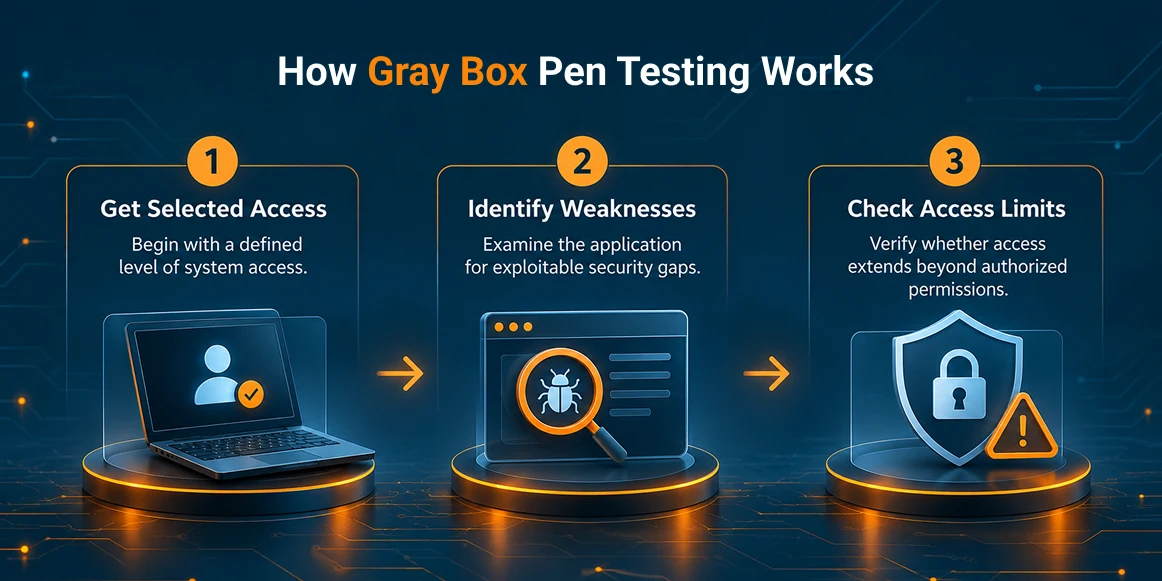
The organization may provide standard user credentials, limited system documentation, selected application details, or access to specific network segments. Testers use this information to investigate vulnerabilities. They also check whether their assigned access leads to restricted resources.
For example, a tester might receive credentials for a standard employee account in a corporate application. The assessment examines whether the account can access information outside its permissions, interact with restricted functions, or reach connected systems.
Strengths of Gray Box Testing
- Balancing Visibility and Testing Depth: Provides enough context to investigate specific security controls while retaining an attacker-oriented perspective.
- Examining Access Boundaries: Evaluates whether user permissions and authentication controls operate as intended.
- Supporting Focused Assessments: Directs testing toward selected applications, roles, or infrastructure.
Limitations of Gray Box Testing
The assessment depends on the information and access to the organization's shares. Limited credentials or documentation may leave some system components outside the testing scope. Results also reflect the access level and assumptions the engagement sets.
Black Box vs. White Box Pen Testing: Key Differences
Black box and white box testing represent two different levels of visibility. Black box testing starts with minimal internal knowledge, while white box testing provides extensive technical information.
| Comparison Factor | Black Box Testing | White Box Testing |
|---|---|---|
| Initial Knowledge | Little or no internal information | Extensive technical information |
| Source Code Access | Typically withheld | Shared when in scope |
| Credentials | Withheld at the start | May include multiple user roles |
| Testing Perspective | External or uninformed attacker | Detailed internal assessment |
| Primary Focus | Exposed assets and entry points | Application logic, configurations, and internal controls |
| Testing Depth | Depends on externally accessible information | Supports deeper component-level investigation |
| Suitable Scenario | External attack surface assessment | Source code and architecture security review |
Black Box vs. Gray Box Pen Testing: Key Differences
Both approaches can simulate attacker behavior, but they differ in the information available at the beginning of an assessment. Black box testing starts with little or no internal knowledge, while gray box testing provides selected information or access.
| Comparison Factor | Black Box Testing | Gray Box Testing |
|---|---|---|
| Initial Knowledge | Little or none | Partial information |
| Credentials | Withheld at the start | Selected credentials may be provided |
| Access Level | Begins from the defined external or unauthenticated perspective | Begins with a defined level of access |
| Primary Focus | Discovering exposed entry points | Evaluating access boundaries and connected resources |
| Testing Perspective | Uninformed external attacker | Attacker or user with limited knowledge |
| Suitable Scenario | Public-facing application testing | Authenticated application and assumed-breach testing |
White Box vs. Gray Box Pen Testing: Key Differences
White box and gray box testing both use information about the target environment. Their main difference lies in how much information testers receive and how broadly they can investigate internal components.
| Comparison Factor | White Box Testing | Gray Box Testing |
|---|---|---|
| Initial Knowledge | Extensive | Partial |
| Source Code Access | Typically available when relevant to scope | Usually limited |
| Credentials | May include multiple roles and privilege levels | Often includes selected user credentials |
| Architecture Visibility | Detailed documentation may be provided | Selected system information may be provided |
| Primary Focus | Detailed component and implementation analysis | Access controls and interactions from a limited-access perspective |
| Suitable Scenario | Secure code reviews and detailed internal assessments | Role-based access and authenticated application testing |
Black Box, White Box, and Gray Box Pen Testing: Side-by-Side Comparison
The following table brings the three approaches together to show how their testing conditions and objectives differ.
| Comparison Factor | Black Box | White Box | Gray Box |
|---|---|---|---|
| Knowledge Level | Minimal | Extensive | Partial |
| Source Code | Generally unavailable | May be provided | Usually limited |
| Credentials | Withheld at the start | May include multiple roles | Selected credentials |
| Architecture Details | Minimal | Detailed | Selected information |
| Testing Perspective | Uninformed external attacker | Internal technical review | Partially informed user or attacker |
| Primary Objective | Identify externally discoverable weaknesses | Examine implementation and internal security | Validate access boundaries and connected risks |
| Typical Use | External assessments | Code and infrastructure reviews | Authenticated and assumed-breach assessments |
Each approach covers a specific set of testing objectives. Organizations can select one methodology or combine approaches to examine different parts of their security environment.
Also Read: Network Segmentation Testing: Can Attackers Actually Reach Critical Systems?
Which Approach Should You Choose?
The right choice among black box, white box, and gray box testing depends on three factors. These are the organization’s goals, the information testers can access, and the resources the team commits. Each approach serves a different testing objective.
Black Box Testing: Choose this approach when the objective is to understand how an external attacker might discover and exploit weaknesses in public-facing systems. It suits external attack surface assessments and evaluations of internet-facing applications.
White Box Testing: Choose this approach when the assessment requires detailed visibility into source code, application architecture, configurations, and internal security controls. It supports secure development reviews and deeper technical investigations.
Gray Box Testing: Choose this approach when the objective involves evaluating authenticated access, user permissions, and potential movement between connected resources. It works well for role-based access assessments and assumed-breach scenarios.
Consider Budget and Available Time
Testing duration and cost depend on the environment's size, technical complexity, scope, and required expertise. Black box assessments may require additional reconnaissance to understand the target. White box assessments can involve extensive code and configuration reviews. Gray box assessments require agreement on the access levels, credentials, and scenarios testers will evaluate.
A clearly defined scope helps teams allocate time and resources according to their priorities.
Account for Assumed-Breach Scenarios
Gray box testing suits organizations that want to evaluate the impact of compromised credentials or insider access. Testers begin with a defined level of access and examine whether permissions, connected systems, or security controls create additional exposure.
Also Read: Cloud IAM Attack Paths: How One Identity Can Become Full Environment Access