OT and ICS Penetration Testing Services
An ICS engagement runs by different rules than a network test. Testing methods get selected to match what each system can tolerate: passive analysis where a system is fragile, active testing where it can take it. IEC 62443 alignment, IT/OT segmentation, and legacy protocol exposure all get assessed, and nothing runs against a live process unless your engineers agree first.

Security Testing Wasn't Built With Production Lines in Mind
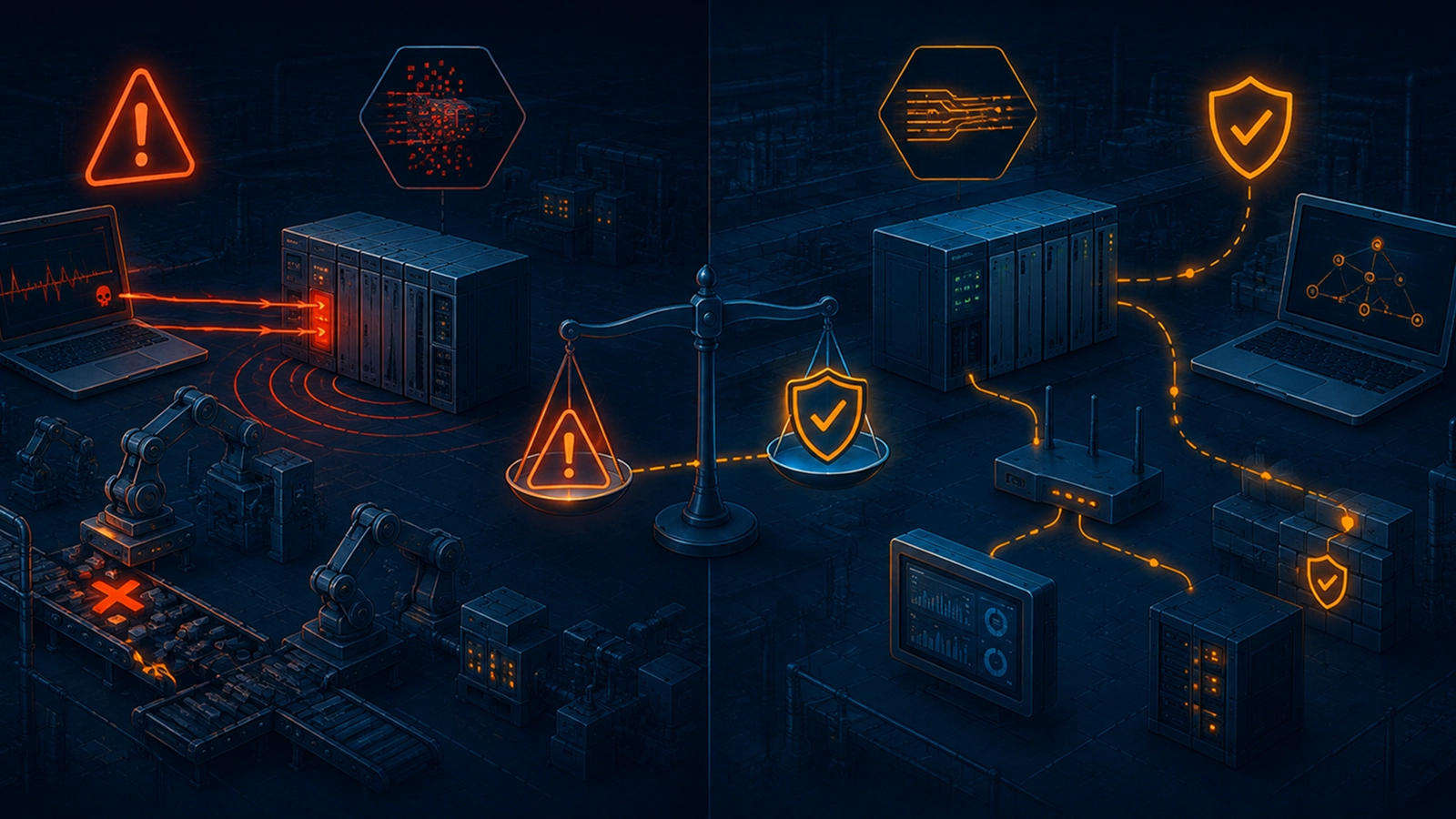
Standard penetration testing assumes a target can absorb aggressive traffic and recover if something goes wrong. A programmable logic controller running a production line operates under very different constraints. A single malformed packet sent to the wrong legacy protocol can stall a process and create hours of operational disruption.
Engineering workstations, vendor remote access, and IT/OT boundaries each introduce risks that require careful testing. OT penetration testing uses the right method for each system, from passive analysis where a system cannot tolerate additional load to controlled active testing where the environment can safely support it.
Four Areas Where OT Risk Concentrates

IT/OT Boundary Review
The line between corporate IT and the plant floor is where most OT incidents start. This review maps the crossing points and tests whether segmentation actually holds under pressure.

Vendor and Remote Access Testing
Third-party vendors often hold standing remote access to control systems long after a project ends. Testing traces exactly what that access can reach and whether it should still exist.

Legacy Protocol and PLC Assessment
Modbus, DNP3, and similar protocols were built for reliability, not security. A tester identifies where their lack of authentication turns into an exploitable path to a PLC.

IEC 62443 Requirement Alignment
Findings get mapped to the specific IEC 62443 requirements your organization is working toward, and cross-referenced against MITRE ATT&CK for ICS, so the engagement produces evidence, not just a list of technical issues.
See Where Your OT Environment Stands Against IEC 62443
More Than a List of Fixes

Cyber insurers and auditors increasingly ask for proof of OT-specific testing, not just IT security documentation. This engagement produces exactly that.

Years of vendor onboarding often leave remote access paths nobody fully tracked. This engagement surfaces what's still open and who can still reach it.

Testing methods get reviewed with your engineering team before anything runs against a live system, so the people who own uptime aren't caught off guard.
A Rollback Plan Exists Before Testing Starts
Before any active test touches a live control system, a rollback plan and a named engineering contact get confirmed. If a system shows unexpected behavior mid-test, testing stops immediately, not after something breaks.
Vulnerabilities identified through passive analysis get confirmed on a spare unit or a test cell rather than the live system, so your team gets validated results without additional risk to production.
Common Questions About Penetration Testing Services for OT and ICS
How is OT testing different from a standard network penetration test?
OT testing accounts for what a system can safely tolerate. Passive analysis gets used where a system can't absorb active testing, and every test maps to IEC 62443 requirements in addition to standard vulnerability categories.
What happens if a system behaves unexpectedly during testing?
Testing stops immediately. A rollback plan and a named engineering contact are confirmed before any active test begins.
Do you test vendor remote access into our control systems?
Yes. Vendor and third-party access paths are mapped and tested as part of every OT engagement.
Is a retest included if we remediate a finding?
Yes, at no additional cost. The retest window gets set during kickoff, since an OT fix often waits on a scheduled maintenance outage rather than fitting inside the original engagement timeline.
Which industries or ICS/SCADA vendors has DivIHN tested before?
OT and ICS penetration testing applies to any industry running industrial control systems, most commonly manufacturing, energy and utilities, pharmaceuticals, food and beverage production, and transportation, logistics, and more. We have direct experience testing environments where PLCs, SCADA systems, and industrial networks connect to corporate IT, environments that carry the same underlying risk regardless of sector.
What's the process if a legacy system can't be touched at all?
Systems that can't tolerate any testing get assessed through documentation review, configuration analysis, and testing against an identical offline unit where one exists. The engagement notes the exclusion and the reasoning in the final report, so the gap in coverage is documented rather than silently skipped.
How long does an OT engagement take?
Timeline depends on your outage calendar more than any other factor, since active testing on production-adjacent systems often has to fit inside a scheduled maintenance window. Scoping sets a realistic timeline once your outage schedule is known.