Security By Design - Part 6
Contributors


In my last post we examined the Risk Manager role we each play in our daily lives, as well as in our professional lives. Seems simple, doesn’t it?
From the Moment we are Born, we are Confronted by Risks
We survive from Birth because someone is Managing Risks to Protect Us
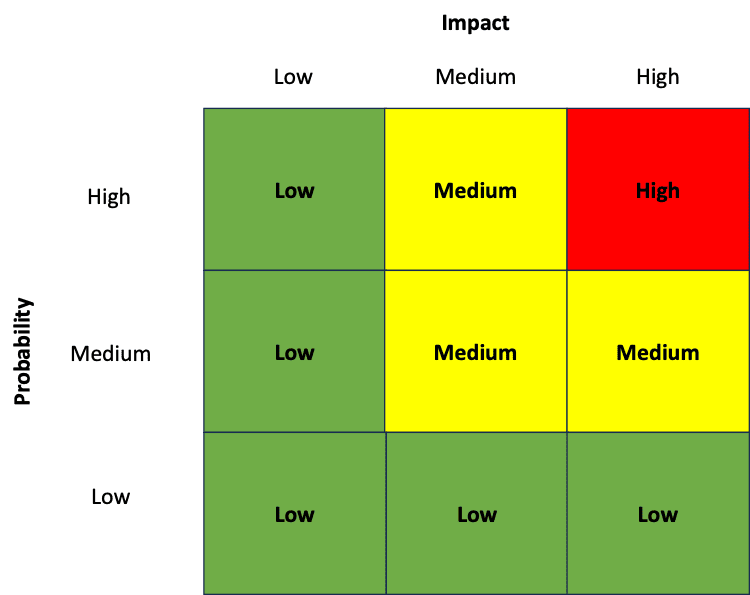
In business, we have audit departments and others who assess risks, and we engage in supporting risk assessments. One of the annual rights of passage for any business and information technology group is participating in the annual risk assessment process and the production of the Annual Risk Report. As cybersecurity professionals and business leaders we may even present the results of our risk assessment to the company’s Board of Directors Audit Committee. A significant amount of time, effort, thought, and angst goes into creating these reports and presentations. We even become experts at preparing and interpreting classic management consulting 9X or 3×3 frameworks to map risks against Impacts and Probability. You may even use more sophisticated frameworks. Each of our traditional risk assessment frameworks ask us to identify risks, determine the potential impact of an identified risk, and also to assess a risk’s potential to occur or probability of occurrence. Using these graphical frameworks, we then plot individual risk and or categories of risk into an assessment box which labels a risk as low, medium, or high.
Today, however, the infusion of information technology into every aspect of our business, the interconnectedness of our business operations with hyper-connected suppliers, distributors, customers, and layers of third and fourth parties, spanning the world, has massively increased the Business / Cyber Risks we face.
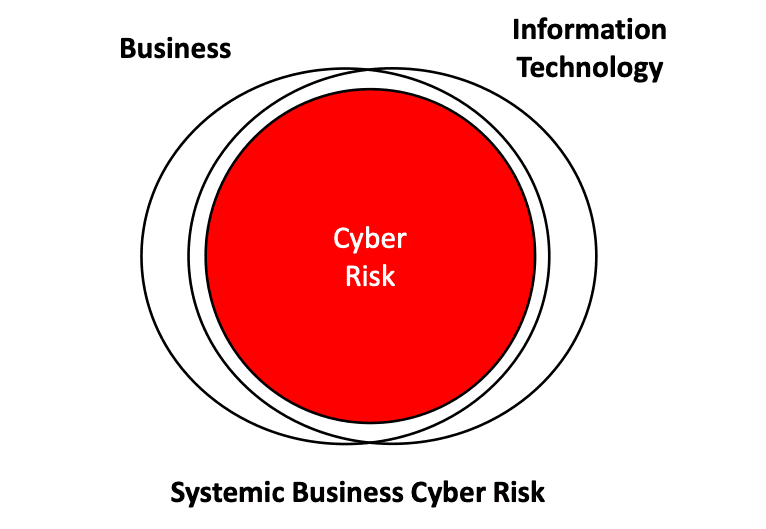
I believe that the ways we have assessed Risks to our Business in the past are no longer adequate to address the complex nature of the web of risks we now face. Simple low, medium, and high-risk assessments no longer suffice to inform our business leaders and board members about the true nature of cyber driven risks.
Systemic Digital Risk in Complex Digital Environments
Systemic Risk is the threat that component failure in a complex system will cascade and jeopardize the much larger system. Systemic risk is inherent in all modern digital business environments. Systemic risk has become more prevalent as digital disruption and transformation advance throughout every aspect of business planning and operations, as well as in every aspect of society. The ability of organizations to create, capture and preserve value in rapidly changing digital economic systems makes understanding systemic digital risk a priority for all business leaders and boardroom members.
There are eight digital domains that work together across complex digital systems to produce and preserve business value.
- Data
- Information architecture
- Risk Communications
- Emerging Technology
- Cybersecurity
- Third Parties
- IT Operations
- Regulations
These eight domains enable complex digital businesses. They work in integrated relationships of people, processes, and digital systems to produce and preserve value. In traditional risk assessments we would identify risks within each of these domains, without necessarily fully appreciating the potential for individual domain risks to directly impact other domains.
Systemic Risk in complex digital businesses is primarily caused by five elements which impact these domains. These five key systemic risk causes are:
- Replaceability
- Interconnectedness
- Size
- Complexity
- Cross or X-Jurisdictional
I believe it to be imperative for business oversight to understand and comprehend risk within each of the eight domains of complex digital businesses and their systems, in conjunction with the compounding nature of Systemic Risk generated by the five key elements of systemic dependencies between and among these domains.
Any of the five key elements of Systemic Risk has the potential to trigger cascading contagion risk throughout and across not just a single business, but across every connected business in today’s complex customer-business-supplier value chains.
In my next post I will expand upon this introduction to Systemic Digital Risk and lay a foundation to deep dive into Cybersecurity Driven Risks and the five key elements of Systemic Risk.
Note: Source Material for this post- “Systemic Digital Risk: Understanding and Overseeing Complex Digital Environments With The DiRECTOR™ And RISCX™ Frameworks”, Digital Directors Network.
Joseph F. Norton is a Risk, Security, and Crisis Management professional.
He is a founding member and Qualified Technology Executive of the Digital Directors Network, Chair of the Advisory Board with Next Era Transformation Group, and Chief Security Officer with APF Technologies.
He has served as Chief Security Officer, SVP at Atos, Chief Technology Officer and Head of Operations, SVP at Philips, Chief Technology Officer, SVP at Novartis, Executive-in-Residence with McKinsey & Company, and Chief Technology Officer at McDonald’s. He has also held professional roles during his career with JPMorgan Bank, Oracle, Sybase and Grumman Aerospace Corporation, and the United States Navy.


Other Popular Articles
In the digital age, businesses must adopt an ad
GRC is the capability, or integrated collection
Get the latest insights straight from our desk to your inbox.
Other Featured Articles
Explore More
How to Perform a Successful Network Penetration Test: Comprehensive Guide for 2025
Learn how to perform a successful network penetration test to identify vulnerabilities, simulate real cyberattacks, and strengthen your organization’s network security.
Cybersecurity Solution Group
Marketing Group view
What Is Penetration Testing? A 2026 Expert Guide
A 2026 expert guide to penetration testing for security leaders and IT teams seeking proactive defense, compliance, and stakeholder trust.
Cybersecurity Solution Group
Marketing Group view
OT Ransomware Prevention: Practical Best Practices for Industrial Cybersecurity
Explore enterprise grade OT ransomware prevention strategies, including segmentation, identity control, threat informed detection, and resilient recovery design to protect industrial operations fro
Cybersecurity Solution Group
Marketing Group view
10 Myths About OT/ICS Security That Put Your Business at Risk
Think your OT network is secure? Learn the 10 most dangerous myths about OT and ICS cybersecurity that leave industrial operations exposed to attacks.
Cybersecurity Solution Group
Marketing Group view
OT Ransomware Risks and Response for Industrial Systems
Learn why OT environments face higher ransomware risk, how attackers gain access, and how effective detection and response reduce operational impact.
Cybersecurity Solution Group
Marketing Group view
AI Risk Assessment: Risk Types, Best Practices & More
Explore AI risk types, essential assessment frameworks, and proven best practices to mitigate threats in AI deployment. Learn actionable strategies for secure AI systems today.
Cybersecurity Solution Group
Marketing Group view
AI Risk Assessment: Everything You Need to Know
Learn essential processes, methodologies, risk types, regulatory requirements, and practical implementation strategies for safe AI deployment.
Cybersecurity Solution Group
Marketing Group view
Whitepaper: Ransomware Threat Management
Ransomware continues to be a real threat to business operations across all industries, no organization is safe from this threat.
Laszlo S. Gonc
CISSP, First Senior Fellow, DivIHN Cybersecurity Center of Excellence view
Cybersecurity Incident Response Preparedness
An incident response framework provides a structure to support incident response operations. A framework typically provides guidance on what needs to be done, but not on how it is done.
Laszlo S. Gonc
CISSP, First Senior Fellow, DivIHN Cybersecurity Center of Excellence view
IoT Medical Device Cybersecurity
Healthcare data and medical devices would be aggressively targeted by ransomware attacks since early 2017 has proven to be true